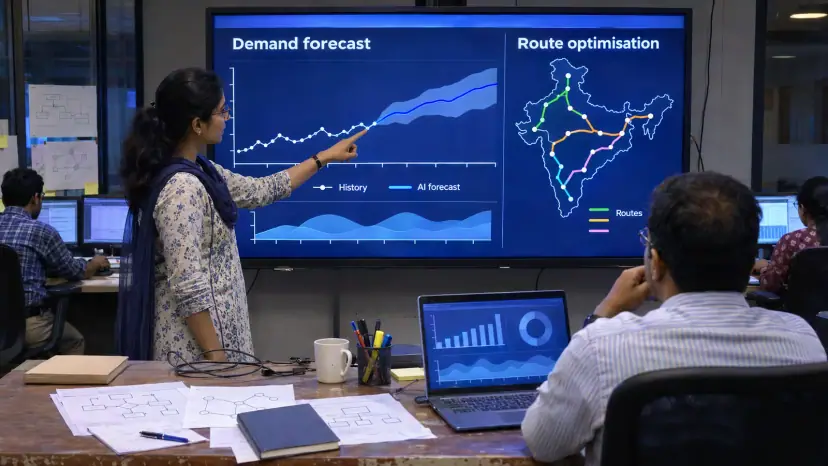
Supply chain AI solutions help logistics operators, distributors and supply chain teams forecast SKU demand, spot delayed shipments early and spend less time chasing warehouse exceptions. Brainguru scopes the model, data pipeline and workflow integration around the ERP, WMS or TMS you already run. Planners and coordinators approve every purchase order, dispatch change and customer message.
A forecasting model, a route optimisation engine and a shipment assistant solve different problems. They do not need the same data or evaluation method. We select a bounded first project before expanding across the supply chain.
Why logistics teams are investing in better data now
Logistics is a large cost for Indian businesses. A study by DPIIT and NCAER, summarised in a PIB backgrounder of 27 November 2025, put India's logistics cost at 7.97% of GDP and 9.09% of non-services output for 2023-24, using primary data from over 3,500 industry stakeholders. Small gains in forecast accuracy, stock placement or exception handling therefore add up.
Public infrastructure is also producing more usable data. The same backgrounder describes the Logistics Data Bank 2.0 syncing with Unified Logistics Interface Platform (ULIP) APIs to give exporters and MSMEs container visibility across road, rail and sea, and notes that the Eastern Dedicated Freight Corridor cut wagon turnaround from 15-16 days to 2-3 days. Better event data makes shipment exception tools more practical, but only if your own order and tracking records are clean enough to match against it.
Practical AI use cases in logistics and supply chain
Demand forecasting and replenishment support
Forecast SKU demand at the level where planners make decisions, such as product and warehouse. Inputs can include sales history, promotions, lead times and stock availability when those records are reliable. Sales during a stockout may understate demand; a forecast should account for this limitation. The planner reviews suggested replenishment quantities before a purchase order is raised.
Shipment exception detection and ETA assistance
Combine order events, promised dates and carrier updates to highlight shipments needing attention. An assistant can summarise the last confirmed event and route the issue to the right team. Estimated arrival times should distinguish a prediction from a confirmed carrier commitment. Missing scans, inconsistent timestamps and delayed updates belong in the exception rules.
Route planning and warehouse workflow support
Route planning combines travel estimates with capacity, delivery windows and operational restrictions. Optimisation may use mathematical methods alongside ML; a language model should not invent a feasible route. Warehouse support can prioritise exceptions or retrieve approved handling instructions, while stock adjustments and dispatch changes require the agreed approval.
Illustrative pilot: shipment exceptions for one customer account
Begin with one account, a defined set of carrier feeds and the existing promised-date rules. The assistant lists overdue shipments, explains which events triggered each flag and drafts a customer update from confirmed information. An operations coordinator checks the facts and approves the message. Carrier downtime or incomplete event data triggers a fallback to the existing process.
Measure valid alerts, missed exceptions, investigation time and the accuracy of customer updates. This is an illustrative scope, not a reported delivery-time improvement or a promise that every delay can be predicted.
Data requirements and ERP, WMS or TMS integration
- Forecasting: Dated sales and returns, product identifiers, stock availability, promotions and relevant replenishment lead times. Select a forecast horizon that matches the decision.
- Shipment operations: Stable order and tracking identifiers, event definitions, time zones, promised-date rules and permissions for carrier data.
- Route planning: Vehicle capacity, service times, delivery windows, depot rules and constraints that dispatchers actually follow.
- Integration: Available ERP, warehouse management or transport management APIs, sandbox access, update frequency and an owner for each source system.
Start with read-only access or controlled exports if production connectors are not ready. Validate units, duplicate records and late-arriving events before model training. Credentials, role access, retry handling and an audit trail need explicit design when the pilot connects to live systems.
How we evaluate forecasting and logistics AI
For forecasting, compare with an agreed simple baseline such as seasonal demand or your current planning method. Hold out later periods and roll the model forward across more than one window, as described in Microsoft's forecasting evaluation guidance. Check error by product group and warehouse, not only one average across all SKUs.
- Demand planning: Review forecast error alongside service levels, inventory cost and the consequences of over- or under-ordering.
- Shipment exceptions: Track valid alerts, false alarms, missed issues and time saved after including the coordinator's review.
- Routes: Compare feasibility, capacity utilisation and actual operating outcomes against dispatcher-approved plans.
- Reliability: Test missing data, carrier outages, duplicate events and manual override. Do not silently write recommendations into operational systems.
Where AI agents fit in supply chain operations
Multi-step AI agents that read emails, check systems and take actions are attractive for logistics, where one delayed shipment can involve a carrier, a warehouse and a customer. They are improving fast but are not yet reliable enough to act alone. The Stanford AI Index 2026 reports that agents rose from 12% to about 66% task success on the OSWorld benchmark of real computer tasks, yet still fail roughly 1 in 3 attempts on structured benchmarks.
That makes the case for supervised designs. Let an agent gather facts, draft the update and propose the next step, and keep a coordinator approving anything that changes a booking, an order or a customer commitment. Our AI agent development work follows that pattern.
How to choose supply chain AI solutions
Many ERP, WMS and TMS products now include forecasting or AI features, and some needs are met by a well-configured rule. Before commissioning a build, ask:
- Baseline: What does the current method achieve, measured the same way the new model will be?
- Data ownership: Who owns each source system, and who fixes a broken feed?
- Explanation: Can planners see why a forecast or alert changed?
- Write access: Will the tool only recommend, or can it change live records, and under what limits?
- Fallback: What happens on the day a carrier feed or model service is down?
Weak data is the usual reason projects stop. In July 2024, Gartner predicted that at least 30% of generative AI projects would be abandoned after proof of concept by the end of 2025, with poor data quality first on its list of causes. A data review at the start of discovery is cheaper than a stalled pilot.
Implementation and cost drivers
Discovery defines the decision, source systems and acceptance tests. Data preparation and a historical evaluation come before a limited pilot with planners or coordinators. A production release adds monitoring, escalation rules, access controls and a rollback process. Model refreshes should respond to demonstrated changes in demand or operations.
Costs depend on data quality, the number of systems and feeds, forecast granularity, optimisation constraints and support requirements. A simpler rule-based workflow may be enough for some exceptions. Read examples of AI automation across Indian businesses for context, our demand forecasting guide for distributors, and our AI agents guide for approval controls in multi-step operations. For the wider software around these models, see our supply chain solutions and big data analytics services.
Local logistics and supply chain planning guides
Choose a city for official local references, enquiry information and a reviewed workflow. Each guide covers logistics and supply chain teams we serve from Noida; we do not run branch offices in these cities.