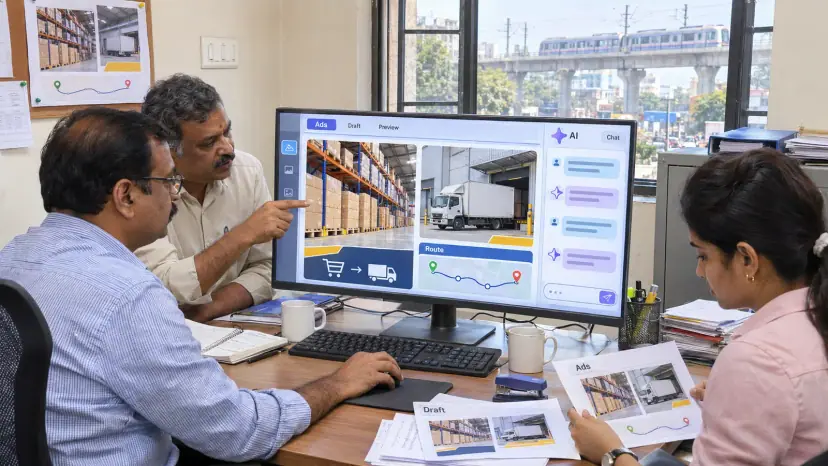
Hyderabad freight enquiries: complete RFQs and reviewed serviceability
When a shipper in Hyderabad asks you to quote a lane, the quality of the reply depends on what you captured and who checked it. Logistics and Supply Chain teams can use this guide to set up RFQs by lane, with operations reviewing serviceability. We list the details to record and the local sources to use, then explain an assistant's permitted tasks and the steps a person must approve. Nothing here reports a Brainguru client result, as the workflows are for planning. Scoping follows your real business, data and permissions.
Which district does the Hyderabad address fall in?
The Hyderabad district administration publishes district information, public utilities and service contacts. Check from a documented address whether that resource covers the operating location. Searching for "Hyderabad" does not prove that all addresses across the metropolitan area belong to one district.
Consult Hyderabad district with that in mind. It helps with administrative context, and it establishes nothing about demand, commercial availability or the standing of a private carrier. Enter the Hyderabad address and verified district and hold them against the approved business record. A reviewer must decide any mismatch before directions, coverage information or an appointment instruction go on the page or in the assistant.
The district's How to Reach page is a transport and access resource for orientation. Do not use it as a commercial routing engine, because it cannot confirm serviceability, transit time or handling capacity for any carrier.
Six RFQ details for a Hyderabad lane
Treat this as a working brief, and you will avoid a city name sitting beside a national offer that has no bearing on it. Statements stay linked to sources and reviewers. If cargo or lane details are missing, log what is missing and pass it to someone in operations. The model does not get to assume them.
- Actual pickup and delivery locations: Record each address with its verified district. Where the goods really move matters, and where the adverts ran does not.
- Cargo type, quantity and handling needs: Write down the goods, the amount and any special handling, as these set the limits on what you can offer.
- Requested lane/service mode: Capture the route and service mode requested. Anything undefined goes back as a review question.
- Verified operating capability and constraints: File the latest approved evidence of capability and its constraints. Depot pictures and city names are not evidence.
- RFQ versus shipment-status enquiry: Tell quote requests from status checks and note what was asked for, routing the wrong kind elsewhere.
- Operations/quotation reviewer: Assign the operations or quotation contact who must confirm the reply before any next step is put forward.
Take an illustrative request from Hyderabad. It needs to get through the location check and then the check on cargo type, quantity and handling needs, with no commercial or professional next step before that. Failed checks stay visible and unresolved in the handoff. Operations then knows what to answer, and the pipeline does not fill with falsely qualified leads.
AI for RFQ extraction, operations for lanes and capacity
Marketing for a logistics business has to establish the actual locations, the cargo and what service is required. Extracting RFQ fields and flagging missing handling information suit AI well. Confirming the lane and capacity is the job of operations. Do not let an indicative enquiry blur into an accepted quote, a booking or a completed shipment. Having a Hyderabad landing page proves nothing about whether each route, hazardous cargo type or storage requirement is supported.
Your authorised list sets the boundary for connections: an approved knowledge pack, the relevant operational system and, where it is needed, a CRM or intake route. An answer should always be traceable to its source version. Try out access permissions and revision rights first, and only then bring in live customer data. Extracted fields, predictions and drafts help whoever reviews them, and they do not bind you commercially.
For a planning example, take a buyer who asks for a quote for a pallet load to a city outside Telangana, with pickup next week. The assistant extracts the cargo, pallet count, pickup address and destination, and flags that the delivery contact and pickup time are missing. It asks for those. It does not quote. Operations checks lane availability and vehicle type, and sets the price through the quotation process, and the reply says which details the quote assumes.
What logistics pages must not invent
Keep invented transit times, customs approvals, temperature-control capability and carrier partnerships off the page. State the assumptions behind any freight estimate and send it through the responsible quotation process. Shipment tracking relies on an authorised operational source, never on a status guessed from a marketing conversation.
Permits are a place where pages go wrong. The Telangana Transport Department site lists goods carriage permits, including national permits, among its services. Do not let the page or the assistant say a vehicle is permitted for a lane. The operations team should confirm the permit position for the vehicle it plans to use, and record who checked it and when. The site tells you what the process covers, and it is silent on what your fleet holds.
Telugu, Urdu and English, search and tracking to completion
An audience needing Telugu, Urdu and English calls for competent speakers to review terminology, locality names and the proposed next step. Think of these as options to assess with the business. We do not suggest all customers use them or that we supply every translation. Use one actual address and a steady contact route across the page and business records, and do not create offices or profiles to pass as local.
An enquirer in Hyderabad might need a service fulfilled somewhere else, so distinguish audience location from fulfilment location and put the approved serviceable area into content and routing. Track each of these on its own: lane enquiry → cargo/serviceability review → quote → accepted booking → operational completion. Rejected, cancelled and unsupported requests are kept in the evaluation. A click or a conversation is not revenue until freight has moved under an accepted booking.
Scenarios to test are a lane you cannot support, a cargo declaration with gaps, a temperature requirement and a status enquiry wrongly treated as a sales lead. Check reviewed outcomes against your own baseline before spend increases. Use mismatched search queries to find the answer or handoff that needs work. We promise no ranking, no inclusion in AI answers, no lead volume and no return on investment.
Where to go next in Hyderabad
Read about industry scope in Logistics & Supply Chain solutions, and find implementation detail in Demand Forecasting for Indian Distributors: Data Requirements and Pilot Evaluation. Its subject is a related workflow, and it is not evidence of client work in Hyderabad.
Hyderabad has further planning tasks under Manufacturing and E-Commerce. Visit Hyderabad and other city guides for a comparison of supported information and official references.
A free consultation needs the actual pickup and delivery locations, cargo type, quantity and handling needs, approved source material and a reviewer who can decide the next step. We deliver from our office in Noida, and we claim no branch in Hyderabad. Scope, integrations and possible on-site work are handled case by case.
Resources from local and sector sources were checked on 5 October 2026. Please recheck the latest instructions ahead of campaign changes. Any photographs are illustrative and not verified images of local offices, customers or facilities.