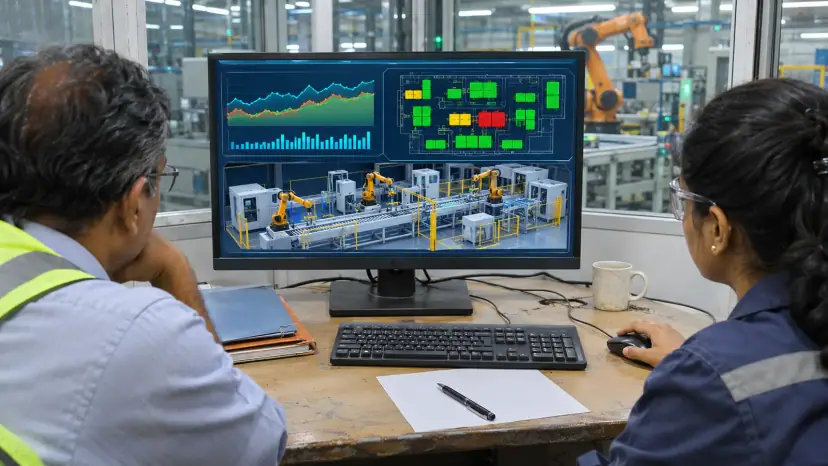
Brainguru's smart manufacturing solutions connect machines, production data and people. We build IoT monitoring, MES and ERP integrations, predictive maintenance, quality analytics and production dashboards for manufacturers who want less downtime and clearer decisions. These manufacturing solutions are software and AI services: we work with your existing equipment rather than selling machines.
Where Indian manufacturing stands
Indian factories are growing and investing. According to IBEF, manufacturing gross value added grew by 11.60% in FY2025-26, up from 8.30% in FY2024-25. The same source reports that the Production Linked Incentive schemes have an outlay of Rs. 1.91 lakh crore across 14 sectors, and that by December 2025 they had generated investments of more than Rs. 2.16 lakh crore.
New capacity raises the bar for how plants are run. Buyers expect consistent quality, export customers ask for traceability, and every hour of unplanned downtime costs more when lines run close to capacity. Paper logs and end-of-shift spreadsheets cannot keep up with that.
Common problems on the factory floor
- Unplanned downtime: Machines fail without warning because nobody saw the early signs.
- Late information: Output, scrap and stoppages are known only at the end of a shift or a day.
- Quality escapes: Defects are found at final inspection or by the customer, not where they start.
- Disconnected systems: Machines, MES, ERP and spreadsheets each hold part of the picture.
- Rising costs: Energy, material and labour costs are hard to control without data by line and product.
- Supply swings: Late materials or sudden order changes upset schedules and inventory.
Manufacturing solutions we build
- Machine monitoring with IoT: Sensors and controller data that show machine status, cycle times, temperatures, vibration and energy use in real time.
- Predictive maintenance: Machine learning models that learn normal behaviour and flag patterns that usually come before a failure, so maintenance is planned rather than rushed.
- Quality analytics: Linking process data with inspection results to find the causes of defects, and camera-based inspection where defects are visible.
- MES and ERP integration: Connecting shop-floor data with production orders, inventory, purchasing and finance, so plans match what actually happens.
- Production dashboards: Live views of output, downtime reasons, scrap and overall equipment effectiveness by line, shift and product.
- Digital twins: Virtual models of a line or process for testing changes, layouts and schedules before trying them on the real plant.
- Supply chain and inventory tools: Demand planning, stock visibility and supplier tracking, linked with our supply chain solutions.
- Energy and sustainability tracking: Energy use by machine and product, to cut waste and support reporting.
Automation and robots: the wider trend
Factories around the world are adding automation quickly. The International Federation of Robotics reported in September 2026 that factories installed more than 600,000 new industrial robots in 2025, taking the global operational stock to a record 5 million units.
India is a smaller but fast-growing market. The same IFR release says India installed almost 10,500 robots in 2025, up 15%, ranking sixth worldwide, and that annual installations grew by 27% a year on average between 2020 and 2025. We do not supply robots, but we build the software around them: collecting their data, connecting cells to MES and ERP, and showing how automated lines actually perform.
How to start: one line, one problem
The plants that get value fastest start small. Choose one line and one problem that costs real money, such as the stoppages on your busiest machine or the scrap on one product. Measure the current state, connect only the data needed, and agree a simple test of success with the plant team. When the first project works, the same data platform can be extended to more lines and sites.
Connecting machines and business systems
Most plants run a mix of old and new equipment. We work with PLCs, SCADA systems, industrial protocols and existing MES and ERP software, adding gateways and middleware where machines cannot connect directly. The aim is to extend what you already run, not to rip it out.
Data from the floor usually flows to a cloud or on-premises platform for storage and analytics, set up by our cloud services team, and on to business systems through documented interfaces built by our API development team. Some processing stays at the edge, close to the machines, where delays or patchy networks would otherwise cause problems.
Security on a connected shop floor
Connecting machines to networks creates new risks. Keep production networks separate from office networks, give each device and user only the access it needs, change default passwords, keep an inventory of connected assets and plan how updates are applied without stopping production. Our cybersecurity and cloud solutions team can review the design before devices go live.
What affects the cost of a manufacturing solution?
We do not publish prices. The main drivers are the number of machines and sensors, how easily existing equipment can be connected, the number of systems to integrate, the analytics and AI models required, whether the platform runs in the cloud or on site, and how many lines or plants are included. Support and training after launch also matter. Starting with one line keeps the first investment small and gives evidence for the next step.
Common mistakes to avoid
- Collecting everything: Gathering every possible signal without a question to answer creates cost but little insight.
- Leaving out the plant team: Operators and maintenance staff know the machines; dashboards they did not shape often go unused.
- Weak data quality: Wrong timestamps, missing downtime reasons and inconsistent product codes undermine every report.
- No owner after launch: Models and dashboards need someone to keep them accurate as products and machines change.
- Too many pilots: Several small trials that never scale cost more than one project taken to full use.
Questions to ask before you start
- Problem: Which loss are we trying to reduce, and how is it measured today?
- Data: Which machines can share data now, and which need extra sensors or gateways?
- Integration: Which MES, ERP or quality systems must receive the results?
- People: Who on the floor will use the new information, and how will they be trained?
- Ownership: Who owns the data, the models and the code at the end of the project?
Manufacturers in electric mobility can also see our EV solutions, and plants that want to reach more buyers can see our AI Marketing for Manufacturing page.