In this article
- The 2026 Shift - Why "AI Agents" Replaced "AI Chatbots"
- Agents vs Chatbots vs RPA vs Traditional Automation — The Actual Differences
- The 7 Agent Archetypes Indian Businesses Are Deploying
- The Indian Business Agent Stack (4 Layers)
- How to Think About Cost and ROI
- Cost - Building an Agent vs Renting One
- Compliance - DPDP + Sector-Specific
- Illustrative Scenario: An SDR Agent for a B2B SaaS Outbound Motion
- What NOT to Deploy Agents For (Yet)
- The Agent Maturity Model - Where to Start
- Frequently Asked Questions
- The Bottom Line
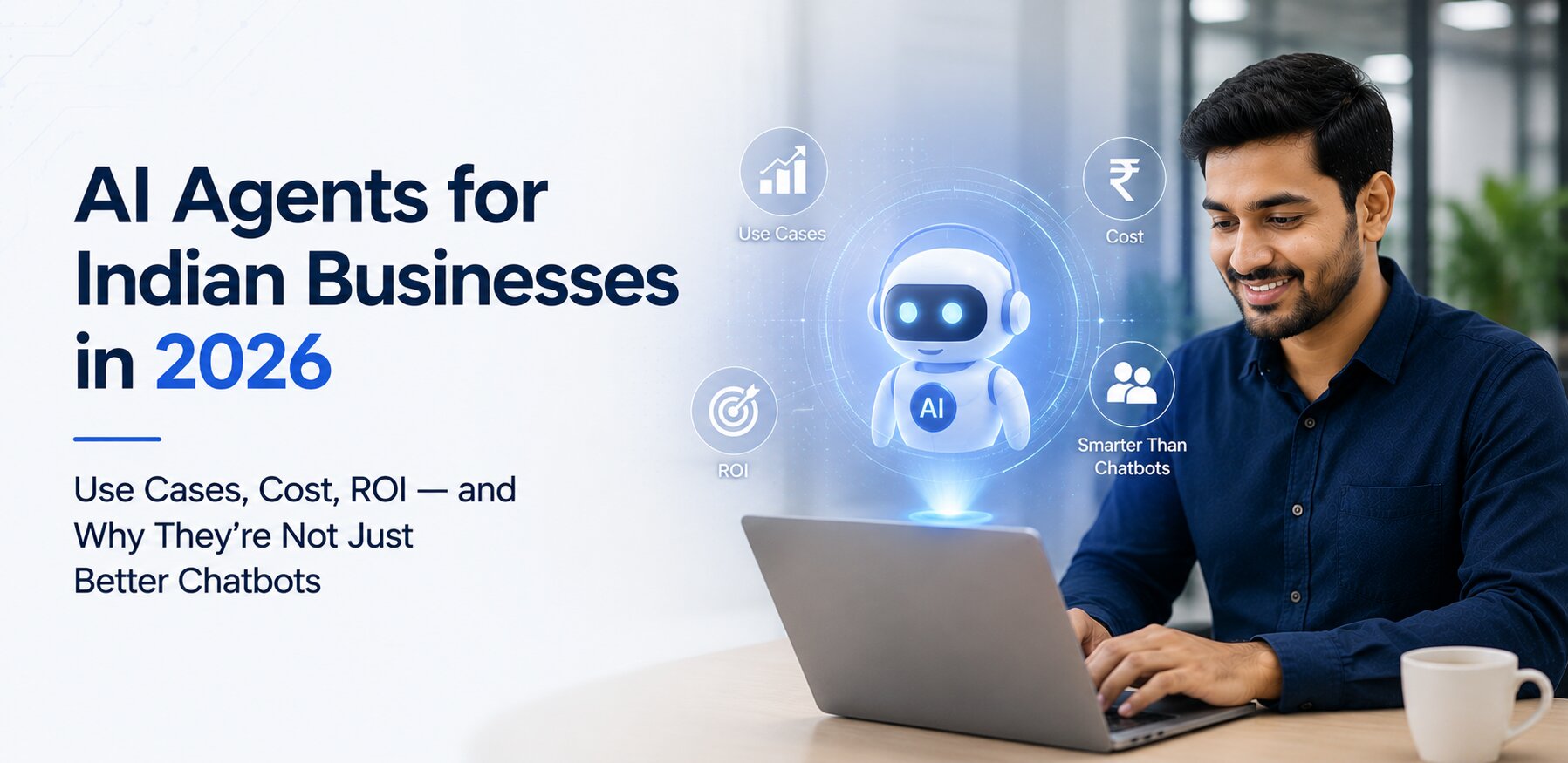
By the second half of 2025, the phrase "AI chatbot" started feeling dated even though the underlying technology had only improved. The shift that drove this was real: agentic AI - systems that don't just respond to a prompt but actually take multi-step actions toward a goal - became commercially viable. By 2026, Indian businesses across sales, ops, finance, and support are exploring and deploying AI agents. The serious operators among them report meaningful productivity gains, while teams still treating these systems as simple "chatbots" tend to capture less of the value.
This is a practical 2026 guide to AI agents for Indian businesses. What's actually different about agents vs chatbots, the seven agent archetypes Indian businesses are deploying, how to think about ROI and costs, compliance frameworks (DPDP + sector-specific), and an illustrative scenario showing how an SDR agent can reshape an outbound sales motion.
The 2026 Shift - Why "AI Agents" Replaced "AI Chatbots"
The vocabulary change isn't marketing - it reflects an architectural shift. Chatbots respond to user prompts. Agents pursue goals.
A chatbot answers "what's our return policy?" An agent: receives a customer ticket → identifies the issue → checks the order status in your CRM → checks shipping data → drafts a response → if return is needed, opens the return ticket, schedules pickup, sends the customer notification, updates inventory. Multi-step. Multi-system. Goal-directed. With humans typically reviewing exceptions rather than every step.
Three technical changes made this commercially viable in 2025–26:
Function calling / tool use in LLMs reached production-grade reliability
Memory and state management matured (LangChain, LlamaIndex, custom systems)
Falling cost per token made multi-step agentic workflows far more economical than they were a couple of years earlier
Agents vs Chatbots vs RPA vs Traditional Automation — The Actual Differences
Approach | What It Does | Best For |
|---|---|---|
Traditional automation (scripts, cron jobs) | Hard-coded if-then sequences | Repetitive deterministic tasks |
RPA (UiPath, Automation Anywhere) | Mimics human UI clicks | Bridging legacy systems |
AI Chatbot | Conversational response to user prompts | FAQ, basic Q&A, basic data lookup |
AI Agent | Multi-step, goal-directed, multi-system actions | Open-ended workflows with uncertainty |
The line between them is sometimes blurry. A practical heuristic: if it requires deciding what to do next based on previous step outcomes, it's an agent. If it's a fixed sequence, it's automation.
The 7 Agent Archetypes Indian Businesses Are Deploying
1. Sales SDR Agent
The agent autonomously: pulls qualified leads from your CRM, researches each lead (LinkedIn, company website), drafts personalised outreach emails, sends them via your email platform, tracks responses, and escalates to a human SDR when interest is shown.
Where it helps: lifting outbound throughput per rep and freeing humans to focus on higher-intent conversations rather than research and first-draft writing.
2. Customer Support Agent (Multi-Turn Resolution)
Beyond Tier-1 chatbots, this agent handles end-to-end resolution: ticket creation, internal system lookups, decision-making, action-taking, and human escalation only for novel cases.
Where it helps: reducing routine load on the support team and shortening resolution times, which can in turn support better customer satisfaction.
3. Ops / Procurement Agent
For SMEs especially: agent generates RFQs to multiple vendors, compares received quotes, negotiates within parameters, and surfaces a final shortlist for human decision.
Where it helps: cutting the manual coordination time involved in gathering and comparing vendor quotes.
4. Finance Agent (AP/AR)
Invoice processing, AP/AR matching, exception flagging, customer payment reminders. Indian finance teams running Tally or Zoho Books can integrate these agents into existing workflows.
Where it helps: reducing repetitive manual work in the finance function so the team can focus on exceptions and analysis.
5. HR Agent (Resume Screening + Scheduling)
Resume parsing, JD-fit scoring, automated interview scheduling, candidate communication. Particularly useful for high-volume hiring (BPO, tele-callers, sales).
Where it helps: speeding up the early stages of the hiring funnel, especially when application volumes are large.
6. Marketing-Research Agent
Competitor monitoring, brief generation, content suggestion, performance summary. The marketing leader's research-intern equivalent.
Where it helps: expanding a marketing team's research and drafting capacity without necessarily expanding headcount.
7. Coding / DevOps Agent
PR review, security scans, deployment supervision, anomaly detection. Used by tech teams at Indian SaaS startups.
Where it helps: handling routine reviews and checks so engineers can spend more time on higher-value work.
The Indian Business Agent Stack (4 Layers)
Layer | What It Does | Typical Tools |
|---|---|---|
Foundation Model | The brain — LLM that reasons | OpenAI GPT, Anthropic Claude, Google Gemini, Meta Llama |
Orchestration | How the agent plans and executes | LangChain, LlamaIndex, Microsoft Agent Framework, custom Python |
Tools | What the agent can DO (call CRM API, send WhatsApp, etc.) | Custom integrations, MCP servers, n8n, Zapier |
Data | What the agent KNOWS (retrieval, memory) | Pinecone, Weaviate, in-house vector DB |
For a managed-services view, see our AI agent development service.
How to Think About Cost and ROI
Every agent project has two cost components: a one-time build and an ongoing run cost (LLM tokens, infrastructure, monitoring, and tuning). The ranges below are indicative planning guidance only - actual figures depend heavily on your data, integrations, and the complexity of the workflow. They are not guaranteed outcomes.
Agent Type | Indicative Build Cost (₹) | Indicative Monthly Run Cost (₹) |
|---|---|---|
SDR agent (small SaaS) | 3–8 L | 20K–50K |
Customer support agent | 5–15 L | 30K–1L |
Ops/procurement agent | 2–6 L | 10K–30K |
Finance agent | 4–10 L | 20K–60K |
HR agent | 3–8 L | 15K–40K |
Marketing research agent | 2–5 L | 10K–25K |
DevOps agent | 5–15 L | 25K–80K |
Payback depends entirely on the cost of the human time the agent offsets, your volumes, and how well the agent performs in your environment - so treat any "payback period" number you see online with caution and model it against your own figures. To do that against your specific FTE and operational costs, use our AI cost calculator.
Cost - Building an Agent vs Renting One
Three options for an Indian business (ranges are indicative planning guidance, not quotes):
Build in-house: roughly ₹15–₹50L upfront for a senior AI engineering team, with ongoing maintenance often in the ₹3–₹15L/month range. Best for companies with large engineering teams, unique data, or competitive-moat use cases.
Hire a specialist agency (like us): typically ₹3–₹15L for the build and ₹20K–₹2L/month operational. Best for SMEs that want production-grade agents without building an in-house team.
Use SaaS agent platforms: commonly ₹5K–₹50K/month per agent. Best for vanilla use cases (basic SDR, basic support) where deep customisation isn't critical.
Compliance - DPDP + Sector-Specific
Agents processing personal data fall under DPDP. Additional sector rules can apply:
Fintech: RBI digital lending rules apply to any agent making credit-related decisions
Healthcare: telemedicine and NMC rules constrain medical-advice agents
Insurance: IRDAI rules on advice-giving agents
Always confirm current requirements with qualified legal or compliance advisors for your sector before deploying.
Illustrative Scenario: An SDR Agent for a B2B SaaS Outbound Motion
The following is a hypothetical, illustrative scenario — not a real client engagement — to show how the pieces fit together. It contains no real customer data or financial outcomes.
Imagine a B2B SaaS company whose sales motion depends on a small team of SDRs sending outbound emails each day. Much of their time goes into researching prospects and writing first drafts, leaving relatively little for handling replies and booking calls.
A typical SDR agent build for a scenario like this might involve three cooperating components:
Lead enrichment agent: pulls leads from the CRM, researches each company on LinkedIn and its website, and scores fit
Outreach agent: drafts personalised emails (referencing specific, verifiable company details) using a brand-tuned LLM
Response handler agent: monitors inbox replies, categorises responses, drafts follow-ups, and schedules calls on the relevant calendar
The plausible direction of impact in such a setup: higher outbound volume per human, more consistent personalisation, and SDRs spending more of their time on higher-intent conversations instead of research and drafting. The actual results in any real deployment depend on data quality, list quality, offer, and market — so any specific numbers should be measured in your own environment, not assumed.
What NOT to Deploy Agents For (Yet)
High-stakes individual decisions (medical diagnosis, large financial commitments) where one wrong answer is catastrophic
Pure-creative work (brand voice, creative direction) where AI quality often lags human
Trust-critical customer interactions where customers want to know they're talking to a human (luxury, premium services)
Use cases where data quality is too poor for the agent to do anything useful
The Agent Maturity Model - Where to Start
Step 0: identify your biggest internal bottleneck - where is human time most wasted on routine work?
Step 1: deploy a first agent (typically SDR, support, or research).
Step 2: measure outcome. Iterate the agent until performance matches or exceeds your human baseline.
Step 3: deploy a second agent. Use learnings from the first.
Step 4: build agent orchestration — multiple agents interacting with each other (e.g., a marketing research agent feeds the SDR agent, which feeds support post-conversion).
Step 5: an agentic operating model — agents are the default, humans handle exceptions and strategy.
Many Indian businesses are at Step 0 or 1 in 2026. The competitive advantage of moving further up the model can be significant.
Frequently Asked Questions
What's the difference between an AI agent and an AI chatbot?
Chatbots respond to user prompts. Agents pursue goals across multiple steps and systems. A chatbot answers "what's your return policy?" An agent receives a return request and actually executes the return.
Can an AI agent really replace an FTE?
For routine-task roles (SDR, Tier-1 support, basic ops), agents can take over a large share of the repetitive work, and humans get redeployed to higher-value tasks. For knowledge-worker roles, agents tend to augment rather than replace. The right framing is usually "how much routine work can this offload?" rather than headcount.
Are AI agents legal under Indian regulations?
Generally yes, but sector rules apply. RBI rules cover lending and banking agents, and SEBI rules cover investment-advice agents. NMC covers medical-advice agents. IRDAI covers insurance-advice agents. For most non-regulated use cases (sales, support, research), there is typically no specific legal barrier — but confirm with qualified advisors for your situation.
How long does it take to deploy a production AI agent?
It varies widely. Simpler agents (such as SDR or basic support) tend to be faster to ship, while complex multi-system agents (procurement, finance) and heavily customised enterprise deployments take considerably longer. Scope, data readiness, and integration complexity are the main drivers.
What's the ongoing cost of running an AI agent?
Ongoing cost is made up of LLM token usage, infrastructure (servers, databases, monitoring), and ongoing tuning and maintenance. See the indicative monthly ranges in the cost section above, and remember they depend heavily on volume and complexity.
How is agent quality measured?
Three dimensions: task completion rate (does the agent finish what it starts?), task quality (when it completes, is the output good?), and human-in-loop frequency (how often does it need to escalate?). Track all three regularly.
The Bottom Line
AI agents have moved beyond the pure-hype phase and into production use for many Indian businesses in 2026. SDR agents, support agents, and ops agents can deliver meaningful productivity gains — but the size of that gain, and how quickly it pays back, depends on your own data, volumes, and execution. The companies waiting indefinitely for "AI agents to mature" risk falling behind competitors who start learning now.
The right first move for most Indian businesses: identify the biggest internal bottleneck where routine work consumes valuable human time, deploy one agent there, measure rigorously, iterate — then scale.
For a discovery call on which agent makes sense for your business, talk to our AI agent team. You can also reach us at +91-8010010000.
Related Articles

AI Claims Document Processing: Workflow, Data Requirements and Human Review
Plan an insurance claims document AI pilot: extraction fields, source evidence, exception handling, data controls and human-reviewed acceptance tests.
Read More
AI Contract Review for Indian Legal Teams: Playbooks, Citations and Confidentiality
Evaluate AI contract review using an approved playbook, clause evidence, matter permissions and lawyer-reviewed tests. Includes a practical NDA pilot checklist.
Read More
Demand Forecasting for Indian Distributors: Data Requirements and Pilot Evaluation
Plan a distributor demand-forecasting pilot with SKU data, stockout checks, seasonal baselines, time-based testing and planner-approved replenishment.
Read More
Comments
Be the first to share your thoughts on this article.