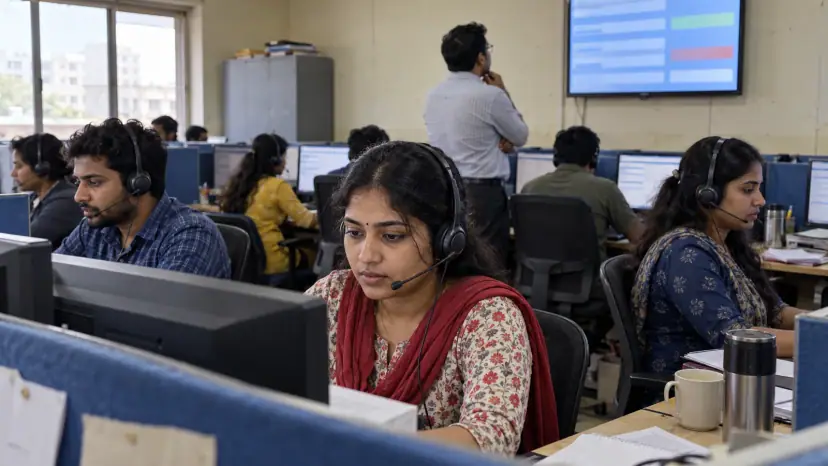
Brainguru is one of the cloud telephony providers in India that set up and run business calling over the internet instead of on office phone hardware. We configure IVR menus, virtual numbers, call routing, recording, CRM integration and bulk voice and SMS, so your sales and support teams can take and make calls from anywhere and every call is logged.
What is cloud telephony?
Cloud telephony, also called hosted telephony, runs your business phone system on a provider's platform rather than on a PBX box in your office. Calls reach your numbers as usual, but the routing, menus, recordings and reports live in the cloud and are managed from a web dashboard. Agents can answer on a desk phone, a mobile app or a browser.
Because nothing is installed on site, adding lines, agents or locations is a settings change rather than a hardware project. And because the platform has an API, calls can be linked to your CRM, helpdesk and marketing tools.
The audience is large. TRAI's subscription data for September 2026 counted 1,367.93 million telephone subscribers in India, of whom 48.74 million were on wireline connections, and 1,212.80 million active mobile subscribers. Almost every customer you serve can be reached by phone, and most will call you from a mobile.
Key features of our cloud telephony solutions
- IVR menus: Callers choose a language, department or service from a menu, and the call goes to the right team without a receptionist transferring it.
- Virtual numbers: Local, toll-free or mobile-style numbers that ring wherever your team is, so you can publish one number per campaign, branch or product.
- Call routing: Rules that send calls by time of day, caller history, agent skill or availability, with overflow to a backup team.
- Call recording and reports: Recordings for quality checks and training, and reports on missed calls, waiting times and agent activity.
- CRM integration: Each call is logged against the right contact automatically, with click-to-call from the CRM screen.
- Voice bots and chat: Automated answers to common questions, appointment booking and first-level qualification, handing over to a person when needed. See our AI chatbot development service for the chat side.
- Bulk SMS and voice broadcasting: Reminders, alerts and permitted promotional messages sent at scale, within the telecom rules for commercial communication.
- Missed-call services: A number customers call and hang up on, which triggers a callback or an SMS, useful for enquiries and opt-ins.
Benefits of cloud telephony for businesses
- Lower setup cost: No PBX hardware to buy, house or maintain.
- Scales with demand: Add agents for a sale, an admission season or a product launch and remove them afterwards.
- Remote and hybrid work: Agents work from home or another city on the same number and the same reports.
- Fewer missed calls: Routing, queues and callbacks mean calls are answered or returned rather than lost.
- Better data: Every call is counted, timed and linked to a customer, so managers can see what is happening.
The data point matters more than it seems. In Salesforce research published in December 2022, sales reps spent just 28% of their week actually selling, with much of the rest taken up by tasks such as deal management and data entry. Calling that logs itself in the CRM removes part of that load. Our CRM solutions cover the CRM side of the setup.
Rules for business calling in India
Business calls and messages in India are regulated, and a good provider builds the rules into the setup rather than leaving them to you.
- Commercial communication: Promotional and transactional calls and SMS fall under TRAI's Telecom Commercial Communication Customer Preference Regulations (TCCCPR) 2018, which cover sender registration, templates and customer preferences.
- Number series: According to Business Standard's May 2024 report, the Department of Telecommunications allocated a separate 10-digit series starting with 160 for service and transactional calls from government bodies, regulators and financial entities, under TCCCPR 2018. Banks, insurers and similar firms should plan their outbound service calls around it.
- Call recordings and personal data: Recordings and call logs contain personal data. Under the Digital Personal Data Protection Act 2023 and the DPDP Rules notified on 13 November 2025, the main duties start on 13 May 2027. Tell callers when calls are recorded, limit who can listen and set how long recordings are kept.
Industries that use cloud telephony
- E-commerce and retail: Order and delivery queries, returns, and callbacks on abandoned orders.
- Healthcare: Appointment booking and reminders, and patient helplines. See our healthcare call center solutions in India.
- Banking and finance: Service calls, payment reminders and transaction alerts, within the 160-series and TCCCPR rules.
- Real estate: Lead capture from portals and ads, quick callbacks and site visit scheduling.
- Education: Admission enquiries, counselling calls and fee reminders during peak season.
How to choose cloud telephony providers in India
- Number types: Can they provide the local, toll-free or mobile numbers you need, in the circles you need?
- Call quality: How do they handle poor connections, and can you test with real calls before signing?
- Integrations: Is there a working connector or API for your CRM and helpdesk?
- Compliance: How do they handle sender registration, templates, consent and the 160 series where it applies?
- Recording and data: Where are recordings stored, for how long and who can access them?
- Reports: Do the reports show missed calls, waiting times and outcomes in a form managers will read?
- Support: Who answers when your own phone line fails at peak time?
For a longer, practical guide, read our article on cloud telephony and IVR for Indian businesses.
Choose the campaign interaction
Use the short code campaign brief when a person starts a keyword-based SMS enquiry. Use the voice campaign brief when an eligible recipient receives a recorded call. Confirm number resources, permissions, response handling and provider terms for the chosen channel before launch.
How we set up cloud telephony
- Call flow review: We map who calls you, why, when and what should happen to each call.
- Design: IVR menus, routing rules, numbers and reports are designed around that map.
- Integration: We connect the platform to your CRM and other tools and test that calls log correctly.
- Launch and training: Agents and managers are trained, then the new numbers go live.
- Review: After a few weeks we look at missed calls, waiting times and outcomes, and adjust.
We work with businesses across India from our Noida office.