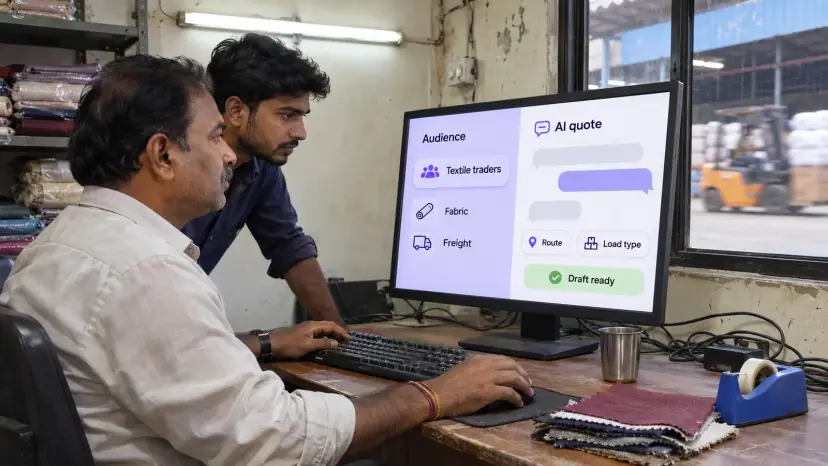
Surat logistics RFQs by lane, with operations checking what can be served
Three locations get mixed up in a Surat freight enquiry: the city, your facility and the buyer’s delivery destination. This guide helps Logistics and Supply Chain teams keep them straight and get each lane reviewed by operations. We explain what to collect, which local sources to use, what an assistant may do and when a person must approve the next step. Please read the workflows as planning examples, because they are not Brainguru client results. Any service we offer is scoped to your actual business, data and permissions.
Separating the city, the facility and the destination
The Surat district administration provides locality and service information. Record Surat city, the actual operating facility and the buyer’s delivery destination as three separate items. A district resource helps you check administrative context, but it says nothing about the quality or authenticity of goods a business sells.
Go to Surat district first. It supports administrative context only, so do not use it to claim market demand, commercial availability or the endorsement of a private business. Write down the Surat facility and the buyer delivery destination separately, then compare the location with the approved business record. When the two do not match, a reviewer should fix that before the page or assistant gives directions, coverage information or an appointment instruction.
The local page How to Reach covers transport and access, and it is useful for orientation. It is not a commercial routing engine. It cannot confirm a carrier’s serviceability, transit time or handling capacity.
What to capture on a Surat RFQ
Put these fields in your working brief, and do not just place a city name beside a national offer that has no link to it. Each statement should show its source and its reviewer. Where an answer is unknown, log it as a gap for a person to follow up. Do not let the model make an assumption.
- Pickup and delivery locations: Enter the Surat facility and the buyer’s destination as separate addresses. Use where you really operate, not where your ads run.
- Cargo type, quantity and handling needs: Describe the goods, the amount and any special handling, since these decide whether the lane can be served at all.
- Requested lane and service mode: Capture the route and mode as the customer stated them. A missing detail stays open for review.
- Verified operating capability and constraints: Attach current, approved evidence of capability and its limits, because a photograph or city name does not show either.
- RFQ or shipment-status enquiry: Say which it is. A customer chasing a shipment needs operations, not a sales follow-up.
- Operations or quotation reviewer: Identify who signs off the serviceability answer or the quote before anything is offered.
Imagine a Surat request used as an example. It has to clear the location check and the cargo check before a commercial next step comes up. When one fails, that failure goes into the handoff unresolved, so the receiving team has a specific point to answer. They are not handed a lead that only looks qualified.
Using AI on RFQs while operations keeps the decision
Good logistics marketing names the real pickup and delivery locations, the cargo and the service requirements. AI is useful for extracting RFQ fields and flagging handling information that is missing. Confirming the lane and capacity is the job of operations. An indicative enquiry is not an accepted quote, a booking or a completed shipment, so record each one separately. Having a Surat landing page does not show that you support every route, hazardous cargo type or storage requirement.
Limit connections to authorised sources and systems, such as an approved knowledge pack, the relevant operational system and a CRM or intake route if you need one. Save the source version used for every answer. Check access permissions and who can edit content before you work with live customer data. Reviewers can use drafts, predictions and extracted fields as aids, but none of these is a commercial commitment.
Transit, customs and tracking claims
Never make up transit times, customs approvals, temperature-control capability or carrier partnerships. A freight estimate should list its assumptions and pass through the responsible quotation process. Tracking information must come from an authorised operational source. A status guessed from a marketing chat is not acceptable.
Four roles touch every enquiry: sales takes the first message, the planner checks the lane, the dispatcher holds the vehicles and the customer service lead owns tracking replies. What breaks is the line between planner and dispatcher. The planner says a lane is served, the dispatcher has no vehicle that week, and the shipper is quoted for something nobody can move. Make the quote step wait for both, and let the assistant say that operations will confirm availability for the requested date. After each quote, record whether the lane was served, since that record is how the team learns which enquiries the page should discourage.
Gujarati and English, local search and following a shipment through
For an audience that needs Gujarati and English, competent speakers should review terminology, locality names and the next step you propose. You can assess these options with the business. Listing them does not mean all customers use them or that Brainguru supplies every translation. The page and your business records should show the same real address and contact route, and you should not create extra offices or profiles to look local.
The person enquiring from Surat may want goods moved elsewhere, so treat audience location and fulfilment location as different things. Your page content and enquiry routing should reflect the approved serviceable area. Follow every stage on its own: lane enquiry → cargo/serviceability review → quote → accepted booking → operational completion. Requests that were rejected, cancelled or unsupported still count in the evaluation, as clicks and conversations are not revenue.
Test the setup with an unsupported lane, an incomplete cargo declaration, a temperature requirement and a status enquiry that gets mistaken for a sales lead. See how the reviewed results compare with the business’s own baseline before spending more. If search queries show mismatched intent, improve the answer or handoff they lead to. We do not guarantee rankings, AI-answer inclusion, lead volume or return on investment.
Further reading and your consultation
The industry scope is in Logistics & Supply Chain solutions, and you can find implementation detail in Demand Forecasting for Indian Distributors: Data Requirements and Pilot Evaluation. Because that article explains a related workflow, it is not evidence of a Surat client engagement.
In Surat we also have planning guides for Manufacturing and E-Commerce. Use Surat and other city guides if you want to compare supported information and official references.
Bring these to your free consultation: pickup and delivery locations, cargo type, quantity and handling needs, approved source material and the reviewer who can decide the next step. Our team delivers from the Noida office, and we claim no branch in Surat. Scope, integrations and on-site work vary by job, so we discuss them for each one.
Our last check of local and sector resources was on 5 October 2026. Look at current instructions again before campaign changes. The photographs are illustrations and do not verifiably show local offices, customers or facilities.