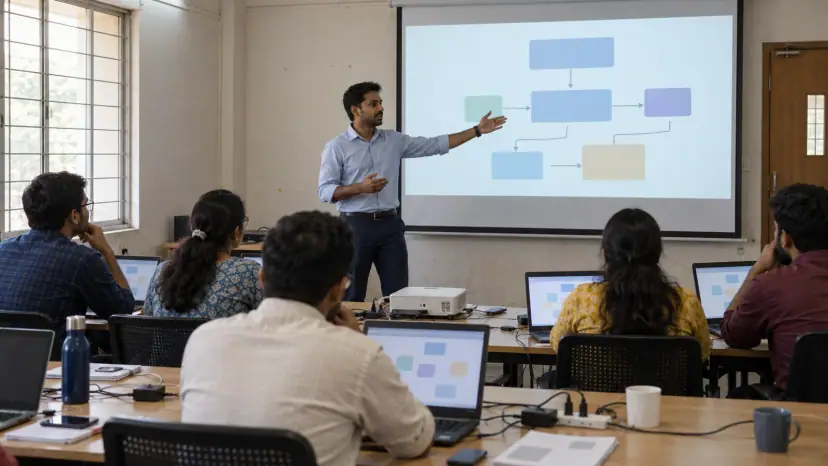
Brainguru's corporate training services teach your teams practical skills in AI, digital marketing, software development, cloud and IT management. Each programme starts from your tools, projects and skill gaps, mixes short explanations with hands-on work, and ends with an assessment, so you can see what people learned and where they still need support.
Why corporate training matters now
Skills are changing faster than most teams can keep up with on their own. The World Economic Forum's Future of Jobs Report 2025 found that, on average, workers can expect 39% of their existing skill sets to be transformed or become outdated between 2025 and 2030. It also found that 63% of employers see skill gaps as a major barrier to transforming their business, and 85% plan to prioritise upskilling their workforce.
Training is also tied to keeping people. In LinkedIn's 2025 Workplace Learning Report, 88% of organisations said they were concerned about employee retention, and providing learning opportunities was respondents' top retention strategy. The same report found that 49% of learning and talent professionals agreed their executives worry that employees lack the skills to carry out the business strategy.
The good news is that training works when it is close to real work. WEF also found that the share of workers who had completed training, reskilling or upskilling rose to 50%, from 41% in its 2023 edition.
Our corporate training services
Programmes are built from modules, and each module can be shortened, extended or combined with others to fit your team.
AI and machine learning: AI and machine learning basics, natural language processing, computer vision, predictive analytics, using AI tools safely at work, and planning AI projects. For teams that will build AI systems, this links to our data and AI solutions.
- How AI models work, in plain terms, and where they fail
- Writing good prompts and checking AI output
- Choosing AI use cases with a clear business case
- Data quality, privacy and responsible use
Digital marketing: Search engine optimisation, paid search and social advertising, social media, analytics, content, conversion and marketing automation. See our AI marketing automation service for how these tools are used in practice.
- Setting up and reading analytics correctly
- Planning and measuring paid campaigns
- Content that answers real customer questions
- Automating follow-ups without spamming
Software development and IT: Full stack development methods, Agile and DevOps practices, cloud and cybersecurity basics, databases, mobile development and user experience.
- Code review, testing and release habits
- Cloud basics on AWS, Azure and Google Cloud
- Secure coding and common web vulnerabilities
- Working with APIs and integrations
IT management and transformation: IT governance and risk, data for decision-making, process automation, infrastructure planning, vendor management, budgeting and change management.
Who is the training for?
- Technical teams: Developers, testers and IT staff learning a new framework, cloud platform or practice.
- Marketing and sales teams: People who need to run campaigns, read data and use automation tools well.
- Managers and business owners: Decision-makers who need to understand technology well enough to plan, budget and judge vendors, without becoming engineers.
- New joiners: Graduates and lateral hires who need to get productive on your stack quickly.
How we design a training programme
- Skills review: We talk to managers and a sample of learners, and where useful run a short pre-assessment, to find the real gaps.
- Programme design: We choose and adapt modules, set learning goals for each, and plan exercises using your own tools or close copies.
- Delivery: Sessions run on site, online or in a mix, in short blocks that fit around work.
- Practice: Learners apply each topic to a task from their own job, with feedback.
- Assessment and follow-up: A final assessment shows progress against the starting point, and follow-up material or sessions support people who need more help.
Delivery formats
- Workshops: One or two focused days on a single topic, such as prompt writing or analytics setup.
- Programmes: A series of sessions over several weeks, with practice between them.
- On-site, online or hybrid: Chosen to suit your locations and schedules.
- Team-specific cohorts: Groups formed by role, so examples match what people actually do.
How to measure whether training worked
Attendance and feedback forms are not enough. Agree the measures before training starts and check them afterwards.
- Knowledge: Compare pre- and post-training assessment scores for each topic.
- Behaviour: Check whether people use the new skill at work, for example whether code reviews now include tests, or campaigns now have tracking set up.
- Work output: Look at measures the team already tracks, such as release frequency, campaign reporting time or support tickets, and compare them over the following months.
- Confidence and retention: Short surveys a few weeks later show whether people feel able to apply what they learned.
Be careful with claims about return on investment. Training is one factor among many, so look for changes in day-to-day behaviour first.
How to choose a corporate training provider
- Trainers: Do they do the work they teach, or only teach it?
- Customisation: Will exercises use your tools and situations, or a generic case?
- Assessment: How will you know what each person learned?
- Materials: Can your team keep the slides, exercises and recordings?
- Follow-up: Is there support after the last session?
- Safety: For AI and security topics, do they cover data privacy and safe use, not only features? For a wider security review of your systems, see our cyber security consulting.
What affects the cost of corporate training?
We do not publish prices. The main factors are the number of participants, the number and length of sessions, how much content is customised, delivery on site or online, assessments and follow-up support. A short workshop on one topic costs far less than a multi-week programme with custom exercises. We work with organisations across India and abroad from our Noida office.