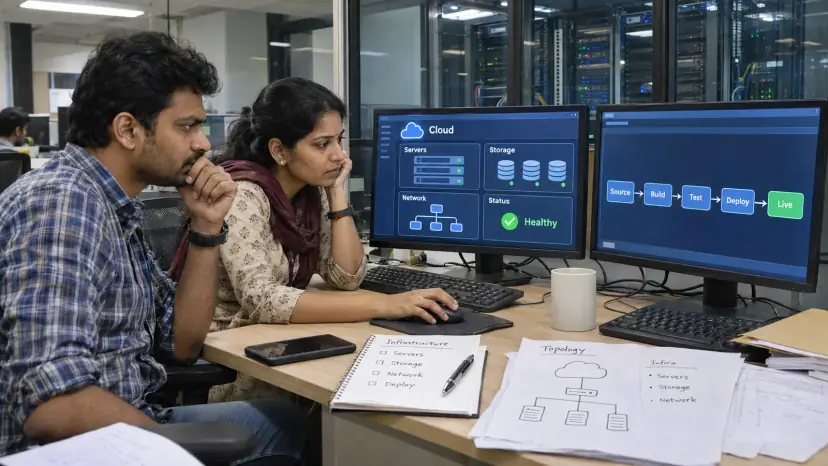
Cloud services in India for reliable infrastructure
Brainguru provides cloud services in India and abroad on AWS, Microsoft Azure and Google Cloud: planning, migration, DevOps, cost control and round-the-clock managed operations. Whether you are leaving your own servers, cutting an inflated cloud bill or building a new product, the aim is the same: infrastructure that is secure, affordable and ready to grow.
Infrastructure choices decide how fast your application runs, what it costs each month and how easily it scales. Our team works with containers and orchestration, CI/CD pipelines, infrastructure as code, monitoring and site reliability practices. For how the main platforms compare, read our AWS vs Azure vs Google Cloud vs Oracle guide.
We do not start from a fixed template. Every business has different workloads, compliance rules, performance needs and budgets, so the first step is always to understand yours and design around them.
Where the Indian cloud market stands
Cloud use in India is growing quickly. According to IDC's December 2023 release, India's public cloud services market reached $3.8 billion in the first half of 2023 and is expected to reach $17.8 billion by 2027, growing at 22.9% a year from 2022. IDC also noted that the top two providers held more than 40% of the market.
Most organisations do not run on cloud alone. The Flexera 2026 State of the Cloud Report found that 73% of organisations operate hybrid estates, mixing public cloud with their own infrastructure. The same report found that respondents estimate 29% of their cloud spend is wasted. Both findings shape how we work: plan for hybrid where it makes sense, and build cost control in from day one.
Our cloud and DevOps service offerings
- Cloud Migration Services: A planned move of applications, databases and workloads from your own servers or another cloud to AWS, Azure or Google Cloud, in stages and with rollback plans.
- Cloud Strategy Consulting: Advice on cloud adoption, platform choice, multi-cloud and hybrid approaches, cost forecasting and governance.
- DevOps as a Service: CI/CD pipelines, infrastructure as code, automated testing and deployment, so software reaches users faster and more safely.
- Cloud FinOps Services: Cost visibility, right-sizing, commitment planning and budgets that reduce your cloud bill without hurting performance.
- 24x7 Managed Cloud Services: Round-the-clock monitoring, incident response, patching, backups and tuning, so your team can focus on the product.
Choosing between AWS, Azure and Google Cloud
All three providers run data centre regions in India, and all three can host most business workloads well. The differences that matter are practical:
- Existing software: Firms that rely on Microsoft licences and identity often find Azure simpler to adopt.
- Services you need: AWS has a very broad catalogue; Google Cloud is strong in data analytics and machine learning tools.
- Skills: The platform your team, or the people you can hire, already know reduces risk.
- Pricing model: Each provider discounts steady use differently, so compare costs for your actual workload mix.
- Data location: Check which services are available in the Indian regions you need.
Many businesses end up using more than one provider. That is fine when it is a deliberate choice, and costly when it happens by accident.
Why choose Brainguru for cloud and DevOps
- Multi-cloud experience: We work across AWS, Azure and Google Cloud, so the recommendation follows your needs rather than one vendor.
- Cost awareness: Right-sizing, reserved capacity planning, spot instances and architecture changes are part of every design, not an afterthought.
- Security first: Encryption, network segmentation, access control, vulnerability scanning and logging are built into each environment.
- Automation: Provisioning, deployments, scaling and alerts are automated where possible, which reduces human error and routine work.
- Structured migration method: Discovery, waves, testing and rollback plans keep risk low during a move.
Security and compliance in India
Cloud systems in India carry specific duties. The CERT-In directions of 28 April 2022 require service providers, data centres and body corporates to report listed cyber incidents within 6 hours of noticing them, and to keep ICT system logs for a rolling 180 days within Indian jurisdiction. Where systems hold personal data, the Digital Personal Data Protection Act 2023 applies, and under the DPDP Rules notified on 13 November 2025 its main duties start on 13 May 2027. We design logging, retention, access and backup settings with these rules in mind. For wider security work, see our cybersecurity and cloud solutions, and for testing an application before launch, our security testing services.
Industries we serve
- SaaS and technology: High-availability setups, auto-scaling, multi-tenant infrastructure and CI/CD pipelines for frequent releases.
- E-commerce: Peak traffic handling, CDN setup, database replication and disaster recovery for online stores.
- Financial services: Cloud setups built to support RBI, PCI DSS and SOC 2 requirements, with encryption, audit logging and access controls.
- Healthcare: Environments designed around the DPDP Act, with HIPAA-aligned designs for US healthcare clients, secure storage and telemedicine hosting.
- Media and entertainment: Content delivery, video processing, streaming and storage-heavy designs.
- Government and public sector: Data residency, high-security configurations and hosting in Indian regions.
Our process
- Assessment and planning: We review your current infrastructure, applications and workflows to understand dependencies, performance needs, compliance and current costs.
- Architecture design: We design the target setup for compute, storage, networking, security, monitoring and disaster recovery, sized for your workloads and budget.
- Migration or build: We carry out the migration or new build in phases, testing each stage, with rollback plans to limit disruption.
- Automation and optimisation: After go-live we add CI/CD pipelines, infrastructure as code, auto-scaling and dashboards.
- Ongoing management: Our managed services team provides monitoring, maintenance, cost reviews and 24x7 incident response.
Startups have a simpler path: getting accounts, networks and tags right at the start avoids costly fixes later. Our startup cloud architecture service covers this.
What affects the cost of cloud services?
We quote each engagement after an assessment. The main factors are the number and type of workloads, the platforms involved, data volumes, compliance needs, the level of automation, the response times you need for support and whether the work is a one-off project or an ongoing service. For migrations, our page on cloud migration cost in India explains each factor.