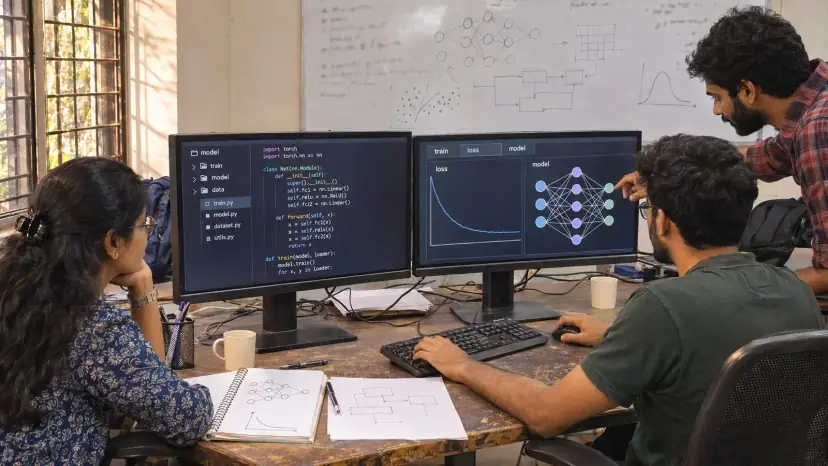
AI model development is the work of designing, training, testing and deploying a model that learns from your data to make a specific prediction or decision: which customer may leave, which transaction looks fraudulent, which part has a defect. Brainguru builds these models with machine learning, deep learning, NLP and computer vision, and connects them to your existing systems.
What is AI model development?
A model is a program that has learned patterns from examples rather than following hand-written rules. Building one that works in practice involves four stages:
- Data collection and preparation: Gathering the right records, cleaning them, labelling examples and splitting them so the model is tested on data it has not seen.
- Model selection and training: Choosing a method that suits the problem and the amount of data, from simple regression to deep neural networks, and training it.
- Evaluation and tuning: Measuring accuracy and errors against a baseline, checking performance across customer groups or product types, and tuning until it meets the agreed target.
- Deployment and integration: Putting the model behind an API or inside an application, with monitoring so problems are noticed.
Most of the effort sits in the first and last stages. Training is often the shortest part of the project.
Custom model or existing model?
Large general-purpose models are now cheap to use. The Stanford AI Index 2025 found that the inference cost of a system performing at the level of GPT-3.5 dropped more than 280-fold between November 2022 and October 2024. The same report notes that nearly 90% of notable AI models in 2024 came from industry. For many language tasks, the sensible route is to use one of those models with your own data and instructions.
A custom model earns its place when the answer depends on your own history: your customers, your transactions, your machines. Forecasting demand for your products, scoring your leads or spotting defects on your production line are problems no general model has seen. Often the best design combines both: a custom model for the prediction and a language model to explain the result to staff.
Our page on off-the-shelf vs custom AI development sets out this choice in more detail.
AI model development services
Machine learning models
Supervised, unsupervised and reinforcement learning models for predictive analytics, customer segmentation, anomaly detection and sentiment analysis. Where data is mostly tables of numbers and categories, well-tuned classic methods often beat deep learning and are easier to explain.
Natural language processing (NLP)
Models that read and process text and speech for chatbots and virtual assistants, automated customer support, intent and sentiment analysis, and summarisation and translation. See our NLP development services for more.
Computer vision and image recognition
Models that interpret images and video for object detection and classification, automated quality control in manufacturing, and medical image analysis that supports clinicians. Facial recognition is possible, but it involves sensitive personal data, so it needs a clear lawful purpose, consent where required and strict access controls.
Recommendation systems
Models that learn from behaviour to suggest products, content or next actions in ecommerce, streaming and content platforms.
Fraud detection and risk assessment
Models that spot unusual transactions and behaviour in finance, ecommerce and cybersecurity, and rank cases so investigators look at the riskiest first.
Deployment and integration
Models connected to your software, cloud platforms and CRM systems, so predictions arrive where decisions are made rather than in a separate report.
Industries that benefit from AI model development
- Ecommerce and retail: Product recommendations, customer behaviour analysis and support chatbots.
- Healthcare and pharmaceuticals: Diagnostic support, predictive analytics for patient care, and research and trial support.
- Finance and banking: Fraud detection, risk management, forecasting and customer support.
- Manufacturing: Predictive maintenance, process optimisation and defect detection.
- Education and e-learning: Tutoring and assessment tools, grading support and personalised learning suggestions.
How we build and test a model
- Define the problem: What decision will the model support, who will use it and what counts as success. We write down the baseline, such as the current error rate or the time a task takes today.
- Assess the data: How much exists, how reliable the labels are, and whether it represents the cases the model will meet in real use.
- Build a first version: A simple model first, to set a benchmark that more complex models must beat.
- Evaluate honestly: Test on held-out data, look at the errors that cost most, and check results across groups so the model is not accurate on average but unfair to some.
- Pilot: Run the model alongside the current process before it makes decisions on its own.
- Deploy and monitor: Track accuracy, data drift and response times, and retrain on a planned schedule or when performance drops.
Models trained on your data can carry risks that ordinary software does not. NIST's AI Risk Management Framework, released on 26 January 2023, gives a structured way to think about them, and its Generative AI Profile followed on 26 July 2024. In India, data used for training must also respect the Digital Personal Data Protection Act, 2023, whose main duties start on 13 May 2027.
Why projects fail, and how to avoid it
In July 2024, Gartner predicted that at least 30% of generative AI projects would be abandoned after proof of concept by the end of 2025, citing poor data quality, inadequate risk controls, escalating costs or unclear business value. The same causes sink classic machine learning projects. In practice:
- No agreed success measure: If nobody wrote down what "good enough" means, the project never ends.
- Training data that does not match reality: A model trained on last year's clean data may struggle with this year's messy inputs.
- Leakage: Information that would not be known at prediction time sneaks into training and inflates test results.
- No owner after launch: Models degrade as the world changes. Someone must watch them.
Why choose Brainguru for AI model development?
Custom work: Models designed for your specific problem, data and constraints.
Modern frameworks: We use TensorFlow, PyTorch, scikit-learn and OpenAI models, chosen to suit the task rather than habit.
Security and privacy: Data access is limited to the project team, and models are built to handle growing data volumes safely.
Integration: Models connected to your applications, cloud platforms and automation tools.
Support after launch: Monitoring, retraining and tuning so accuracy holds up as conditions change.
Data science skills are in demand: the US Bureau of Labor Statistics projects employment of data scientists to grow 35 percent from 2025 to 2035. Working with a partner gives you that capability without a long hiring process. If you are budgeting, our page on AI development cost in India explains what drives the estimate, and AI-powered data mining covers the data preparation side.