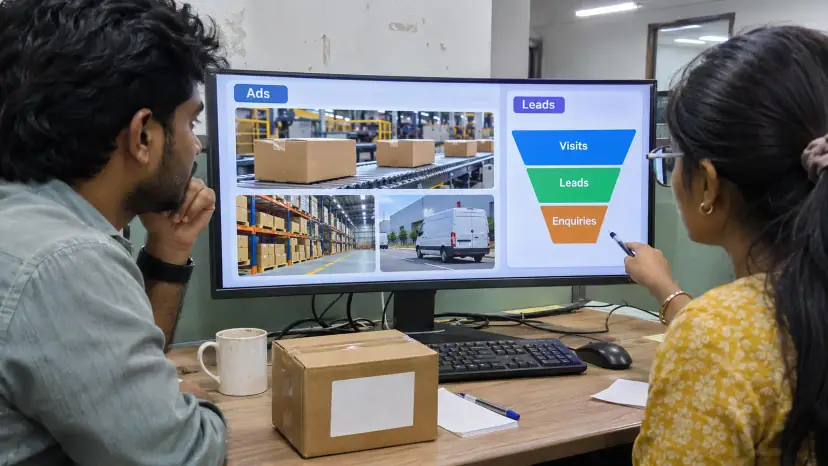
Noida freight RFQs that name the lane, with operations confirming serviceability
An RFQ that says “Noida to somewhere” cannot be priced, and nobody should promise a route on the strength of it. Logistics and supply chain teams in Noida can use this guide to work lane by lane and have operations review serviceability. We explain what to capture, which local source to consult, what an assistant can handle and when a person must approve the next step. Every freight workflow below is a planning example and shows no Brainguru client result. Scoping starts from your real operation, data and permissions.
Noida sectors, Greater Noida and the official sources
Noida-related administrative information officially starts at the Gautam Buddha Nagar district portal. Hold one address and service-area record for Noida and a different one for Greater Noida. Our documented office is in Noida, and that fact does not establish any branch elsewhere.
Go to Gautam Buddha Nagar district first. The portal provides administrative context, without showing market demand or commercial availability, and it endorses no private carrier. Enter the Noida sector, creating a separate record for Greater Noida. Compare that entry with the approved business record. A mismatch must be resolved by a reviewer before the page or assistant offers directions, coverage details or an appointment instruction.
For orientation, the portal has a page called How to Reach. It covers local transport and access. It is no commercial routing engine, and it cannot confirm a carrier’s serviceability, transit time or handling capacity.
What your Noida RFQ brief should capture
Shippers need specifics, so a city name beside an unrelated national offer will not do. Treat the fields below as a working brief, and keep every statement with its source and reviewer. If a detail is absent, log it and pass it to a person. Do not let the model assume a weight, a route or a capability.
- Actual pickup and delivery locations: Take both ends of the movement, using the Noida sector for pickup and a separate record for Greater Noida.
- Cargo type, quantity and handling needs: Describe what is moving and how much, plus any handling it requires, because these decide whether the job is possible.
- Requested lane/service mode: State the lane and mode asked for, and treat anything missing as a question for operations.
- Verified operating capability and constraints: Keep current evidence of what the operation can do and where it stops, as a depot photo proves nothing.
- RFQ versus shipment-status enquiry: Decide whether this is a new quote or a status question, and send status queries away from sales.
- Operations/quotation reviewer: Name the operations or quotation person who confirms the lane before a price or next step is offered.
Picture an illustrative Noida RFQ. Location is checked, then cargo type, quantity and handling needs, and a commercial next step is proposed only after that. A failed check remains unresolved when it reaches operations, who then have a clear question to answer and not a falsely qualified lead.
AI reads the RFQ, and operations confirms the lane
Your marketing should make the real pickup and delivery locations, the cargo and the service requirements plain. AI can extract RFQ fields and flag handling information that is missing, while operations confirms the lane and capacity. Keep an indicative enquiry apart from an accepted quote, a booking and a completed shipment. Having a city landing page does not show that every route, hazardous cargo type or storage requirement is supported.
Connect only sources and systems that the business has authorised: an approved knowledge pack, the operational system involved and a CRM or intake route where needed. Save the version of the capability or rate source behind each answer. Try out access rights, and establish who can revise content, before live customer data arrives. A draft, prediction or extracted field helps the reviewer, and it never commits the business automatically.
A common mistake is to treat a request for a shipment status as an RFQ because both mention a lane. It happens when one inbox serves sales and customer service. The sales team spends time on a question that needs a tracking lookup, and the shipper waits for an answer. Separate the two at the first message, and give status questions to the people who hold the tracking source.
Freight claims you must not make up
Transit times, customs approvals, temperature-control capability and carrier partnerships must be real, never invented. Any price you estimate for a load should list what it assumes and then go through the responsible quotation process. Tracking information must come from an authorised operational source, because a status guessed from a marketing conversation is worthless.
The Invest UP site has a Warehousing and Logistics sector page. It gives context about state priorities, not about your own capability, and it implies no link between the state and any carrier. A quote should describe only the lanes and services the operation has verified.
Hindi and English, local listings and counting by stage
If the audience needs Hindi and English, competent speakers should review terminology, locality names and the proposed next step. These languages are to be assessed with the business, and they imply nothing about every customer’s use or about Brainguru supplying every translation. The real address and one consistent contact route should be carried across the page and business records. Do not create further offices or profiles to pretend you have a local presence.
The audience may be in Noida while the service is fulfilled elsewhere, so the two locations stay apart. Page content and enquiry routing need to respect the approved serviceable area. Track stages independently: lane enquiry, cargo and serviceability review, quote, accepted booking, then operational completion. Keep rejected, cancelled and unsupported requests in the evaluation, since a click or conversation brings in no revenue.
Run these tests: a lane you cannot support, a cargo declaration left incomplete, a temperature requirement and a status enquiry mistaken for a sales lead. Check reviewed outcomes against the business’s own baseline before raising spend. Search queries can reveal mismatched intent, so improve the answer or handoff they land on. This work comes with no guarantee of rankings, AI-answer inclusion, lead volume or return on investment.
In the first weeks, read the RFQs that operations declined and note why. If many concern lanes or cargo the operation does not handle, the page is too broad. If many quotes are sent and few answered, review the speed of the reply and what the quote assumes before you change the ads.
Reading list and consultation preparation
Have a look at Logistics & Supply Chain solutions for the industry scope and at Demand Forecasting for Indian Distributors: Data Requirements and Pilot Evaluation for implementation detail. It explains a related workflow and offers no evidence of a Noida client engagement.
Other Noida planning tasks are Manufacturing and E-Commerce. If you want to compare supported information and official references, there is Noida and other city guides.
Please bring the actual pickup and delivery locations, the cargo type, quantity and handling needs, approved source material and the reviewer who decides next steps to a free consultation. Your contact point with us is our documented Noida office, which is where delivery runs from. Scope, integrations and on-site work, if required, are looked at for each case.
We checked these resources on 5 October 2026, so look at current instructions again before making campaign changes. Photographs serve as topic illustrations and are not verified pictures of local offices, customers or facilities.