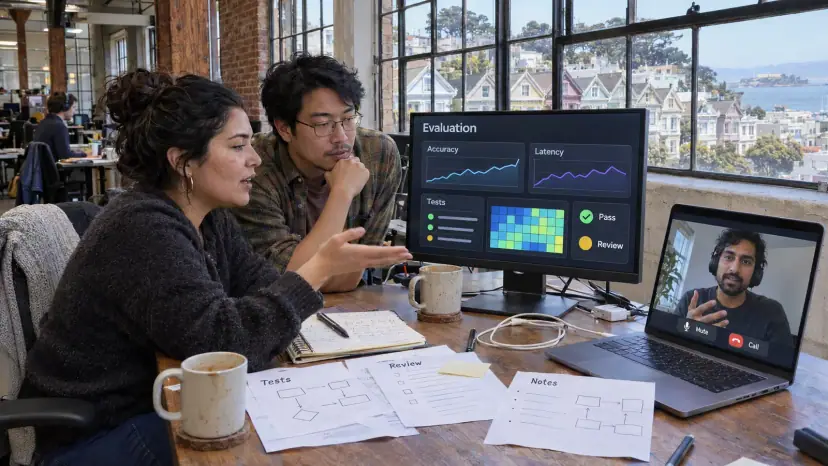
If you need an AI development company in San Francisco but cannot hire fast enough locally, Brainguru works remotely from Noida for Bay Area founders and CTOs. We build LLM applications, retrieval systems, AI agents and machine learning models, or add senior engineers to your team. Work runs under an NDA, and the code and data stay yours.
Why Bay Area teams look beyond local hiring
The Bay Area has more AI money and ambition than anywhere else, and that makes experienced engineers hard to hire. The Stanford AI Index 2025 reports that US private AI investment reached $109.1 billion in 2024, nearly 12 times China's $9.3 billion. The same report found that 78% of organisations used AI in 2024, up from 55% the year before. More companies are now competing for the same people.
Salaries reflect that demand. According to the US Bureau of Labor Statistics, the median annual wage for data scientists was $120,230 in May 2025, and employment is projected to grow 35% from 2025 to 2035. The BLS figure for software developers was $135,980. These are national medians, before benefits, equity and recruiting costs, and Bay Area pay for AI specialists usually sits well above them.
An outside team does not replace your core staff. It suits a defined product, a backlog your team cannot reach, or a skill you need for a few months rather than for years. Keep product ownership, architecture decisions and code review in-house, and give the outside engineers clear tickets, access and a named contact. Teams that treat remote engineers as part of the same team, with the same standards and the same reviews, get far better results than teams that hand over a specification and wait.
AI and ML work we take on
- LLM applications: Assistants, copilots and AI features inside your product, built on commercial or open-weight models, with tests that measure answer quality.
- Retrieval-augmented generation (RAG): Question answering over your documents and data, with search, ranking and citations so answers can be checked.
- AI agents: Multi-step workflows that call your APIs, with limits on what the agent may do and human approval for risky steps. Our AI agent development page covers this in depth.
- Chatbots: Support and internal assistants with handover to people. US-specific chatbot work is described on our AI chatbot development company in the USA page.
- Computer vision: Detection, classification, OCR and inspection models for images and video.
- Predictive models: Forecasting, churn and risk models built on your historical data.
- Document processing: Extraction, classification and summarisation of contracts, forms and reports.
- MLOps: Training pipelines, model registries, deployment, monitoring and drift checks.
- Data engineering: The pipelines and warehouses that reliable AI depends on.
When an AI feature needs a full product around it, our software development, web and mobile teams can build the rest.
How remote AI work should run
Remote AI work succeeds or fails on process, not on location. These are the practices we recommend, whoever you hire:
- Shared tools: The outside team works in your repositories, issue tracker and chat channels, so there is one backlog and one definition of done.
- Planned overlap: India is many hours ahead of Pacific time. Agree fixed overlap hours for standups, reviews and urgent fixes, and write clear handover notes for the rest of the day.
- Evaluation first: Agree a test set and target scores before building, so progress is measured on your own data rather than on demos.
- Small releases: Ship working pieces often, with automated tests and a way to roll back.
- Clear ownership: Sign the NDA and IP assignment before work starts, and keep code, model weights, prompts and cloud accounts in your name.
We work remotely from our Noida office. Our hours are Monday to Saturday, 9:00 AM to 7:00 PM IST, and overlap with your workday is agreed at the start of each engagement.
Our AI and engineering stack
We choose tools for each use case, weighing accuracy, speed, running cost and where the data must live.
- Models: Commercial and open-weight large language models, behind a layer that lets you switch models later.
- Retrieval: Embedding pipelines, vector stores and hybrid search with re-ranking.
- ML frameworks: Python, PyTorch, TensorFlow, scikit-learn and Hugging Face libraries.
- Cloud: Managed AI services, GPU instances and serverless deployment on the major clouds, set up through our cloud services.
- Observability: Experiment tracking, evaluation pipelines and monitoring for quality, drift and cost.
Running cost deserves early attention. In the McKinsey State of AI 2026 survey, about 20% of respondents said AI operating costs, including token costs, had constrained their AI use. Smaller models for routine requests, caching and usage limits keep monthly bills predictable.
Security, privacy and California rules
US AI projects touch several sets of rules. These are the ones Bay Area teams most often plan for:
- California privacy law: According to the California Attorney General, voters approved the CPRA in November 2020, adding rights such as correction from January 1, 2023 on top of the CCPA rights to know, delete and opt out.
- Automated decisions: The California Privacy Protection Agency rules on automated decisionmaking technology, risk assessments and cybersecurity audits were approved on September 22, 2025 and took effect on January 1, 2026, with extra time for some duties. AI that makes significant decisions about people needs a plan for notices, opt-outs and access requests.
- US health data: In the US, AI that handles protected health information for a covered entity or business associate falls under HIPAA, which affects hosting, vendor agreements and logging.
- Risk management: The NIST AI Risk Management Framework, released on January 26, 2023, and its generative AI profile of July 26, 2024, give a practical structure for documenting risks and controls.
- LLM attacks: Prompt injection is ranked first, as LLM01:2025, in the OWASP Top 10 for LLM Applications. Any system that reads documents or takes actions must treat that input as untrusted.
We are not a law firm. We build to the requirements your legal and security teams set, with least-privilege access, encryption, audit logs and data retention rules that are easy to show an auditor.
From prototype to production
Many AI projects stall after the first demo. In July 2024, Gartner predicted that at least 30% of generative AI projects would be abandoned after proof of concept by the end of 2025, citing poor data quality, weak risk controls, rising costs or unclear business value. A sound process tackles those four risks from the start:
- Discovery: Agree the use case, users, data, success measures and constraints.
- Ownership setup: Sign the NDA and IP assignment, and set up access to your repositories and cloud accounts.
- Pilot: Build one narrow use case and measure it against the agreed test set.
- Harden: Add guardrails, monitoring, security controls and cost limits.
- Release and improve: Roll out in stages and keep evaluating on real usage.
What affects the cost of AI development?
We quote after a scoping call and do not publish prices. The main drivers are data readiness, accuracy targets, the number of integrations, compliance needs, team seniority and the length of the engagement. Running costs for models, GPUs and storage continue after launch and should be budgeted separately. Our guide to AI development cost in the USA explains each driver.
Choosing an AI development company in San Francisco
Whether the team sits in the Bay Area or works remotely, ask the same questions before you sign:
- Evaluation: How will you measure quality on our data, and what scores count as ready?
- Ownership: Who owns code, weights, prompts and cloud accounts at the end?
- People: Will we work directly with the engineers doing the work?
- Overlap: Which hours will you be available during our workday?
- Exit: What documentation will let another team take over?