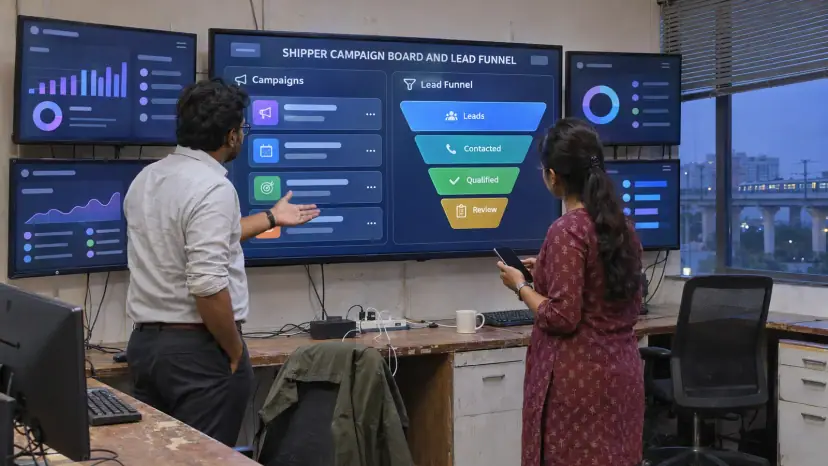
Delhi logistics: RFQs lane by lane, kept apart from the wider NCR and checked by operations
An enquiry mentioning “NCR” could mean three different administrations and very different lanes. If you run a Logistics and Supply Chain team serving Delhi, this guide shows how to capture lane-specific RFQs and have operations review serviceability. It tells you what to collect, the local source to use, what an assistant may do and at what point a person approves the next step. The workflows are planning examples. They are not client results we have reported. Your actual business, data and permissions decide the scope.
Delhi districts, localities and NCR locations
Delhi is one scope and the wider NCR is another. Noida and Gurugram come under different state administrations, so hold their addresses apart from Delhi’s. To find the office linked to the actual Delhi address, go to the Revenue Department’s district resources.
Your reference point is the Delhi Revenue Department. This source gives local administrative context, while market demand, commercial availability and any endorsement of a private carrier lie beyond it. Log the Delhi district and locality for this workflow, placing NCR locations on separate lines. Check the entry against your approved business record. Disagreements go to a reviewer first, and only then may a page or assistant give directions, coverage information or an appointment instruction.
A lane-level enquiry brief for Delhi
Keep to the following fields as your working brief, so that Delhi does not simply appear beside an unrelated national offer. Each statement has a source and a reviewer attached. Where you lack information, log the gap and give it to someone in the team, and do not let the model make an assumption about a lane.
- Actual pickup and delivery locations: Give the Delhi district and locality for pickup and delivery, with NCR locations listed separately, based on where the goods truly are.
- Cargo type, quantity and handling needs: Describe the goods, the quantity and the handling they require, including any limits you already know of.
- Requested lane/service mode: Write down the requested lane and mode of service, and leave any missing detail as a question for operations.
- Verified operating capability and constraints: Hold current, approved evidence of capability and constraints, since a depot photograph or a mention of Delhi settles nothing.
- RFQ versus shipment-status enquiry: Divide new quotation requests from status questions, and route anything unsupported or misplaced elsewhere.
- Operations/quotation reviewer: Identify the person in operations or quotations able to confirm the action before a next step is offered.
Any illustrative Delhi request must pass the location check, and the check on cargo type, quantity and handling needs, before a commercial or professional next step is suggested. What fails stays unresolved in the handoff. The receiving team therefore starts from a concrete question, and no lead is falsely qualified.
AI for field extraction, operations for lanes and capacity
Logistics marketing works when it names the real pickup and delivery locations, cargo and service requirements. Let AI extract RFQ fields and flag where handling information is absent. Lane and capacity decisions sit with operations. An indicative enquiry should not be confused with an accepted quote, a booking or a completed shipment. Nor is a city landing page proof of support for every route, hazardous cargo type or storage requirement.
Connect the sources and systems the business has authorised, and nothing more: an approved knowledge pack, the operational system in use and a CRM or intake route where necessary. Record the source version that informed each RFQ reply. Before using live customer data, test permissions for access and for revising content. Drafts, predictions and extracted fields are there for the reviewer, and they carry no automatic commercial commitment.
Here is a pallet enquiry, shown as a planning example. A shipper asks for a quote on pallets from a Delhi warehouse to a city in another state. The assistant captures the pickup locality, the delivery pin code, the cargo type, the weight and the date wanted, and flags that handling needs are missing. Operations checks the lane and the vehicle type, confirms or declines, and only then does a quote go out. The status in the record moves from enquiry to quote to booking, and each stage keeps its own owner.
Transit, customs and tracking rules before you publish
Do not invent transit times, customs approvals, temperature-control capability or carrier partnerships. Assumptions must be stated in any freight estimate, which also goes through the responsible quotation process. Use an authorised operational source for shipment tracking, because a status guessed from a marketing conversation can mislead a customer.
The Delhi Transport Department site covers vehicle registration and permits in Delhi, and lists commercial vehicles whose fitness has lapsed. Ask operations to keep a current record of the fitness and permit status of every vehicle used, including subcontracted ones, and never describe a vehicle as permitted or fit without that record. The site shows where the information sits. It does not confirm anything about your fleet.
Hindi and English, Delhi listings and the path to completion
For Hindi and English audiences, competent speakers should review the terminology, locality names and proposed next step. Assess both options with the business. We do not suggest that every customer uses them or that we supply every translation. Your actual address and one contact route need to stay consistent on the page and in business records. Making up offices or profiles to look present in Delhi is ruled out.
Audiences in Delhi may need a service performed in another part of the NCR, so separate where they are from where the job is fulfilled. Use your approved serviceable area in page content and enquiry routing alike. Keep separate counts for each stage: lane enquiry → cargo/serviceability review → quote → accepted booking → operational completion. Do not take rejected, cancelled or unsupported requests out of the evaluation, as clicks and chats are not revenue.
Test four situations: an unsupported lane, an incomplete cargo declaration, a temperature requirement and a status enquiry mistaken for a sales lead. Before more budget goes in, compare reviewed outcomes with your baseline. Look at search queries for mismatched intent, then correct the answer or handoff that needs it. Rankings, AI-answer inclusion, lead numbers and returns on investment cannot be guaranteed by us.
Other reading for Delhi teams
Logistics & Supply Chain solutions shows the industry scope. For implementation detail there is Demand Forecasting for Indian Distributors: Data Requirements and Pilot Evaluation. It describes a related workflow, which is different from evidence of a client engagement in Delhi.
Further Delhi tasks sit under Manufacturing and E-Commerce. Check Delhi and other city guides when comparing official references.
When you ask for a free consultation, bring your pickup and delivery locations, cargo type, quantity and handling needs, your approved source material and the reviewer who decides the next step. We work from our Noida office, which is outside Delhi, and no Delhi branch is claimed. Scope, integrations and any on-site work are agreed for your lanes.
The local and sector resources here were checked on 5 October 2026, so reread current instructions ahead of campaign changes. Images are illustrative only, and we have not verified them as local offices, customers or facilities.