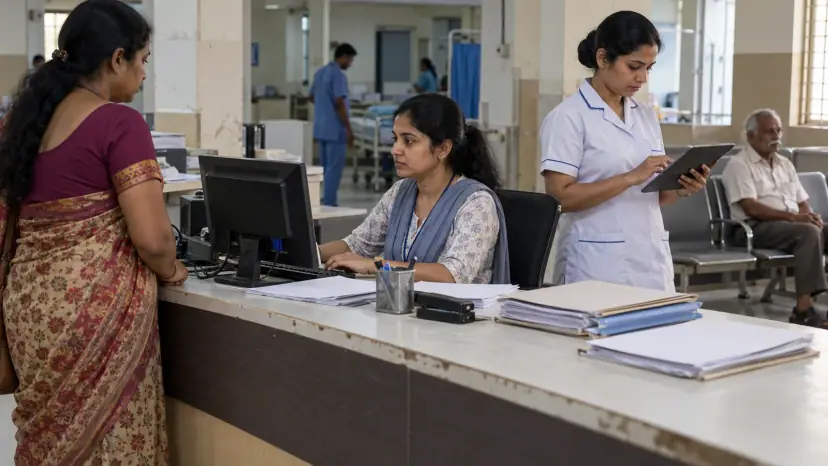
Healthcare solutions are the software and systems that hospitals, clinics, labs, pharmacies and health-tech companies use to register patients, keep records, run teleconsultations, bill and protect data. Brainguru designs and builds them, from patient portals and hospital management systems to AI, IoT and cloud tools, with privacy and India's digital health standards built in.
Why healthcare technology matters now in India
India's public digital health infrastructure has grown fast, and private providers increasingly need to connect to it.
Digital health records: A PIB note on the Ayushman Bharat Digital Mission dated 6 July 2026 reports over 104 crore health records linked to over 93 crore ABHA accounts. The same note says ABDM's Scan and Share service, which lets patients scan a QR code to join a hospital queue, had issued over 23.21 crore tokens as on 18 June 2026, and cites an IIHMR study that found it cut waiting time from about an hour to 2 to 5 minutes.
Telemedicine: According to a Health Ministry release of 6 October 2026, eSanjeevani, the national telemedicine service, crossed 50 crore teleconsultations, with 2,41,923 registered healthcare providers and about 2.5 to 3 lakh consultations a day in 15 languages.
For a private hospital or health-tech company, this means patients increasingly expect digital registration, online records and remote consultation, and your systems need to work with the national network rather than sit apart from it.
Our healthcare solutions
AI in healthcare
AI can help with the administrative load that takes up staff time: summarising documents, sorting incoming queries, drafting letters, predicting no-shows and flagging records that need review. Chat assistants can answer routine patient questions about timings, preparation and reports, and hand over to staff when needed. Clinical decisions stay with qualified clinicians; AI should support their judgement, not replace it. This work draws on our AI and ML solutions.
Electronic health records and data management
We build and customise electronic health record (EHR) systems that store patient records securely, give the right staff fast access and keep an audit trail of who viewed or changed what. Where a facility joins the ABDM network, records can be linked to a patient's ABHA and shared with the patient's consent.
Telemedicine and remote patient monitoring
Telemedicine platforms with secure video visits, appointment booking, e-prescriptions and follow-up reminders on web and mobile apps. Remote monitoring links readings from home devices to a dashboard, with alerts when values cross limits that clinicians set, so care teams can act early for patients with chronic conditions.
IoT and wearable technology
Connected devices such as blood pressure monitors, glucometers, pulse oximeters and wearables can send readings straight into a patient's record. The engineering work is mostly in reliable data collection, handling gaps and errors, and showing clinicians only the readings that matter.
Blockchain for health data
Blockchain can provide a tamper-evident log of who accessed or shared a record, which is useful for consent tracking and audit trails between organisations. It is not the right choice for storing medical records themselves, and many projects are better served by a conventional database with strong logging. We help you decide which fits.
Hospital and clinic software
Hospital management systems (HMS), clinic software, patient engagement platforms, medical billing and pharmacy inventory systems, built to match how your departments actually work. We can build new systems or extend and connect the ones you already use.
Cloud infrastructure for healthcare
Cloud hosting gives healthcare systems room to grow, reliable backups and access across sites. The design work is in choosing where data is stored, encrypting it, controlling access and planning for outages so care can continue. Our cybersecurity and cloud solutions cover this layer.
Patient experience
Online booking, automated reminders, digital check-in, patient portals with reports and bills, and virtual assistants that answer common questions. These reduce phone queues and front-desk crowding and give patients clearer information. For patient communication at scale, see our healthcare call center solutions.
Compliance and healthcare IT consulting
We help you meet the rules that apply to you: India's DPDP Act for patient data, ABDM's integration requirements, and HIPAA or GDPR when you serve patients in the US or Europe. We also advise on secure IT infrastructure and digital workflows. For patient outreach under the same rules, read our DPDP-aware guide to healthcare marketing.
Patient data protection
Health data is among the most sensitive personal data a business holds. Under the Digital Personal Data Protection Rules, 2025, the main duties of the DPDP Act come into force on 13 May 2027. Rule 6 sets minimum security safeguards, including encryption or masking, access control, logs and monitoring, backups and keeping logs for one year. Rule 7 requires a breach to be reported to the Data Protection Board without delay, with a detailed report within seventy-two hours.
ABDM sets its own bar. The PIB note says apps cannot simply connect to ABDM: every new app must first be tested in a sandbox and pass a security audit before going live, and records are shared within the network only when the patient consents.
In practice, every healthcare system we build should include:
- Encryption of data in storage and in transit
- Role-based access, so a receptionist does not see what a doctor sees
- Audit logs of every view and change, kept for the required period
- Consent records that show what each patient agreed to
- Tested backups and a plan for continued care during an outage
- A breach response plan that meets the reporting deadlines
How a healthcare technology project works
- Discovery: We spend time with the clinical, front-desk and billing staff who will use the system, and map the workflow as it really happens.
- Requirements and compliance scope: We agree features, integrations and the rules that apply, such as DPDP, ABDM and any overseas requirements.
- Design: Screens are designed for busy staff and for patients with different levels of digital comfort, then tested with real users.
- Build in stages: Working features are delivered in short cycles, so staff can try them early and changes are cheap.
- Testing: Functional, security and load testing, plus ABDM sandbox testing where the system connects to the national network.
- Launch and training: A planned go-live, often one department or site first, with staff training and support during the first weeks.
- Support: Monitoring, updates and new features as your needs change.
Who we build healthcare solutions for
- Hospitals and nursing homes: HMS, EHR, billing, bed management and patient portals.
- Clinics and specialty practices: Booking, records, teleconsultation and reminders.
- Diagnostic labs and imaging centres: Sample tracking, report delivery and record linking.
- Pharmacies: Inventory, prescriptions and order management.
- Pharmaceutical companies: Field force tools, supply chain tracking and data platforms.
- Health-tech startups: Products built from a first version to scale. See our AI stack for healthcare startups.
How to choose a healthcare technology partner
- Ask how they handle patient data in development and testing. Real patient data should not be used in test systems.
- Ask whether they have worked with ABDM's sandbox and integration process.
- Ask to see how audit logs and access roles work in a demo.
- Ask who owns the code and data, and how you would move to another provider.
- Ask how they involve clinical staff in design and testing.
What affects the cost of healthcare software?
We quote after a free consultation. The main drivers are the number of modules and user types, integrations with existing EHR, lab, device or billing systems, ABDM integration and audit, security and compliance requirements, AI or IoT features, the number of sites, data migration from old systems, and the level of support after launch.