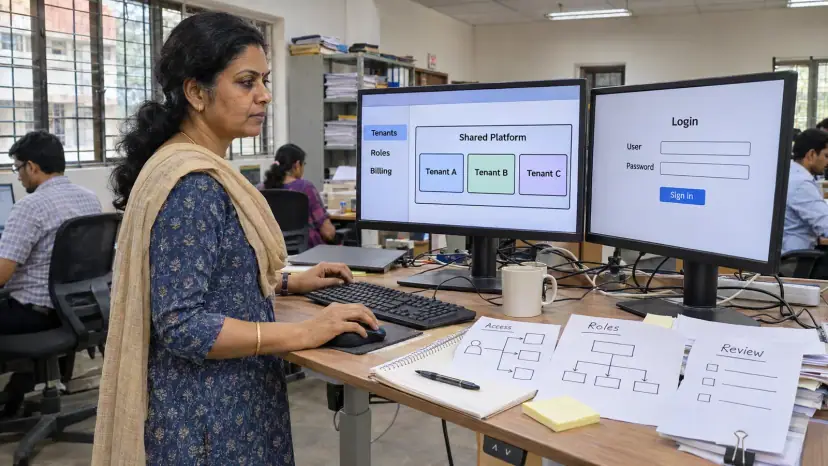
SaaS application development is building software that customers use through a browser or app and pay for by subscription. Brainguru designs and builds multi-tenant SaaS platforms for B2B and B2C companies: tenant separation, sign-up and roles, subscription billing, admin consoles, integrations and the cloud set-up that keeps the product secure as it grows.
Our SaaS application development focus
- Multi-tenant SaaS platforms: One product serving many customer organisations, each with its own users, data and settings.
- Cloud-native web applications: Applications built to run on managed cloud services, deployed automatically and scaled with demand.
- Enterprise SaaS products: Single sign-on, audit logs, granular permissions and data controls that larger buyers ask for.
- Subscription software: Plans, trials, upgrades, invoices and usage limits built into the product, not bolted on later.
- B2B and B2C applications: Team tools and business platforms as well as consumer subscription apps.
Architecture and tenancy
The first real decision in a SaaS build is how tenants are separated. A shared schema with a tenant identifier on every row is the most economical to run and the simplest to update, and it suits high-volume, lower-touch products. A database per tenant costs more to operate but gives cleaner isolation, simpler per-customer backup and restore, and an easier answer when an enterprise buyer asks where exactly their data lives.
| Model | Usually suits |
|---|---|
| Shared database, shared schema | Many smaller customers, self-service sign-up, frequent releases |
| Shared database, schema per tenant | Mid-sized customers who need some separation without separate infrastructure |
| Database per tenant | Enterprise or regulated customers, strict data location or backup needs |
Many products mix models: shared infrastructure for most customers and dedicated databases for a few large ones. The choice shapes cost, onboarding speed and your compliance story, so settle it before the first schema is written rather than after.
The underlying technology is usually less exotic than people expect. In the Stack Overflow 2025 Developer Survey, PostgreSQL was the most used database, at 55.6% of respondents, and Docker the most used tool in its category, at 71.1%. Proven, widely supported components make a SaaS product easier to hire for and to keep running.
What a SaaS platform needs
- Identity and access: Sign-up, roles and permissions, team invitations, and single sign-on where enterprise customers expect it.
- Subscription and billing: Plans, trials, upgrades and downgrades, proration, invoices, taxes, dunning and failed-payment recovery.
- Tenant administration: An internal console for support staff to inspect an account, adjust a plan and resolve issues without touching the database.
- Metering and limits: Usage tracking where pricing depends on seats, volume or consumption.
- Integrations and APIs: Webhooks and a documented API, since most buyers expect a product to fit the tools they already run. Our API development team builds these.
- Onboarding: Sample data, guided set-up and in-app help that get a new customer to their first useful result quickly.
- Observability: Logging, error tracking and per-tenant performance visibility, so problems are found before customers report them.
Security and compliance
Multi-tenant products carry a specific risk: a single missing tenant filter can expose one customer's data to another. That is a form of broken access control, which the OWASP Top 10:2025 ranks first, reporting that 100% of the applications tested had some form of it.
We treat tenant scoping as an architectural rule enforced in the data-access layer, not a rule each developer must remember, and back it with automated tests that try to read across tenants. Around it sit encryption in transit and at rest, audit logging, role-based access and regular dependency updates. The last point matters: the Verizon 2026 Data Breach Investigations Report found that 31% of breaches now start with software vulnerabilities.
Breaches are costly for a software business, because customers trust you with their own customers' data. IBM's Cost of a Data Breach Report 2025 put the average cost of a breach in India at INR 220 million. Where your market requires it, the design can follow the data protection and data location rules that apply to your customers, such as India's Digital Personal Data Protection Act, 2023 or the EU's GDPR. Your legal adviser should confirm which apply.
Cloud and running costs
A SaaS product's hosting bill grows with every customer, so architecture affects margins. The Flexera 2026 State of the Cloud Report estimated wasted spend on cloud infrastructure and platform services at 29%, the first rise after five years of decline. We size infrastructure to real usage, use autoscaling, set budgets and alerts, and track cost per tenant so you can see which plans pay for themselves. If you want the pipeline and hosting managed for you, see DevOps as a Service.
How we engage
- Discovery: We turn the idea into a defined scope, a data model, a tenancy decision and a release plan.
- MVP: Many teams then build an MVP covering the core workflow and the billing path. Our MVP development service covers this stage.
- Launch to real users: Early customers show what they actually use, where they get stuck and what they will pay for.
- Iterate in sprints: Working software at the end of each cycle, so priorities can shift as the market answers back.
- Scale and support: Performance work, new features, integrations and support, with automated tests guarding each release.
The architecture chosen at the start decides how cheaply that last stage runs. Automated testing is part of every stage, not a phase at the end.
Common mistakes in SaaS builds
- Billing left until last: Plans, trials and failed payments touch many screens and are hard to add late.
- No admin console: Support staff end up editing the database directly, which is slow and risky.
- Tenant rules in the interface only: Hiding data in the browser does not stop an API call from reaching it.
- Custom work for one customer: Special code paths for a single client multiply testing and slow every release. Use configuration or feature flags instead.
- No usage data: Without product analytics, roadmap decisions rest on guesses.
What shapes the budget?
We do not publish prices. These factors drive the estimate:
- Feature scope: The number of workflows, screens and business rules in the first release.
- Tenancy model: Dedicated databases or regions add infrastructure and operations work.
- Billing complexity: Flat plans are simpler than usage-based pricing, multiple currencies or tax rules.
- Integrations: Each CRM, accounting tool, payment provider or identity provider adds work.
- Security and compliance: Audit evidence, data location rules and enterprise security reviews.
- Design depth and support: Custom design, mobile apps and ongoing feature work after launch.
For a fuller look at budgeting, see our guide to SaaS application development cost.