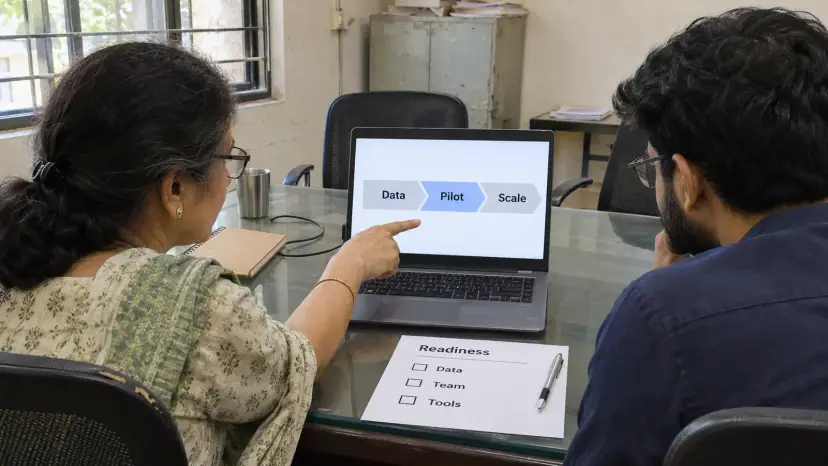
Brainguru's AI consulting services help businesses decide where artificial intelligence is worth using, what it needs in data, people and budget, and how to move from an idea to a working system. As an AI consulting company, we cover strategy, use cases, data readiness, proofs of concept, governance and, if you want it, delivery by our own teams.
What does an AI consultant actually do?
An AI consultant's job is to reduce the risk of spending money on the wrong thing. That means asking which business problems are worth solving, whether AI is the right tool for each one, whether your data can support it, and what it will take to run the result once it is built.
Good AI consulting is as willing to say "not yet" or "use a simpler tool" as it is to recommend a model. Many problems that look like AI problems are really data quality, process or software problems, and fixing those first is often cheaper and faster.
Why businesses use AI consulting services
Adoption has moved fast. The Stanford AI Index 2025 reported that 78% of organisations used AI in 2024, up from 55% the year before, and the 2026 edition puts organisational adoption at 88%. With most competitors experimenting, the question is less whether to use AI and more where it pays off.
- Skill gaps: Few companies have data scientists, ML engineers and AI product managers in-house.
- Risk: Projects without a clear problem, owner and success measure tend to stall after the pilot.
- Cost control: A roadmap separates quick wins from long projects, and stops money going into tools nobody uses.
- Governance: Privacy, security and fairness questions are easier to settle before a system is built than after.
Our AI consulting services
AI strategy and roadmap: We review your goals, processes and data, list candidate use cases, score them for value, feasibility and risk, and turn the shortlist into a phased roadmap with owners, milestones and measures.
Use case discovery workshops: Short sessions with business and technical teams to find where AI could help, and where it would not.
Data readiness assessment: A review of what data you hold, its quality, where it lives, who owns it and what is missing, with a plan to close the gaps through our data intelligence services where needed.
Build, buy or adapt: Advice on whether to use an off-the-shelf tool, adapt an existing model or build a custom one. Our comparison of off-the-shelf and custom AI development explains the trade-offs.
Proof of concept: A small, time-boxed build on your real data that tests whether the idea works before a larger commitment.
Governance and responsible AI: Policies for data use, model risk, human oversight and vendor selection, aligned with frameworks such as the NIST AI Risk Management Framework, released on 26 January 2023 and extended with a generative AI profile on 26 July 2024.
Implementation support: When you want delivery as well as advice, our teams build the solution through our AI and ML solutions and generative AI solutions work.
Areas we advise on
- Machine learning: Forecasting, pricing, fraud and anomaly detection, churn prediction and recommendation.
- Language AI: Chatbots, document processing, summarisation, translation and search, building on our NLP development work.
- Generative AI: Assistants, content tools and knowledge bots built on large language models.
- AI agents and automation: Software that carries out multi-step tasks in your systems, with human approval for important steps. See AI agent development.
- Computer vision: Inspection, document capture and image classification.
- Analytics and BI: Dashboards, segmentation and predictive reporting.
- Process automation: Invoice processing, onboarding and other repetitive workflows.
How our AI consulting services work
- Discovery: We learn your goals, constraints, systems and data through interviews and document review.
- Opportunity map: We list and score use cases, and agree a shortlist with you.
- Roadmap: We set out phases, costs to consider, risks, owners and measures of success.
- Proof of concept: We test the top use case on real data and report honestly on what worked.
- Delivery or handover: Our teams build the solution, or we hand the plan to your team or another supplier.
- Review: We check results against the measures agreed at the start and adjust the roadmap.
Whoever you work with, insist on measures of success agreed before any build starts, and on a written report from every proof of concept, including what did not work.
Risks an AI roadmap should cover
- Accuracy: Models make mistakes. Plan how errors will be caught and corrected, especially where customers or money are involved.
- Security: Generative AI brings new attacks. Prompt injection is ranked first as LLM01:2025 in the OWASP Top 10 for LLM Applications.
- Incidents: The 2026 AI Index counts 362 documented AI incidents, up from 233 in 2024. Clear ownership and monitoring reduce the chance of joining that list.
- Privacy: In India, the DPDP Rules notified in November 2025 set an 18-month phased timeline, with most duties applying from 13 May 2027. AI projects that use customer data should plan for them now.
- Running costs: Model usage, hosting and upkeep continue after launch. Costs per use have fallen sharply, with the AI Index 2025 reporting an over 280-fold drop in inference cost at GPT-3.5 level between November 2022 and October 2024, but volume can still make them significant.
- Adoption: A tool that staff do not trust or understand will not be used. Training and change management belong in the plan.
AI in India: support you can use
Indian businesses have public resources to draw on. According to a Ministry of Electronics and IT release of 25 March 2026, the IndiaAI Mission has an outlay of Rs. 10,372 crore, and more than 38 thousand GPUs have been onboarded through its AI compute portal for start-ups and academia at an affordable rate. A good roadmap considers whether such options fit your project.
Who we work with
- Startups: Validating an AI product idea before raising or spending heavily.
- Small and mid-sized businesses: Finding one or two practical uses that save time or win customers.
- Enterprises: Prioritising many ideas, setting governance and scaling what works.
- Sectors: Healthcare, finance, retail, e-commerce, manufacturing, education, real estate and logistics, among others.
We work with clients in India and abroad, from our office in Noida.
Questions to ask an AI consulting partner
- Independence: Will you recommend a simpler or cheaper option, or a tool you do not sell, when it fits better?
- Evidence: How will a proof of concept be judged, and will the report include what failed?
- Data: Who will see our data during the engagement, and where will it be stored?
- Handover: Will the roadmap be usable by our own team or another supplier?
- Running the result: Who will monitor, retrain and support the system after launch, and what will that cost?
We are happy to answer each of these in a free first conversation.
What affects the cost of AI consulting?
We quote each engagement after a free first conversation. The cost depends on the number of business areas in scope, how much data must be reviewed, whether a proof of concept is included, the governance work required, and whether you want ongoing advice or a one-off roadmap. A focused assessment of one process costs far less than a company-wide strategy.