In this article

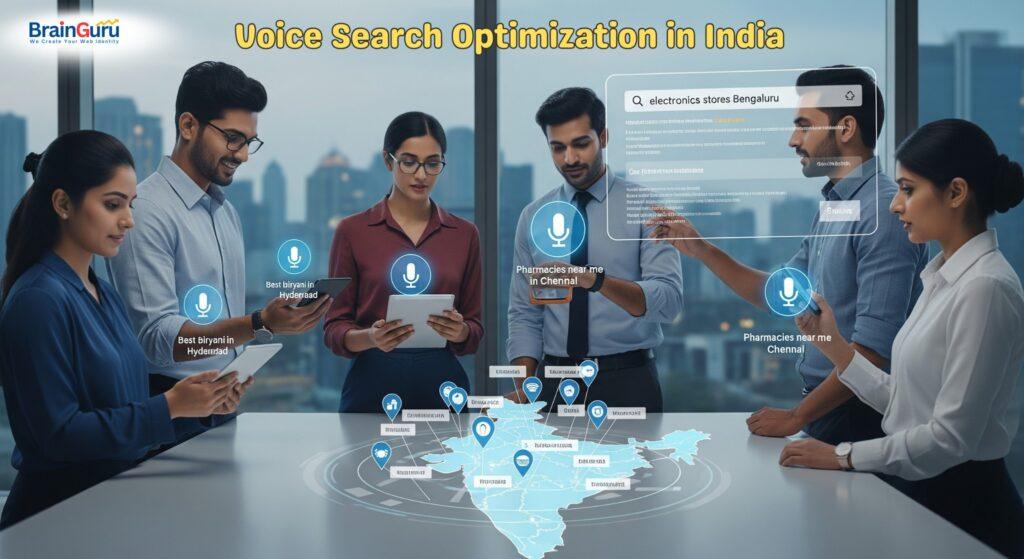
The digital marketing landscape in India is changing rapidly, and one of the most significant drivers of this transformation is voice search technology. With the increasing adoption of smartphones, smart speakers, and AI-powered virtual assistants like Google Assistant, Siri, and Alexa, Indian users are shifting from typing queries to speaking them.
For businesses looking to dominate local markets, Voice Search Optimization (VSO) is no longer just a trend; it’s quickly becoming a necessity. Particularly in India, where linguistic diversity and regional search behavior play an important role, voice-based search is reshaping how people discover local products and services.
In this blog, we will explore why voice search optimization is the next big thing for Local SEO in India, how businesses can adapt their strategies, and the steps needed to stay ahead in this fast-changing digital era.
The Rise of Voice Search in India
India is one of the fastest-growing digital economies in the world. The popularity of affordable smartphones, cheaper data plans, and increasing familiarity with voice assistants like Google Assistant and Alexa has given a massive boost to voice search adoption.
- Regional Language Support: According to Google, voice searches in India occur in more than 10 local languages, including Hindi, Tamil, Telugu, and Bengali. This gives businesses a chance to expand beyond English-speaking audiences.
- Mobile-first Users: Many users in Tier II and Tier III cities prefer voice-based commands over typing due to convenience and ease of use.
- Faster Search Interaction: Speaking is three times faster than typing, which makes voice search the preferred mode in quick, on-the-go situations, such as finding a nearby restaurant, salon, or service provider.
This trend presents enormous opportunities for businesses to connect with their local audiences and gain a competitive edge with optimized voice search strategies.
How Voice Search Differs from Text Search
To understand why businesses must adapt, it’s important to recognize the difference between typed and spoken searches.
- Conversational Queries: Unlike short, keyword-based typed searches (“best dentist Delhi”), voice queries are conversational and natural (“Who is the best dentist near me in Delhi?”).
- Question-driven Searches: Many voice searches are phrased as questions, starting with “what,” “where,” “how,” etc.
- Local Intent: Voice search users are often looking for immediate and nearby solutions. For instance, “Where is the nearest coffee shop open now?”
- Multilingual Nature: Typing in Indian languages is cumbersome, but speaking in Hindi or regional languages is effortless, making voice search dominant in vernacular content consumption.
Using these patterns, businesses can develop a stronger local SEO strategy tailored for voice queries.
Why Voice Search is the Future of Local SEO in India
Local SEO has always been about helping businesses get discovered through queries with geographical intent. Voice search takes this to the next level by enabling faster and smarter ways for people to find local businesses. Let’s look at some specific reasons:
Growing Customer Dependence
Indians are increasingly using voice commands to book cabs, order food, search for local services, and shop for products online. Businesses that ignore this growing channel risk losing significant traffic and customers to competitors who optimize for it.
Enhanced User Experience
Voice search delivers instant, hands-free, and on-the-go results. For local services like hospitals, salons, or grocery stores, providing quick answers is critical.
More Conversions
Voice searches can convert well because they are often intent-driven queries. For example, when someone asks, “Where can I buy organic vegetables near me?” they are highly likely to become a customer right away.
Competitive Edge for Local Businesses
Most Indian businesses, especially small and medium enterprises (SMEs), are still not optimized for voice. Early adopters of Voice SEO can dominate local search results before the competition catches up.
Key Strategies for Voice Search Optimization in India
Voice Search Optimization requires a different approach than traditional SEO. Businesses in India can implement the following vital strategies to stay ahead:
- Optimize for Conversational Keywords
Instead of targeting short keywords like “shoe store Delhi,” optimize for long-tail conversational phrases such as “Which is the best shoe store near Connaught Place in Delhi?”
Pro Tip: Create an FAQ section on your website. Answer questions your customers often ask in natural conversational tones.
- Prioritize Local SEO
Since most voice searches come with local intent, updating your Google Business Profile is critical. Ensure:
- Accurate NAP (Name, Address, Phone Number) details.
- Optimized business categories.
- Positive customer reviews (as they improve voice ranking probability).
- Focus on Featured Snippets
Voice search results often come from featured snippets or “position zero” on Google. Structure your content to provide direct, concise answers, increasing your chances of being picked by Google Assistant.
- Speed and Mobile Optimization
Voice queries largely happen on mobile. Websites must load quickly, be mobile-friendly, and provide an excellent user experience. Optimize images, reduce page load times, and use AMP where applicable.
- Multilingual Content
With millions of Indians using Hindi and regional languages for search, businesses should create multilingual content to capture this market segment. Hindi voice queries, for example, are growing rapidly and expanding opportunities across semi-urban regions.
- Structured Data (Schema Markup)
Schema markup helps search engines understand the context of your content. For local businesses, including structured data about business hours, locations, and services is crucial.
- Continuous Monitoring and Analytics
Track how your customers are discovering your services via voice. Tools like Google Search Console and Google Analytics (combined with local SEO insights) can help measure the effectiveness of your VSO strategy.
Examples of Voice Search in Action for Indian Businesses
To bring things into perspective, here are some hypothetical use cases of Indian businesses benefiting from voice optimization:
- Local Restaurant: Optimizes its website with natural language questions like “Where can I get the best butter chicken near Chandni Chowk?” and ranks high for voice searches on Google Assistant.
- Healthcare Clinic: Updates Google Business Profile with accurate working hours, so voice queries like “Is there a clinic open near me right now?” direct patients to their facility.
- E-commerce Store: Uses product descriptions and FAQs in easy conversational Hindi, tapping into a large new market segment beyond English users.
Challenges for Voice Search Optimization in India
While the opportunities are immense, businesses must also overcome certain hurdles:
- Language Barrier: India has over 22 officially recognized languages and hundreds of dialects, requiring adaptive strategies.
- Lack of Awareness: Many small businesses still don’t realize the importance of voice SEO.
- Technical Adaptation: Implementing schema, optimizing site speed, and building regional content requires expertise.
This is where professional SEO partners like Brainguru can provide tailored local SEO and voice search optimization services, helping businesses expand reach in competitive markets.
How Brainguru Can Help You with Voice SEO
At Brainguru, we understand the evolving dynamics of search in India. Our team of SEO experts can build customized voice search strategies for your business, making sure you are visible to potential customers when they ask their digital assistant for help.
Our services include:
- Conversational keyword research and content optimization.
- Google Business Profile management for higher local rankings.
- Multilingual content development for Hindi and regional markets.
- Structured data implementation for business details such as hours, location and services.
- Comprehensive SEO audits to ensure speed, mobile-friendliness, and user experience.
With Brainguru as your SEO partner, businesses can future-proof their digital reputation while capturing voice-driven opportunities in their local markets.
Conclusion
Voice Search Optimization is reshaping the way Indians interact with search engines, especially for local SEO. With conversational queries, multilingual adoption, and a higher conversion potential, voice search is indeed the next big thing for local businesses in India.
Forward-thinking enterprises that invest in voice optimization today will not only dominate local searches but also build stronger trust, customer engagement, and revenue streams tomorrow. The question is, are you ready to let customers find you with their voice?
Voice Search Trends in India
Voice search in India has moved from a novelty to a daily habit for many users. Reliable recent statistics are scarce and many figures shared online have no traceable source, so the trends below are directional rather than measured.
- Voice is a mainstream way to search in India, especially among mobile-first users.
- Regional languages matter: many voice queries are in Hindi, Hinglish or other Indian languages, not just English.
- Phones come first: smartphones, not smart speakers or cars, are the main voice-search device for most users.
- Local intent is common, with phrases like "near me," "open now," and "best around here".
- Smart speakers such as Amazon Echo and Google Nest are a smaller, mostly urban channel.
- Speed matters: speaking is faster than typing on a phone, which suits quick, on-the-go searches.
- Longer queries: spoken queries tend to be longer and more conversational than typed ones.
- Fewer clicks: a voice answer is often a single spoken result, so only the top answer gets heard.
- Ready to act: voice-triggered local searches often come from people ready to call, visit or buy.
Optimizing for Hindi & Regional Language Voice Search
English-only content misses the many Indians who search by voice in Hindi and regional languages. Optimizing for Hindi and regional voice queries can be a major growth lever for local Indian businesses in 2026.
Hindi and Hinglish Optimization
Most Indian voice users mix Hindi and English naturally. Queries like "Mere paas best pizza shop kaun sa hai?" or "Delhi mein affordable hotel batao" are increasingly common. To rank for these:
- Create Hindi-language FAQ sections with natural conversational phrasing
- Use transliterated (Hinglish) keywords in meta descriptions and H2 headings
- Publish dedicated Hindi landing pages for top services, not just translated English
- Add Hindi content in Google Business Profile posts
Regional Language Strategy
For businesses serving South India, Eastern India, or Western India, regional language voice optimization is essential. Tamil, Telugu, Kannada, Marathi, Bengali, and Malayalam voice searches are a growing opportunity.
- Use hreflang tags to signal language and regional targeting to Google
- Partner with native-language copywriters - machine translation alone produces unnatural voice matches
- Test voice responses in each target language using a real device
- Implement BCP-47 language codes in schema markup
Voice Search and Local SEO: Google Business Profile Optimization
Google Business Profile (GBP) is the foundation of local voice search visibility. When a user asks "Where is the nearest pharmacy?", Google Assistant pulls the answer directly from GBP listings. Here is how to optimize every element:
- Complete every field: Business name, category, hours, phone, website, services, attributes, products, and photos. Incomplete profiles rank lower.
- Primary category matters most: Choose the most specific category that describes your core business (e.g., "Italian Restaurant" beats "Restaurant").
- Voice-friendly business description: Write as if answering a question. Include location, services, and unique value.
- Regular Google Posts: Publish weekly updates, offers, and events. These show up in voice-adjacent contexts.
- Common questions: Answer frequent customer questions in full conversational sentences on your website.
- Reviews and response rate: Target 4.5+ star rating and respond to 100% of reviews. Voice results heavily favor well-reviewed businesses.
- Service area accuracy: Define service zones precisely so voice queries match location intent.
- Holiday hours: Update for festivals and public holidays. "Is this open now?" is a top voice query.
Voice Search Tools and Testing Methods
You cannot improve what you cannot measure. These tools help Indian marketers test and track voice search performance:
- AnswerThePublic: Discovers question-based keywords that match voice query patterns.
- Semrush Position Tracking: Monitors featured snippet rankings, which often power voice answers.
- Google Search Console: Check the Performance report for long-tail queries starting with who, what, where, how, when, and why.
- Schema Markup Validator (validator.schema.org): Validates your schema.org markup, such as LocalBusiness.
- Google's Rich Results Test: Shows which Google rich result types your structured data can produce.
- BrightLocal: Tracks local pack rankings and Google Business Profile health.
- Physical device testing: The most accurate test is asking Gemini (Google's replacement for Assistant on phones), Alexa, or Siri your target queries on a real smartphone and smart speaker.
Establish a monthly voice audit: test 20-30 target queries, record which businesses get cited, and reverse-engineer their schema and content structure.
Voice Search vs Traditional Search: How They Differ
Voice and typed searches tend to behave differently. The comparison below is directional, not measured benchmark data.
| Metric | Text Search | Voice Search |
| Query style | Short keywords | Longer, conversational questions |
| Local intent | Common | Very common ("near me", "open now") |
| Clicks to websites | Users scan and click results | Often none: one answer is read aloud |
| Call conversion rate | No reliable public benchmark | No reliable public benchmark |
| Time to action | Varies | Often immediate for local needs |
| Session length | Varies | Usually short |
| Purchase intent | Medium | High |
The takeaway: voice users often act on a single answer, so you get fewer touchpoints to impress them. That means your answer has to be the right one on the first try. For a complete local visibility strategy, explore our SEO services and Generative Engine Optimization (GEO) services.
Related Reading
Frequently Asked Questions
How important is voice search in India?
Voice search is widely used in India, driven by regional language usage and mobile-first habits, so it matters for local businesses.
How do I optimize my website for voice search in Hindi?
To optimize for Hindi voice search: create content in Hindi/Hinglish targeting conversational queries, add a Hindi FAQ section to your site, optimize Google Business Profile in Hindi, target long-tail conversational keywords, and ensure fast mobile loading.
Related Services
Related Articles
Why Your Website Traffic Doesn't Convert into Leads (and How to Fix It)
Why Your Website Traffic Doesn’t Convert Into Leads in India (And How to Fix It) You open your Google Analytics dashboard. Traffic is growing. Visitors are…
Read More
Top 5 SEO Mistakes Indian Businesses Still Make in 2025 - and How to Fix Them
The digital landscape in India is changing faster than ever. With growing internet penetration, rising competition across industries, and a huge shift toward…
Read More
SEO Strategies for Indian Businesses in 2026
SEO Strategies for Indian Businesses in 2026: Stay Ahead in Digital Marketing Digital marketing in India is evolving at a rapid pace. With over 850 million…
Read More
Comments
Be the first to share your thoughts on this article.