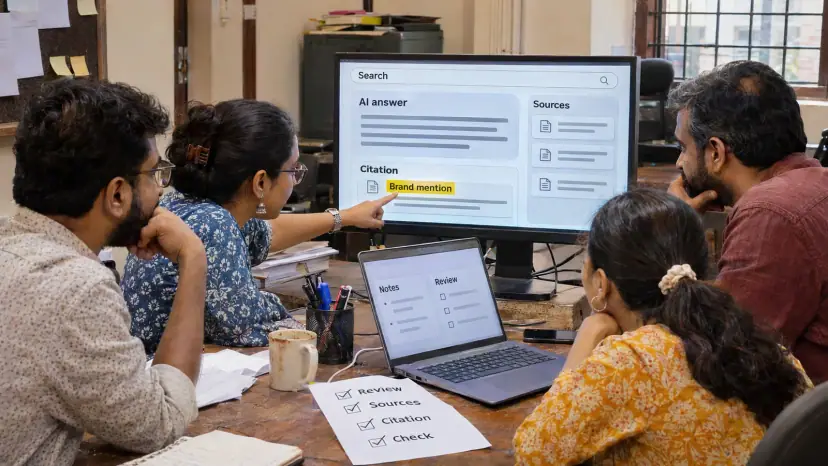
Generative engine optimization (GEO) is the work of making your business easy for AI answer tools to find, understand and cite, so it appears when buyers ask ChatGPT, Gemini, Perplexity or Google's AI Overviews for help. Brainguru offers GEO and LLM SEO services in India, built on sound SEO, clear content and honest measurement.
What is generative engine optimization?
Traditional SEO aims to rank pages in a list of search results. Generative engine optimization aims to have your brand mentioned, summarised accurately and linked inside AI-written answers. The term comes from a 2023 research paper by Princeton and other researchers, later accepted to KDD 2024, which tested content changes on a benchmark of queries and reported visibility gains of up to 40% in generative engine responses, with results that varied by domain.
Three related terms are often used together:
- GEO: Optimising content and brand signals for AI-generated answers across search engines and assistants.
- LLM SEO: Making your content easy for large language models such as ChatGPT, Gemini and Claude to understand, summarise and reference.
- LLM search listing: Working towards your brand being named when people ask AI tools for recommendations, comparisons or solutions in your category.
All three rest on the same base: pages that can be crawled, content that answers real questions, and consistent, accurate information about your business across the web.
Why AI answers matter for your business
AI answers now reach a very large audience. At Google I/O in May 2026, Sundar Pichai said AI Overviews had over 2.5 billion monthly active users, and that AI Mode had passed 1 billion monthly active users within a year. In India, TechCrunch reported in February 2026 that Sam Altman said ChatGPT had 100 million weekly active users in the country.
These answers change how people click. A Pew Research Center study of US browsing data from March 2025 found that users who saw an AI summary clicked a traditional result in 8% of visits, against 15% for users who did not see one, and clicked a link inside the summary in just 1% of visits.
For a business, that creates three risks:
- Fewer clicks: Buyers may get a summary and never visit your site, even when you rank well.
- Being left out: If AI tools do not mention you for questions in your category, competitors who are mentioned gain trust first.
- Being described wrongly: Outdated or inconsistent information about your services, locations or prices can be repeated in AI answers.
Our generative engine optimization services
We offer GEO, LLM SEO and LLM search listing work for businesses across industries. A typical engagement draws on these services:
- AI-friendly content: Clear, question-led pages that answer what buyers actually ask, written so a summary can quote them accurately.
- Structured data: Schema markup that matches what is visible on the page, so search engines such as Google can read your content in context.
- Conversational and voice queries: Content that covers longer, spoken-style questions, not only short keywords.
- LLM SEO: Work aimed at clearer representation of your brand in ChatGPT, Gemini, Claude, Perplexity and AI Overviews.
- LLM search listing strategy: Building the evidence that makes your business a reasonable recommendation in comparison and "best option" questions.
- Multimodal content: Text, video, images and infographics with transcripts, captions and descriptive alt text that AI systems can read.
- Brand authority: Accurate business listings, reviews, expert content clusters, citations from relevant sites and factual consistency everywhere your brand appears.
GEO builds on search fundamentals
Google's guidance on AI features for website owners says normal SEO best practices still apply to AI Overviews and AI Mode. There are no additional requirements, no special AI text files and no special schema needed to appear. Meeting the basics does not promise inclusion, but ignoring them makes it unlikely.
That is why GEO starts with technical health: indexable pages, sensible internal links, fast pages on mobile and content that is not hidden behind scripts. Our SEO guide for Indian businesses covers these basics. Other answer platforms work differently from Google, so an observation in one tool should never be presented as coverage everywhere. For the wider picture, see our guide on how businesses can prepare for AI-driven search results, and our detailed article on generative engine optimization services in India.
What a GEO engagement includes
For a business comparing GEO services, the useful questions are what will change on the website, who reviews the claims and how success will be measured. Scope is agreed against your current site and buyer questions. There is no purchased listing, and no provider can promise placement in an AI answer.
These are the deliverables to agree before work begins:
- A documented baseline of indexed pages, relevant buyer questions, search clicks and qualified enquiries.
- A prioritised list of crawl, internal-link and content issues, with the affected URLs and the reason for each change.
- Reviewed service explanations, comparison answers and supporting evidence that reflect what the business actually sells.
- Structured data that matches visible content, and a record of changes for the team maintaining the site.
- A reporting plan that separates search visibility, visits and business results.
How to measure GEO and judge a provider's report
Ask which buyer questions are being tested, which platform and date each observation belongs to, and whether the answer links to your site. A screenshot of a brand mention is an observation, not proof of increased sales.
Google's guidance also notes that traffic from AI features is included in the Performance report in Search Console, within the "Web" search type. So an ordinary search click must not be labelled an AI Overview click. Visits from assistants such as ChatGPT can be tracked separately in analytics; our walkthrough on tracking ChatGPT and AI assistant traffic in GA4 shows how.
- Use a fixed question set: Test the same buyer questions each month on the same platforms.
- Separate branded and unbranded demand: People searching your name are not new reach.
- Connect visits to results: Tie AI and search visits to your agreed enquiry or purchase event.
Who we work with
Our generative engine optimization, LLM SEO and LLM search listing services cover businesses in many sectors, including:
- Real estate
- Healthcare and digital health platforms
- Education and EdTech
- E-commerce and retail
- BFSI (banking, financial services and insurance)
- Startups and technology companies
We work with startups, small and mid-sized businesses and larger organisations, in India and abroad. Scope varies with the size of your site, the number of services and markets you cover, and how much content needs to change.
What drives the cost of GEO services?
We do not publish prices, because GEO work varies widely. These factors drive the estimate:
- Site size and health: A site with crawl problems needs technical work before content changes help.
- Number of services and markets: Each service, city or language adds buyer questions to cover and test.
- Content gaps: Rewriting or creating pages takes more effort than tuning existing ones.
- Evidence: Gathering reviews, case material and expert input your team can approve takes time.
- Reporting depth: Monthly tracking across several AI platforms costs more than a quarterly check.
Bring your priority services, approved evidence, current search data and the person who can review website changes to a free consultation. We can then discuss the scope for your site.
More Search and Social Services
- SEO Services: technical SEO, content, earned links, local search and reporting.
- Social Media Optimization (SMO): tuning your social profiles and content for reach and engagement.
- SEM Services: PPC advertising and Google Ads management for targeted traffic.
- Local SEO Services: local keywords, Google Business Profile, directory listings and location-specific content.
- Ecommerce SEO Services: keyword research and on-site optimization for online stores.
- Facebook Marketing Services: Facebook campaigns and content built around brand presence and engagement.
- YouTube Marketing Services: video creation, YouTube SEO and influencer outreach for brand channels.
- Online Reputation Management: monitoring online mentions and limiting damage from negative content.