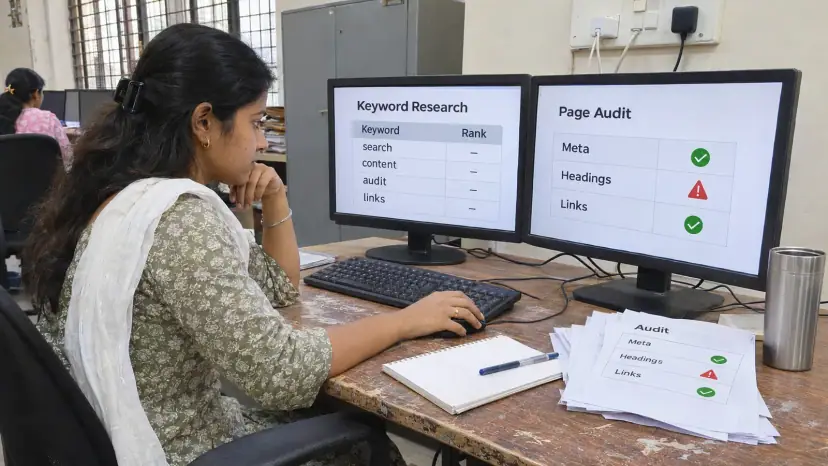
AI SEO automation uses software and machine learning to do the repetitive parts of search optimisation: grouping keywords, auditing content, monitoring technical health and tracking rankings. Brainguru sets this up for small and mid-sized businesses that cannot staff a large SEO team, while our specialists decide strategy, review changes and keep the work within Google's rules.
Why automate SEO now?
Manual SEO means exporting keyword lists, auditing pages one at a time and finding technical problems after rankings have already dropped. For a site with a few hundred pages, that work never finishes. Software can check every page every week, cluster thousands of queries in minutes and flag a broken template the day it ships.
Search itself is also changing. Google said in October 2024 that it was expanding AI Overviews to more than 100 countries, reaching more than 1 billion users every month. A Pew Research Center analysis published in July 2025 found that 18% of the Google searches it studied in March 2025 produced an AI summary, and that users clicked a traditional result in 8% of visits with a summary, against 15% without one. Fewer clicks per search make each page's quality and coverage matter more, and automation frees time for that.
What automation should not do is publish at scale without review. Google's spam policies name scaled content abuse, including using generative AI tools to generate many pages without adding value. Our setup keeps people in charge of what goes live.
Our AI SEO automation services
Keyword research and clustering
We pull queries from Search Console, keyword tools and competitor pages, then group them by meaning and intent rather than by exact wording. Each cluster maps to a page and a stage of the buying journey, informational, comparison or transactional. The output is a content plan that avoids two pages competing for the same search.
Content optimisation and audits
Language models compare your pages with what already ranks for the target query: topics covered, questions answered, entities named, readability and internal links. The result is a list of specific gaps for each page. An editor decides which suggestions to use, because a page that reads as written for a checklist helps nobody.
Technical SEO monitoring
Scheduled crawls catch broken links, redirect chains, duplicate pages, blocked resources, missing canonical tags and indexing problems, and alert your developers. We also track Core Web Vitals. Google's Core Web Vitals documentation recommends a Largest Contentful Paint within 2.5 seconds, an Interaction to Next Paint below 200 milliseconds and a Cumulative Layout Shift below 0.1. Structured data is generated only where it matches visible content and a supported Google feature, such as product or organisation markup.
Rank tracking and SERP analysis
Daily position tracking on Google and Bing, linked to your own site changes and known Google updates, so a drop can be traced to a cause. The SERP module records which features appear for each query, such as local packs, videos, People Also Ask or AI Overviews, so content can be shaped for what searchers actually see.
Link opportunities and digital PR
Automation finds unlinked brand mentions, broken links pointing to pages you could replace, and sites that already cover your topic. People then decide whether there is a real reason to get in touch. We do not buy links or mass-mail outreach templates; the same spam policies list link spam, meaning links created mainly to manipulate rankings.
Visibility in AI search features
Many businesses ask about generative engine optimisation. Google's guidance on AI features says there are no additional requirements to appear in AI Overviews or AI Mode, and that a page must be indexed and eligible to show a snippet to appear as a supporting link. So the work is ordinary good SEO: crawlable pages, clear answers and content people trust. We also offer dedicated GEO services in India.
Local SEO automation
For businesses with one or many locations, we monitor Google Business Profile listings, check name, address and phone consistency across directories, track reviews and follow rankings for location searches. Location pages are written only where each one has something specific to say. See our local SEO services.
Ecommerce SEO automation
Large catalogues need SEO by rule, not by hand. We generate titles and descriptions from product attributes for review, find category pages that compete with each other, manage faceted navigation so filters do not create endless crawlable URLs, and handle out-of-stock products sensibly. See our ecommerce SEO services.
AI SEO automation vs traditional SEO
| Task | Traditional SEO | With automation |
|---|---|---|
| Keyword research | Manual exports and spreadsheets | Queries clustered by intent, reviewed by a strategist |
| Content audits | Page-by-page checklists | Every page compared with what ranks, gaps listed for an editor |
| Technical audits | Occasional crawls | Scheduled crawls with alerts |
| Rank tracking | Weekly or monthly reports | Daily tracking linked to site changes |
| Scale | Limited by team hours | Thousands of pages and queries |
| Reporting | Static PDF reports | Live dashboards with notes on what changed |
Automation does not make Google rank pages faster. It shortens the time between spotting a problem and fixing it, and it lets the same team cover more pages. For a fuller comparison, read manual SEO vs AI SEO automation.
What to automate first
Start where errors are common and checks are mechanical:
- Technical monitoring: Crawls and alerts pay off quickly, because one broken template can affect hundreds of pages.
- Page speed on mobile: The HTTP Archive Web Almanac 2024 found that 43% of websites had good Core Web Vitals on mobile, against 54% on desktop. Regular measurement shows where your own templates stand.
- Metadata at scale: Titles and descriptions for large catalogues, generated from structured data and checked by a person.
- Reporting: Weekly reports assembled automatically, so the team reads them instead of building them.
Leave the judgement calls to people: what the business should be known for, which topics deserve a page, and whether a piece of content is accurate. If your site structure itself needs work, SEO-friendly web design is the place to start.
Common mistakes with AI and SEO
- Publishing unedited AI text: Thin, repetitive pages can fall under scaled content abuse and drag down the whole site.
- Chasing tool scores: A content score from a third-party tool is not a Google metric. Use it as a prompt, not a target.
- Markup that does not match the page: Structured data should describe what visitors can see. It does not earn a place in AI Overviews by itself.
- Ignoring Search Console: Google's own data on queries, clicks and indexing is the best starting point and is free.
Before buying software, compare the options in our guide to AI SEO tools.
How our process works
1. Audit: We review technical health, content, keywords, links and competitors using Search Console, crawls and ranking data, and produce a ranked action plan.
2. Strategy and setup: Our strategists define goals, whether local, national or ecommerce growth, then configure tracking, crawl schedules, content audit workflows and reports.
3. Execution: Fixes and content changes are made in batches, each reviewed before release. The account team oversees every automated process.
4. Reporting and review: Live dashboards show rankings, organic traffic, technical health and conversions. Monthly reviews agree the next priorities.
Explore more SEO and AI marketing services
- SEO Services: Search engine optimisation for businesses across India.
- Generative Engine Optimization (GEO): Visibility in AI-powered search features.
- Local SEO Services: Local search results and map packs for your locations.
- E-commerce SEO Services: Product and category pages that earn organic traffic.
- AI Marketing Solutions: The full range of our AI marketing services.