In this article
- Key takeaways
- 1. You Are Attracting the Wrong Audience
- 2. Your Landing Pages Confuse Visitors
- 3. Your Call to Action Is Weak
- 4. You Are Not Building Enough Trust
- 5. Your Website Is Too Slow
- 6. You Are Tracking Vanity Metrics Instead of Leads
- 7. Your Content Does Not Match the Buyer Journey
- How to Find Your Biggest Leak First
- Website Traffic Is Only the First Step
- Conclusion
- Frequently Asked Questions
Website traffic that keeps growing while enquiries stay flat is one of the most common problems Indian business owners bring to a marketing review. The visitors are real, but something between the first click and the contact form stops them. This guide covers seven common reasons, how to check each one and what to fix first.
Picture a showroom in a busy market. People walk in, look around and leave without buying. Footfall is not the problem; the shop is. A website works the same way. Before you spend more on SEO or ads to bring in extra visitors, find out why the ones you already have do not enquire.
1. You Are Attracting the Wrong Audience
Many businesses chase high-volume keywords because the traffic graph looks impressive. A post that ranks for "digital marketing tips" may bring thousands of readers, but very few of them want to hire an agency.
The issue is search intent, not search volume. Compare two searches:
- "What is SEO?" is usually typed by students and beginners.
- "SEO services company in Delhi" is usually typed by a business owner ready to hire.
Both bring visitors. Only one brings buyers. If your content mostly attracts students, researchers and casual readers, traffic will rise while conversions stay where they are.
How to check: in Search Console, open the Performance report, sort queries by clicks and mark each one as learning, comparing or buying.
If most clicks come from learning queries, your traffic and your lead goal do not match. Build pages around buyer-intent searches instead, such as "website development company in India", "B2B lead generation services" or "SEO services for small businesses". Write about the problems decision-makers actually search for, like "how to increase enquiries from my website" or "why is my website not generating leads". Our step-by-step SEO strategy for startups explains how to choose these keywords.

2. Your Landing Pages Confuse Visitors
Trust and clarity matter before anyone shares a phone number. When someone clicks an ad or a search result, they expect to see at once what you offer and what to do next. If the page creates doubt, they leave.
These are the most common mistakes:
- Long blocks of text with no structure
- No clear next step
- Stock images that look fake
- Long forms that ask for everything upfront
- Services described in jargon instead of plain words
To fix them, keep one goal per page, use plain English, state the benefits clearly and shorten the form. Name, email and phone are enough at first. Add real client testimonials where clients have agreed to be named.
Write the headline around the visitor's result. Instead of "Our Advanced AI-Based CRM Solution", try "Get More Sales Enquiries with CRM Automation". It is simple, clear and about the outcome. Our guide to landing pages that convert more visitors goes deeper on layout and copy.
3. Your Call to Action Is Weak
A button that says Submit, Click Here or Learn More gives visitors no reason to act. Tell them what happens next instead:
- Get a Website Audit
- Book a Strategy Call
- Get a Quote
- Talk to an Expert
Place the main call to action where it can be seen without scrolling, repeat it naturally further down the page and give the button a colour that stands out. Add urgency only when it is genuine, such as a real event date. A clearer call to action is one of the cheapest changes you can test.
4. You Are Not Building Enough Trust
Buyers rarely decide quickly, especially in B2B. Before filling in a form, visitors quietly check a few things:
- Is this company real?
- Who runs it?
- Does it have real clients?
- Is there a phone number and an address?
- Has the site been updated recently?
If the website feels anonymous, conversions drop. Answer those questions on the page with real team photos, Google reviews, case studies with real figures (shared with the client's permission), an office address, clear contact details, a blog that is kept up to date and any certifications you actually hold.
Visitors judge the business by the site. If it looks outdated, they assume the service is outdated too.
5. Your Website Is Too Slow
Many Indian visitors browse on phones over mobile data. A heavy page that takes too long to show its main content loses people before they read a word, and a slow site also hurts the user experience that search engines try to reward.
Google's Core Web Vitals give a clear target. In guidance last updated in October 2024, Google's web.dev team says Largest Contentful Paint should occur within 2.5 seconds, Interaction to Next Paint should be 200 milliseconds or less, and Cumulative Layout Shift 0.1 or less, measured at the 75th percentile of page loads on mobile and desktop.
The usual causes are heavy images, cheap or overloaded hosting, too many plugins, no caching and too many third-party scripts. The fixes follow from them: compress and resize images, move to better hosting, turn on caching, remove scripts you do not need and design for mobile first. Our guide to Core Web Vitals for Indian websites covers what to fix first.
6. You Are Tracking Vanity Metrics Instead of Leads
"We got 20,000 visitors this month" sounds good. The real question is how many enquiries came with them.
Stop judging success by: total page views, impressions and social media likes.
Start tracking: form submissions, demo requests, WhatsApp clicks, phone calls and the conversion rate of each landing page.
In Google Analytics 4, the actions that matter now have their own name. Google's help page says events that measure actions important to the success of your business are now called key events, while "conversion" refers to actions used to measure ad campaigns. Mark form submissions, calls and WhatsApp clicks as key events, so your reports show leads and not just visits.
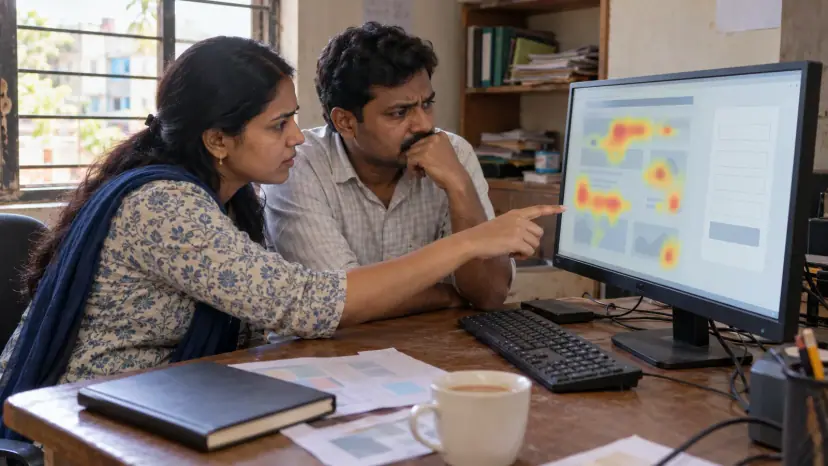
Many Indian buyers would rather start a conversation on WhatsApp than fill in a form, so make that option easy to find and easy to track. Our post on WhatsApp click-to-chat links for business explains how to create and measure them. Heatmaps and session recordings then show where people stop scrolling or give up on a form.
7. Your Content Does Not Match the Buyer Journey
Not every visitor is ready to buy. Some are researching, some are comparing and some are ready to decide. Showing "Book a Demo" to someone reading "What is SEO?" rarely works.
Match what you publish, and what you ask for, to the reader's stage:
- Awareness: educational posts, guides and industry insights. Ask for a checklist download or a newsletter sign-up.
- Consideration: case studies, comparisons and webinars. Ask for a consultation.
- Decision: a pricing page, testimonials and an ROI calculator. Ask the visitor to talk to your sales team.
Nurture before you sell. Many buyers prefer to build a relationship before they commit, and people who learn from you first are more likely to call you later.
How to Find Your Biggest Leak First
You do not need to fix all seven problems at once. Work through them roughly in this order, because each step makes the next one easier to measure:
- Set up lead tracking first, so you can measure every later change.
- Check which queries and campaigns bring visitors, and cut spend on the ones that never convert.
- Pick your three busiest landing pages and rewrite the headline, the call to action and the form.
- Test page speed on a mid-range phone over mobile data.
- Add trust signals: address, phone number, team photos and real reviews.
- Fill content gaps for the comparison and decision stages.
Change one thing at a time where you can, and compare enquiries for a few weeks before and after. That way you know which change worked and which did not.
Website Traffic Is Only the First Step
SEO and ads can bring visitors. Turning them into leads takes clear pages, strong calls to action, visible trust, fast loading and proper tracking. When a site is not producing enquiries, the problem is rarely the amount of traffic. It is usually what happens after the click.
It helps to treat traffic and conversion as two separate jobs with clear owners. Someone is responsible for bringing the right visitors, and someone for making sure the pages turn them into conversations. When both jobs report on the same number, leads, they stop pulling in different directions.
Conclusion
If your website traffic is rising but enquiries are not, look at search intent, landing pages, calls to action, trust, speed, tracking and content stage. Track leads as key events, fix the biggest leak first and measure each change. More visitors only help once the site is ready to turn them into real conversations.
Frequently Asked Questions
Why is my website getting traffic but no leads?
Usually the problem is conversion, not traffic. Common causes are visitors with the wrong search intent, confusing landing pages, weak calls to action, too few trust signals, slow pages, tracking page views instead of enquiries, and content that asks for a sale before the reader is ready to buy.
Which keywords bring visitors who actually enquire?
Buyer-intent keywords bring enquiries. A search such as "What is SEO?" mostly draws students and beginners, while "SEO services company in Delhi" draws a business owner ready to hire. Check your Search Console queries and build pages around the searches people make when they are choosing a provider.
How many fields should my enquiry form have?
Ask only for what you need to start a conversation. For most service businesses, name, email and phone are enough at first. Long forms that ask for budget, company size and detailed requirements upfront put people off. Collect those details later, on the first call or in a follow-up email.
How fast should my website load?
Google's Core Web Vitals guidance says the main content should appear within 2.5 seconds, measured as Largest Contentful Paint at the 75th percentile of page loads. Compress images, use better hosting, turn on caching and remove scripts you do not need, then test on a mid-range phone.
What should I track instead of page views?
Track form submissions, demo requests, WhatsApp clicks, phone calls and the conversion rate of each landing page, and mark these as key events in Google Analytics 4. Page views, impressions and social media likes show attention, but they do not tell you how many real enquiries the website produced.
Read next

SEO Rank Tracking APIs in 2026: Options, Costs and Google's Rules
Search Console's free API, paid SERP APIs and Google's rules on automated queries: what each costs and when to use which.
Read article
Programmatic SEO in India: Lessons From Reviewing Our City Guides
What a review of industry-by-city pages taught us: technical health is not usefulness, and each page needs a reason to exist.
Read article
SEO Services Pricing in India (2026): What You Are Actually Paying For
Cheap proposals usually omit original content and real link building. Ask for named deliverables and quantities.
Read article
Comments
Be the first to share your thoughts on this article.