In this article
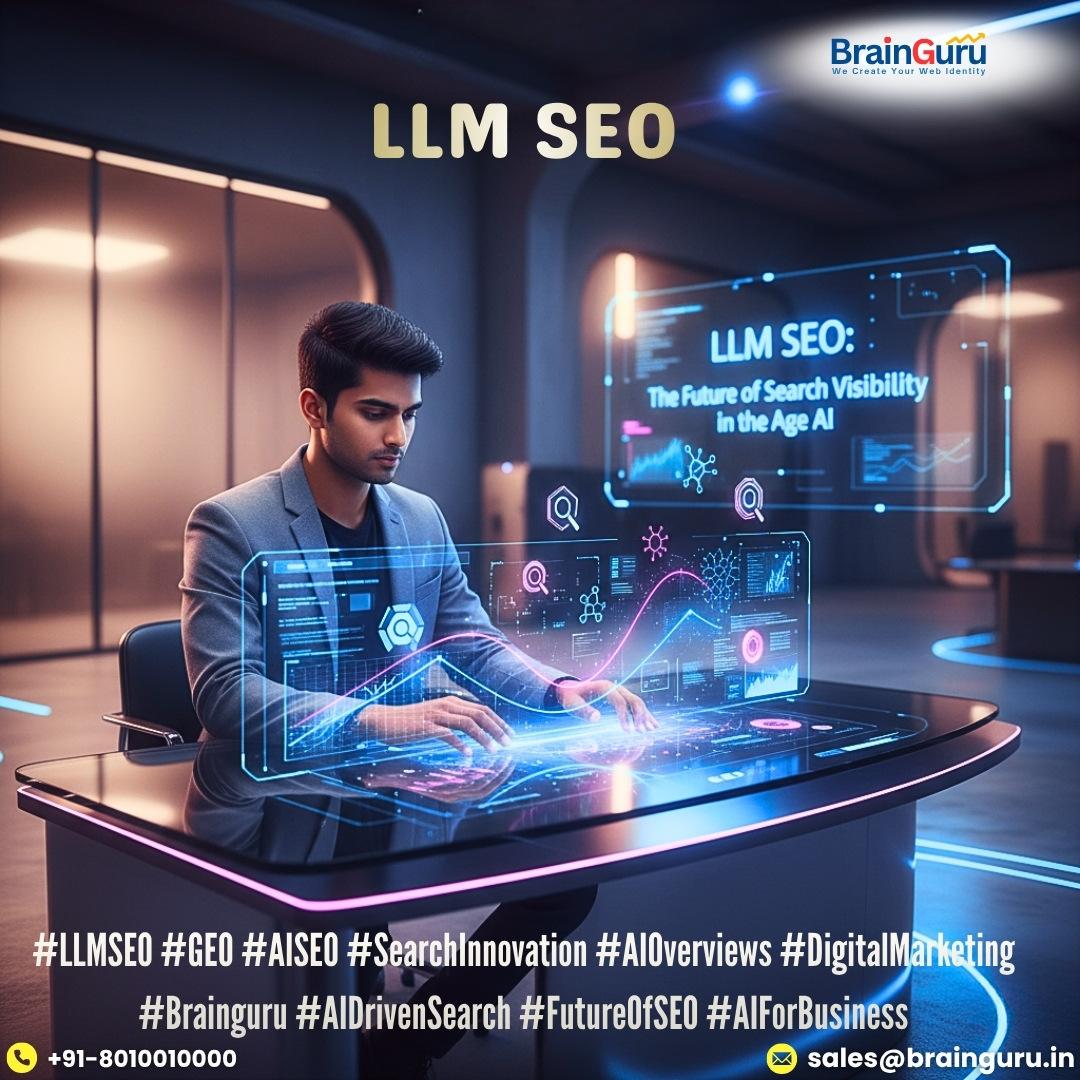

LLM SEO: The Future of Search Visibility in the Age of AI (A Complete Guide by Brainguru)
Search is transforming faster today than at any point in digital history. Until recently, SEO success meant ranking on Google’s first page, building backlinks, and optimising keywords to attract organic traffic. But today, users increasingly rely on AI-powered search tools like ChatGPT, Google’s AI Overviews (SGE), Bing Copilot, Perplexity, and countless other generative systems.
This shift introduces a new frontier: LLM SEO, the practice of optimizing content so that Large Language Models (LLMs) can easily understand, summarise, and cite your content in their responses. For brands, this means the goal is no longer “rank on page one” but “get included in the AI’s answer.”
At Brainguru, we’ve already embraced this shift through our advanced Generative Engine Optimization (GEO) services, a next-generation framework built to make brands visible across AI-driven discovery platforms.
This guide takes you through everything you need to know about LLM SEO, how it powers LLM search listings, and how GEO prepares businesses for the future of AI-driven search.
What is LLM SEO?
LLM SEO (Large Language Model Search Engine Optimization) is the method of structuring content so AI systems like ChatGPT, Gemini, Claude, and other LLM-based search assistants can:
- Understand your information clearly
- Summarise it accurately
- Extract meaning without confusion
- Cite your page or brand in their responses
- Refer users to your website as a trusted source
In simple terms:
LLM SEO helps your content show up inside AI-generated results, not just traditional Google search results.
This is especially important because AI tools rely less on keyword matching and more on meaning, trustworthiness, structured data, and semantic clarity.
Why LLM SEO Matters for Modern Businesses
AI-powered search is rapidly overtaking traditional search behaviour.
Consider the following shifts:
✔ Users prefer answers, not links
People ask AI tools questions directly, and expect immediate answers. They rarely scroll.
✔ AI tools retrieve information differently
LLMs do not scan only the keywords. They look for clarity, structure, authority, and trustworthy patterns.
✔ AI may cite your website - or ignore it
If your content is well-structured and authoritative, an AI answer can mention or link your brand.
If not, your content becomes invisible, even if it ranks well traditionally.
✔ “LLM Search Listing” is the new digital visibility
Just as businesses once competed for SERP rankings, they will now compete for AI answer inclusion.
This is where LLM SEO becomes a game changer.
LLM SEO vs Traditional SEO: What’s the Difference?
Factor | Traditional SEO | LLM SEO |
Goal | Rank on search pages | Be included in AI-generated answers |
Primary Audience | Google/Bing crawler bots | Large Language Models (ChatGPT, Gemini etc.) |
Method | Keywords, backlinks, on-page optimization | Clarity, structure, semantic depth, trust |
Output | Click-through traffic | Citations, summaries, AI answer visibility |
Ranking Logic | Algorithm-driven | Meaning-driven + context understanding |
Content Style | SEO-oriented | Conversational, structured, deeply informative |
Traditional SEO is still important.
But LLM SEO is the new layer that determines visibility inside AI ecosystems.
Introducing GEO: The Evolution Beyond SEO and LLM SEO
Brainguru’s Generative Engine Optimization (GEO) is the strategic framework built for AI-first search.
Where LLM SEO focuses on content structure for LLMs, GEO focuses on full-spectrum AI discoverability, covering:
- AI-driven answer panels
- Conversational search interfaces
- AI-assisted summaries
- Zero-click information retrieval
- Multimodal search (text + voice + video)
- Brand mentions within AI tools
GEO = LLM SEO + AI Visibility Strategy + Perception Optimization
This makes it ideal for businesses in India and globally who want to stay ahead of the AI-first digital transformation.
How AI Tools Select Content: The New Ranking System
To appear in an LLM search listing or AI-powered response, models evaluate content based on:
- Clarity of Information
Short, precise paragraphs, clean definitions, and clear language help AI extract meaning.
- Structured Formatting
Models read content like humans do, with emphasis on:
- Headings (H1, H2, H3)
- Bullet points
- Step-by-step lists
- FAQs
- Tables
- Summaries
- Semantic Depth
LLMs pull in content that:
- Explains concepts thoroughly
- Answers questions contextually
- Connects related topics
- Provides value beyond surface keywords
- Trust Signals (E-E-A-T)
AI systems use trust-weighting to prioritise content that feels:
- Authoritative
- Expert-written
- Cited properly
- Verified
- Updated recently
- Structured Data & Schema Markup
Schema markup helps AI tools identify:
- Key terms
- How-to steps
- FAQs
- Definitions
- Company details
- Services
- Reviews
This can support both LLM SEO and GEO, though Google says structured data isn't required for its AI features.
Key Strategies to Optimize for LLM SEO
Below are the most effective methods to ensure your brand is visible to AI-powered search engines.
- Write Clear, Conversational, Human-Centric Content
AI models favour content that mirrors how users ask questions.
Examples:
- “What is LLM search listing?”
- “How can businesses appear in AI search results?”
- “What is GEO and why is it important?”
Your content should answer questions the way a human consultant would.
- Structure Content Like a Knowledge Base
Use:
- Clean headings
- Bullet lists
- FAQ sections
- Definitions
- Stepwise instructions
- Summary blocks
These structures help AI models extract answers.
- Add an FAQ Section with Natural-Language Questions
FAQs are extremely important for LLM SEO.
Examples to include:
- What is LLM SEO?
- How does LLM search listing work?
- What is GEO?
- How do I improve my website visibility in AI tools?
- Why is structured content important for LLMs?
These questions directly match user queries in AI chat tools.
- Improve Topical Depth & Semantic Coverage
Cover topics holistically with supporting subtopics such as:
- LLM behaviour
- AI search evolution
- Generative engines
- Semantic indexing
- Zero-click behaviour
- E-E-A-T in the LLM era
The more comprehensive your content, the more an AI model recognises you as a source.
- Implement Schema Markup Everywhere
Schema can help:
✔ Google Search
✔ Other search engines
✔ LLM crawlers
✔ Generative models
Use markup for:
- Organization details
- Services
- Articles
- Breadcrumbs
- Products
- Local business details
Google says no special schema is needed to appear in AI Overviews or AI Mode, so treat markup as groundwork for LLM search listing visibility, not a shortcut.
- Build Authoritative Sources & Brand Trust
AI models prioritise content from:
- Credible brands
- Expert-backed articles
- Consistently published resources
- Verified authors
Add:
- Author names + credentials
- Links to social accounts
- Company details & reviews
- Case studies
This reinforces your GEO and LLM SEO authority.
- Make Content Multimodal-Friendly
AI systems now analyse:
- Text
- Videos
- Images
- Infographics
- Audio
Adding these elements boosts your visibility across multimodal AI tools.
How GEO Elevates Your LLM SEO Strategy
At Brainguru, we design GEO strategies that integrate LLM SEO with broader AI visibility tactics such as:
✔ Optimising for AI answer boxes
✔ Ensuring content is cite-ready
✔ Building “AI-snippet” structured blocks
✔ Preparing content for conversational indexing
✔ Improving E-E-A-T for generative engines
✔ Crafting expertise-driven content clusters
✔ Creating AI-friendly service pages
✔ Monitoring AI model outputs for brand mentions
This ensures your brand is visible not only in Google, but across:
- ChatGPT responses
- Google AI Overviews
- Bing Copilot
- Perplexity AI
- You.com
- Other generative platforms
GEO transforms your digital presence from “findable” to AI-discoverable.
LLM Search Listing: Your New Digital Real Estate
Just like Google’s SERP was prime real estate for the last decade, the new battleground is AI answer inclusion.
An LLM search listing typically includes:
- A direct quote or summary from your website
- A citation with link to your page
- A contextual mention (“According to Brainguru…”)
- Embedded insights derived from your content
This is the new SEO: being part of the AI conversation.
Brands that ignore this shift will lose visibility dramatically in the coming years.
Benefits of LLM SEO & GEO for Businesses
✔ Higher visibility in AI-generated answers
✔ Increased brand trust & authority
✔ More citation-based traffic
✔ Dominance in emerging AI search ecosystems
✔ Long-term sustainability as traditional SEO shifts
✔ Improved user experience & clarity
✔ Better alignment with Google’s future ranking standards
For Indian SMEs, startups, and enterprise brands, early adoption provides a massive competitive advantage.
Who Needs LLM SEO and GEO?
- Digital-first businesses
- D2C brands
- Consultants & agencies
- SaaS and IT companies
- E-commerce brands
- Healthcare platforms
- Real estate & finance businesses
- Education & coaching brands
- Enterprises seeking global visibility
If your customers use AI tools, you need GEO.
How Brainguru Helps You Win in the LLM SEO Era
Our GEO and LLM SEO solutions include:
🔹 AI-readiness audits
🔹 LLM-compatible content creation
🔹 Conversational FAQ development
🔹 Schema implementation
🔹 Topic clustering
🔹 Entity building for brand authority
🔹 Multimodal content integration
🔹 Monitoring citations in AI tools
🔹 Continuous optimization for AI Overviews
🔹 Reputation & trust-building for E-E-A-T
We help brands move beyond traditional SEO, into the world of AI-first discovery.
Conclusion: The Future of Search is AI, And the Future of SEO is LLM SEO + GEO
AI has changed how people search, consume information, and make decisions. Ranking on Google alone is no longer enough. Your content must be:
- Understandable
- Trustworthy
- Structured
- Semantic-rich
- AI-friendly
- Citation-ready
This is the essence of LLM SEO, and the foundation of Brainguru’s GEO services.
How LLMs Choose What to Cite: Understanding the Algorithms
Large Language Models do not rank content the way Google does. Instead, they use a combination of training data weighting, retrieval-augmented generation (RAG), and trust scoring to decide which sources to surface. Understanding these three mechanisms is essential for any brand serious about LLM visibility.
Training Data Influence
Models like GPT-4, Gemini, and Claude are trained on massive text corpora that include web crawls, books, academic papers, and licensed datasets. Brands mentioned frequently in high-authority sources during training become part of the model's "world knowledge." This is why established publishers, Wikipedia entities, and frequently cited brands dominate baseline LLM responses.
Retrieval-Augmented Generation (RAG)
When an LLM needs fresh or specific information, it queries a live search index (Bing, Google, or a proprietary crawler). The system retrieves the top results, reads them, and synthesizes an answer. Your content must be crawlable, structured, and answer-oriented to be selected at this stage.
Citation and Trust Signals
AI tools do not publish exactly how they weigh sources. Signals practitioners commonly point to include author credentials, entity recognition, consistency across mentions and references from reputable sites; Google says its AI features rely on its core Search ranking systems. Consistent messaging across sources also makes your brand easier to describe accurately.
LLM SEO Checklist: 15 Things to Optimize
Use this practical checklist to audit your content for LLM discoverability. Complete all 15 items to maximize your chances of being cited by ChatGPT, Gemini, Perplexity, and Google AI Overviews.
- 1. Add a clear, concise definition of your core topic within the first 100 words.
- 2. Structure content with H2 and H3 headings that match question-based queries.
- 3. Include an FAQ section with 5-10 natural-language questions.
- 4. Implement Article and Organization schema markup where it matches your content.
- 5. Add author bylines with verifiable credentials and LinkedIn profiles.
- 6. Cite primary sources and link to authoritative references.
- 7. Use tables and comparison lists for structured data extraction.
- 8. Include statistics, numbers, and concrete examples rather than vague claims.
- 9. Keep paragraphs short (2-4 sentences) for easy extraction.
- 10. Add a TL;DR or summary block at the top of long articles.
- 11. Optimize for zero-click intent - answer the question fully on the page.
- 12. Maintain E-E-A-T signals through expertise, experience, authority, and trust.
- 13. Publish on a fast, mobile-friendly, crawlable site (no JavaScript-only content).
- 14. Build a consistent entity presence across Wikipedia, Wikidata, and knowledge graphs.
- 15. Monitor brand mentions in LLM outputs and iterate based on gaps.
Industries Most Affected by LLM SEO
E-commerce
Shoppers increasingly ask ChatGPT and Perplexity "What is the best running shoe under Rs 8,000?" instead of browsing Amazon. Product review sites, comparison pages, and D2C brand content must be LLM-optimized to appear in these conversational shopping queries.
Finance and BFSI
Personal finance queries - insurance comparisons, mutual fund selection, credit card rewards - are migrating rapidly to AI assistants. Indian fintech brands must establish authoritative content, transparent methodology, and regulatory compliance signals. Trust is the currency of financial LLM SEO.
Healthcare
Patients use AI chatbots to research symptoms, treatments, and doctors. Healthcare brands face unique challenges: LLMs apply stricter trust filters (YMYL - Your Money Your Life) and heavily favor content from verified medical authors, hospitals, and peer-reviewed sources. Medical publishers must implement author schema and credential verification.
Technology and SaaS
B2B SaaS is the vertical most disrupted by LLM SEO. Buyers research tools through ChatGPT before ever visiting a vendor website. Companies with strong documentation, comparison content, customer case studies, and developer communities dominate. Those relying on gated PDFs and thin landing pages get left out entirely.
Tools to Monitor Your LLM Visibility
You cannot improve LLM visibility without measuring it. A new category of tools has emerged specifically to track brand mentions, citations, and sentiment across AI platforms. Here are the most useful ones for Indian marketers in 2026:
- Profound: Tracks brand visibility across ChatGPT, Perplexity, Gemini, and Copilot. Offers share-of-voice analytics and competitive benchmarking.
- Otterly.ai: Monitors how AI search engines mention your brand and competitors. Provides prompt-level tracking and citation reports.
- AthenaHQ: AI visibility analytics platform with mention tracking and sentiment analysis.
- Peec AI: Focused on LLM SEO performance measurement and content optimization recommendations.
- HubSpot AI Search Grader: Free tool that scores your brand's presence in AI responses for target queries.
- Bluefish AI: Enterprise-grade AI visibility monitoring with alerting for brand reputation shifts.
- Manual prompt testing: Weekly spot checks where you ask target questions across ChatGPT, Gemini, Perplexity, and Claude, then document which brands get cited.
Pricing for these tools ranges from free tiers to Rs 15,000-1,00,000/month for enterprise plans. For most Indian SMEs, starting with Otterly.ai or HubSpot's free grader is sufficient to establish a baseline.
Illustrative Scenario: How a B2B Company Could Get Featured in ChatGPT Responses
The scenario below is hypothetical: a composite example, not a real client, and all figures are illustrative. Imagine a Noida-based B2B SaaS company selling workflow automation tools that is invisible in LLM responses despite ranking on page one of Google for several commercial keywords. Over six months, the team executes a focused LLM SEO program and becomes one of the most cited Indian vendors in ChatGPT responses for its category.
Starting Position (Month 0)
Zero mentions across ChatGPT, Gemini, and Perplexity when queried for category keywords. Organic traffic was healthy at 45,000 monthly visitors, but none came from AI referrers. Brand queries on Google were flat.
Actions Taken
- Rewrote 40 pillar pages with conversational structure, FAQ blocks, and clear definitions
- Added FAQPage, Organization, and SoftwareApplication schema across the site
- Published 12 comparison articles (Tool A vs Tool B vs Tool C) with structured tables
- Earned 8 high-authority backlinks from industry publications through expert commentary
- Created a Wikipedia entity for the founder and cross-referenced Wikidata
- Published 15 customer case studies with specific metrics and named clients
- Set up Otterly.ai to track brand mentions across 200 target prompts weekly
Illustrative Results (Month 6)
- Brand cited in 34% of ChatGPT responses for category queries (up from 0%)
- Brand cited in 41% of Perplexity responses
- Brand cited in 22% of Google AI Overviews
- AI-referred traffic reached 8,200 monthly visits with 6.4% conversion rate (vs 2.1% from Google search)
- Pipeline value attributed to AI channels crossed Rs 1.2 crore in the second quarter post-launch
The point of this illustration: LLM visibility can be earned with disciplined execution. Brands that act early will own the AI answer layer, just as early SEO adopters owned Google's first page a decade ago. Learn more about our approach through Generative Engine Optimization (GEO) services and enterprise SEO services.
Frequently Asked Questions
What is LLM SEO?
LLM SEO refers to optimizing your content to be referenced and recommended by Large Language Models like GPT-4, Gemini, and Claude. This involves creating authoritative, well-structured content that LLMs can cite when answering user queries.
How do I get my brand mentioned by ChatGPT and other AI tools?
To increase AI brand mentions: publish authoritative data-rich content, get featured on high-authority websites, maintain active Wikipedia and knowledge panel presence, use structured data extensively, and create FAQ content that directly answers common questions.
Related Services
- Generative Engine Optimization (GEO) Services India
- LLM Development Services AI-Powered NLP Solutions
- AI SEO Automation | AI-Powered SEO Services India
- Best AI SEO Tools 2026 | Top 10 AI-Powered SEO Tools Reviewed
- Manual SEO vs AI SEO Automation | Which Is Better in 2026?
- Expert SEO Services Rank Higher & Grow Online
Related Articles
How Businesses Can Prepare for AI-Driven Search Results
Search is evolving at a pace that businesses can no longer afford to ignore. With the rise of AI-driven search engines like Google’s AI Overviews…
Read More
Discovered - Currently Not Indexed: What It Means and How to Fix It
Google has found your page but not crawled it. What the status really means, a real example from our own new pages, and what to do (and not do) to get indexed.
Read More
How to Track ChatGPT and AI Assistant Traffic in GA4 (2026)
Where visits from ChatGPT, Perplexity, Gemini and Copilot appear in Google Analytics 4, why the numbers undercount, and how to connect AI referrals to real enquiries.
Read More
Comments
Be the first to share your thoughts on this article.