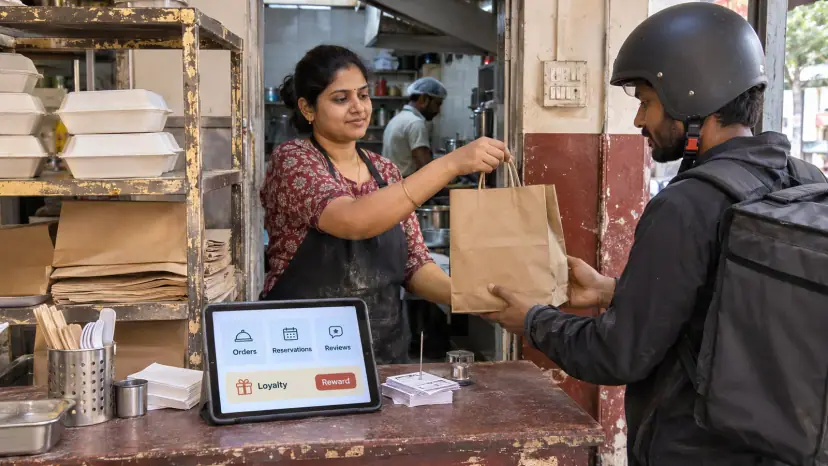
AI marketing for restaurants helps cafes, restaurants, cloud kitchens and food brands get found by nearby diners, keep menus and listings accurate, answer reviews well and win more direct orders. Brainguru plans this work around the outlet's real menu, hours and delivery area, because no campaign can fix a listing that sends people to a closed kitchen.
How diners choose where to eat
Most people now decide where to eat on a phone. They search for a dish or a cuisine nearby, look at photos, check ratings, read a few recent reviews and then either book, walk in or order for delivery. Each of those steps is a chance to win or lose the customer.
The market is big and getting more organised. The National Restaurant Association of India's India Food Services Report 2024, as reported by Mediabrief, valued the sector at Rs. 5.69 lakh crore, contributing 1.9% of India's GDP, and expected the organised share to grow from 43.8% to 52.9% by 2028. More branded chains and cloud kitchens mean more competition for the same local searches.
Reviews carry a lot of weight. In BrightLocal's Local Consumer Review Survey 2026, 89% of consumers said they expect business owners to respond to reviews, 81% expected a response within a week, and templated or generic replies made 50% unlikely to choose a business. Copy-paste replies, whether written by a person or an AI tool, can cost customers.
What AI marketing for restaurants covers
Local search: An accurate Google Business Profile for every outlet, with correct hours, menu, photos and ordering links, plus consistent details on maps and directories. AI helps spot listings with outdated hours or missing information, and tracks how each outlet appears for searches such as a dish plus a neighbourhood. This connects to our local SEO services.
Review monitoring and replies: Reviews from Google, Zomato, Swiggy and other platforms gathered in one place, sorted by theme, with draft replies for a manager to approve and personalise. Recurring complaints about wait times or a particular dish go to the kitchen or floor team, not just into a reply.
Menu marketing: Sales data shows which dishes draw people in and which earn the most. Campaigns and social posts can then feature the right dishes, and delivery menus can be written with clear descriptions and good photos. Pricing decisions stay with the owner.
Direct ordering on WhatsApp and the website: A chat or web ordering flow lets regular customers order without an aggregator, with the menu, sold-out items and delivery area kept current. Our AI chatbot development work covers how such assistants are built and handed over to staff when needed.
Social media content: Food is visual, and short videos and photos do well. AI helps plan posts, draft captions and pick times, while the team supplies real photos of real dishes. More on this is in our guide to AI for social media marketing.
Delivery platform listings: Clear menus, photos and descriptions on each aggregator, consistent across outlets, with ratings and cancellation rates watched closely.
Repeat customers: Messages about new dishes, seasonal menus or bookings, sent only to people who agreed to receive them. A simple loyalty programme can sit alongside, and our AI for customer retention page explains how to measure whether it works.
Honest reviews and honest ads
Food advertising is checked like any other. In its 2024-25 complaints report, the Advertising Standards Council of India counted food and beverage among the most violative sectors, at 4.69% of cases. Keep claims about ingredients, health benefits and prices accurate, and label paid influencer posts as ads.
Review requests should be neutral. Ask every guest, not just the happy ones, never write or buy reviews, and never reward only positive feedback. A review profile that looks managed is easy for diners to spot.
Customer data and consent
Ordering and booking data includes names, phone numbers, addresses and order history. India's Digital Personal Data Protection Act, 2023 applies to this data, and its main duties start on 13 May 2027 under rules notified in the Gazette of 13 November 2025. Keep promotional messages for people who agreed to them, make opting out easy, and keep order confirmations separate from offers.
A workflow for an outlet or a chain
This is a planning outline for owners, outlet managers and whoever runs marketing. It is not a case study and promises no results.
- Outlet discovery: Keep location, hours and the approved menu accurate everywhere. Staff should review service complaints rather than posting automatic defensive replies.
- Direct ordering: Connect campaigns to a working ordering path and the real delivery area. Check sold-out items, payment failures and cancelled orders before spending more on promotion.
- Repeat visits: Use permitted messages to share menu or booking information, and keep review requests neutral.
- Measurement: Track fulfilled orders, attended reservations and contribution after delivery and promotional costs, kept separate by outlet where delivery areas differ.
For a first conversation, have ready the approved menu, your current ordering or booking process, a description of the sales and customer data you hold, and the person who will review content.
What affects the cost?
Each engagement is quoted after a free consultation. Cost depends on the number of outlets and brands, the platforms involved, how much photo and video content is needed, whether a WhatsApp or web ordering flow must connect to your POS, and how many languages your customers use.
Questions to ask a restaurant marketing provider
- Reviews: Who approves replies, and how do you avoid generic templates?
- Orders: Will you report fulfilled orders and margin, or only clicks and followers?
- Data: Who owns the customer list and the ordering data?
- Content: Will photos show our real dishes?
Local Restaurants and Food Planning Guides
Choose a city for official local references, enquiry information and a reviewed workflow. Each guide covers restaurants and diners we serve from Noida, and none of them implies a branch office in that city.