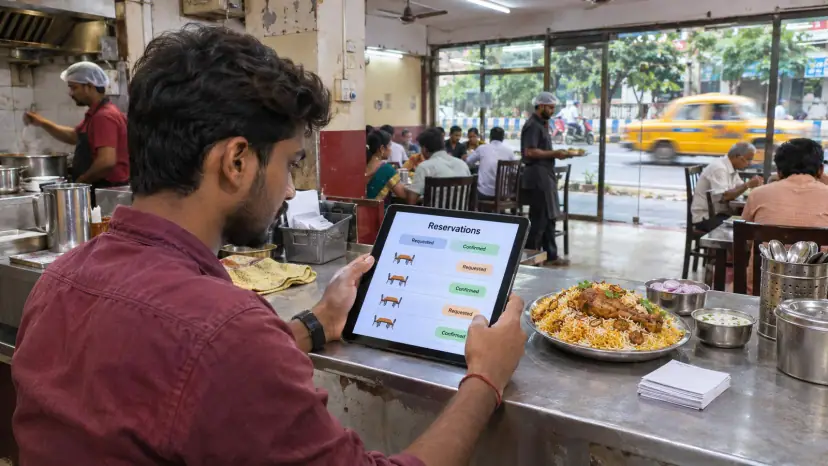
The right menu for the right Kolkata outlet, and orders only marked confirmed when they are
When a diner asks whether a dish is on tonight or a table is free, only that outlet knows the answer. This guide helps restaurant and food teams serving Kolkata keep menu information outlet-specific and record the true state of every order. It lays out what to capture, which local source to consult, what an assistant may do and when a person approves the next step. Nothing here reports a Brainguru client result, since these are planning examples. Scope depends on your actual kitchens, data and permissions.
Each outlet needs its own locality and district
Kolkata administrative contacts can be found starting from the Kolkata district portal. Hold the locality diners see and the documented district in separate fields, particularly because a metropolitan audience can cross municipal boundaries. Choose the source that fits the outlet’s actual premises.
The portal is Kolkata district. Administrative context is all it offers. It is no evidence of demand or commercial availability, and it does not endorse any restaurant. For each outlet, record the Kolkata premises and the actual district, and check them against the approved business record. Whenever they conflict, a reviewer settles it before the page or assistant gives directions, delivery coverage or a booking instruction.
Your outlet-by-outlet brief for Kolkata
A city name next to an unrelated national offer will not fill a table, so build your brief from these fields. Statements keep their source and reviewer attached. If you do not know something, record that and pass it on to a person, because no model should guess at what is in a dish.
- Actual outlet address: Enter the premises and actual district for this outlet alone, so no diner is sent to the wrong branch of the kitchen.
- Approved current menu and item availability: Use the menu approved for this outlet today, and do not borrow items from another location.
- Dietary/allergen information owner: Name who answers for allergens and dietary claims, and treat every unanswered question as one for review.
- Delivery PIN code and service limits: Keep the verified delivery area current, as an address outside it cannot be promised.
- Reservation/order enquiry: Mark whether the guest wants a table or wants to order, and move other requests elsewhere.
- Outlet or kitchen reviewer: Say which person at the outlet or in the kitchen confirms the answer before a next step is offered.
Follow one illustrative Kolkata request. It first faces a location check, then a check on the approved current menu and item availability, and a commercial next step is suggested only after both. Where a check fails, the handoff shows the open point, leaving the outlet with a clear question and no falsely qualified lead.
A request is not a booking until the outlet says so
Begin with the exact restaurant or kitchen outlet and a current approved menu. Retrieving opening information, organising a table request and spotting an order question are all fair jobs for AI, yet live availability and delivery reach must be confirmed by the outlet. A reservation request differs from a confirmed table, and an order enquiry differs from an order that is paid, accepted and fulfilled. Hours or a menu from one outlet should never be applied to every location.
Only the sources and systems authorised by the business are connected, for example an approved knowledge pack, the operational system in use and a CRM or intake route if needed. Note which menu version informed each answer. Staff logins, and who may change a menu entry, need testing before live customer data comes in. Any draft, prediction or extracted field helps the reviewer only, and commits the restaurant to nothing automatically.
Allergens, licences and what a picture cannot tell you
Where applicable, food operators ought to verify registration and licensing information through the official FoSCoS resources. Allergen safety, dietary suitability and hygiene certification must not be inferred from an image or an automated answer. A question that needs the kitchen’s confirmation has to be passed to the responsible staff member.
The FSSAI FoSCoS portal is an independent reference for the sector. Check what it says now, and let the responsible professional decide how it applies to the proposed activity.
Bengali and English, listings and honest order counts
Where guests need Bengali and English, competent speakers should review terminology, locality names and the proposed next step. Assess these with the business, as they do not mean every customer uses them or that Brainguru provides every translation. On the page and in business records, show the real address and one consistent contact route. Additional offices or profiles designed to simulate a local presence should not be created.
A customer’s location in Kolkata may differ from the outlet fulfilling the order, so hold them apart. Follow the approved serviceable area in page content and enquiry routing. Track four stages independently: menu enquiry, availability and serviceability check, accepted booking or order, then fulfilled or cancelled. Rejected, cancelled and unsupported requests stay in your evaluation, since a click or chat is no substitute for revenue.
Try out a sold-out item, a stated allergy, a closed outlet and an address beyond the verified delivery area. See how reviewed outcomes compare with the restaurant’s own baseline before raising spend. If search queries reveal mismatched intent, improve the answer or handoff involved. We offer no guarantee of a ranking, AI-answer inclusion, lead volume or return on investment.
A worked example, from an evening order to a confirmed one
This is a planning example, not a result. A customer messages one evening, asks whether a biryani is available at one outlet and adds that their child has a nut allergy. The assistant checks the outlet's approved menu and the availability source. It does not answer the allergy question. It says the kitchen must confirm and sends the message to the allergen owner.
Meanwhile it records the order as a request. The kitchen manager sees the dish, the PIN code and the allergy note, checks the delivery area, and replies. If the kitchen cannot give a safe answer, it says so and the customer decides. Only when the manager marks the order as accepted does the customer see "confirmed". If your licence or registration number has to appear on a menu or listing, ask your licensing reviewer where, and keep the number in the approved pack so every page shows the same one.
More to read, and what to have ready
The industry scope is at Restaurants & Food solutions, and implementation detail is at Ecommerce Development in India (2026): Platform Choice, Cost and What Breaks. It deals with a related workflow, and you should not read it as evidence of a Kolkata client engagement.
In Kolkata we also have planning material for E-Commerce and Travel & Hospitality. Visit Kolkata and other city guides to compare the supported information and official references.
At a free consultation, it helps to have the outlet address, the approved current menu and item availability, approved source material and the reviewer who can decide the next step. Delivery of our work runs from our Noida office, and we claim no branch in Kolkata. Scope, integrations and any on-site work are talked over for each case.
These resources were checked on 5 October 2026, and you should recheck instructions before a campaign change. Food and venue photographs are illustrative and are not verified images of local offices, customers or facilities.