Noida restaurants: begin with the outlet people actually reach
Anyone looking for dinner in Noida needs the right outlet, the right hours and a working way to order. Knowing the sector is not enough if the map pin leads to another branch or the menu lists dishes you cannot serve. This guide covers outlet discovery and completed orders for restaurants and food businesses in Noida. It treats marketing as separate from kitchen forecasting, and it makes no promise that AI can control delivery-platform rankings.
Keep your address and business evidence in step
The Gautam Buddha Nagar district website is an official local reference. Rely on your documented address and current directions, and do not treat Noida and Greater Noida as the same destination for customers. The sector, building entrance and outlet name should match on your website, in booking confirmations and in the instructions customers receive.
The official system for food-business licensing and registration is FSSAI's FoSCoS portal. Operators should confirm their own record and permissions before saying anything about a licence. A marketing provider cannot certify food safety from a directory entry. This page is not licence advice, and it does not suggest any link with the district administration or FSSAI.
Decide where the licence or registration number lives. Check the display requirements on FoSCoS before you put it on a menu, a listing or an invoice, keep it in one approved place and copy it from there. A number typed from memory into five places is how a wrong digit ends up on a delivery listing. If the licence is renewed or the category changes, update every place on the same day, and have the assistant refer to the licence only in the approved wording.
Write a brief for the menu and the service area
Note the outlet, current opening hours, booking route, ordering channels and the person who updates the menu. Use approved dish photographs, and make clear when an image is an illustration and not the real product. Ingredient and allergen answers must come from a source the kitchen has approved. If the assistant is unsure, it should hand over to staff and not guess from the name of a dish.
Operations should set the delivery area and decide how it changes with capacity. If you do not deliver to every Noida sector, do not advertise that you do. Tell customers how to confirm availability, cancellation conditions and the current total before an order is accepted. An AI-generated offer is not authorised just because it sounds believable.
Give each fact an owner. The restaurant manager owns opening hours and the booking route, the head of the kitchen owns item availability and every allergen answer, and the owner owns the delivery area and offers. What breaks without owners is small and constant. A dish sells out but stays on the website, the delivery app shows a different price from the menu, or a festival closure is not posted. Choose one place where the day's changes are entered, and have the website, the assistant and the apps all read from it.
Send each conversation to the right commercial event
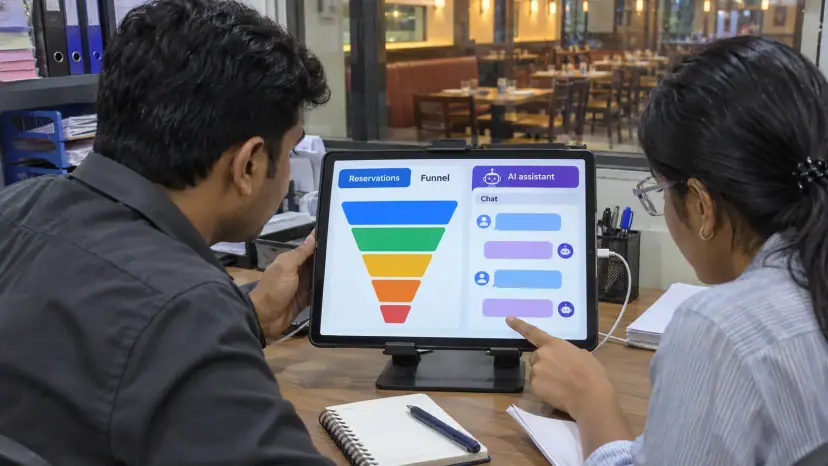
As an illustration, a customer asks whether a table is free at a certain time. The assistant checks only the approved booking route, or asks staff to confirm. It does not turn the question into a confirmed reservation without the required acknowledgement. Orders work the same way, with enquiry, payment, accepted order and completed fulfilment kept as separate states.
Contact preferences should separate replies about a current booking from optional promotions. Staff should approve draft responses to reviews, especially on food safety, refunds or service complaints. When a customer leaves a negative review, investigate it first and do not send an automatic defensive reply.
In the first weeks, read the conversations that ended with staff taking over. If many were about allergens or sold-out dishes, the information the assistant reads is out of date, and fixing that comes before any extra advertising. If people reach the wrong outlet, change the location content first. If bookings are made but not attended, review the confirmation message and the reminder before the budget.
Refund requests need a human from the start. The assistant should collect the order reference and a short description of what went wrong, then pass both to the manager. It should not offer a refund, a replacement or an apology that commits the restaurant to a cost. The manager decides, and the decision is written against the order, so the same complaint is not handled twice.
One Evening Order, From First Message to Handover
Follow a single order as a planning example. A customer messages at half past seven to ask for a family meal for six, to be delivered to a Noida sector, and mentions that one guest has a nut allergy. The assistant first checks the outlet, its opening hours and the delivery area. It confirms that the sector is inside the area. It does not answer the allergy question itself. It tells the customer that the kitchen will confirm and sends the question, with the dish names, to the head of the kitchen.
The kitchen replies that two dishes are made in a shared space and one is not. The assistant passes that wording on exactly as written and adds nothing. The customer chooses, the order is placed and paid, and the outlet accepts it. Only then is it marked as an order. The kitchen sets the time, and the assistant does not guess it. After handover, the system asks for feedback once, and only if the customer agreed to be contacted.
Checks Before an Ordering Assistant Goes Live
Test four situations before customers see it: a dish that has sold out, an outlet that has closed for the night, an allergen question and a refund request. In each, the correct result is a plain answer or a handover to staff, never an invented promise. Offers need an owner and an end date, and the assistant should state only the offers on that list. Claims such as best in Noida need evidence the restaurant can show, or they should be left out.
Check the permission wording for any message that is not about a current order. The Digital Personal Data Protection Act, 2023 applies to the numbers and order histories you hold, and TRAI's rules on commercial messages apply to promotions. Keep a dated log of menu versions and offers, so a complaint about what was promised can be checked against what was live that day.
Count finished orders and tables people actually used
Measure clicks to the correct outlet, completed bookings, attended reservations and completed orders, net of cancellations and refunds. Compare sources using one agreed attribution rule. A map interaction or chatbot message is not a meal sold. If customers keep arriving at the wrong outlet, correct the location content before you spend more on advertising.
See restaurant AI marketing, restaurant operations AI and local SEO. For a free consultation, bring your approved menu details and your actual order flow. Brainguru's real office is in Noida, but that does not make us affiliated with any restaurant. It is also not a food-safety certificate or a promise of order volume.
We checked these local resources on 5 October 2026. Recheck source instructions before using them in a campaign, and review local links every quarter. Photography is illustrative and does not prove a local office or client.