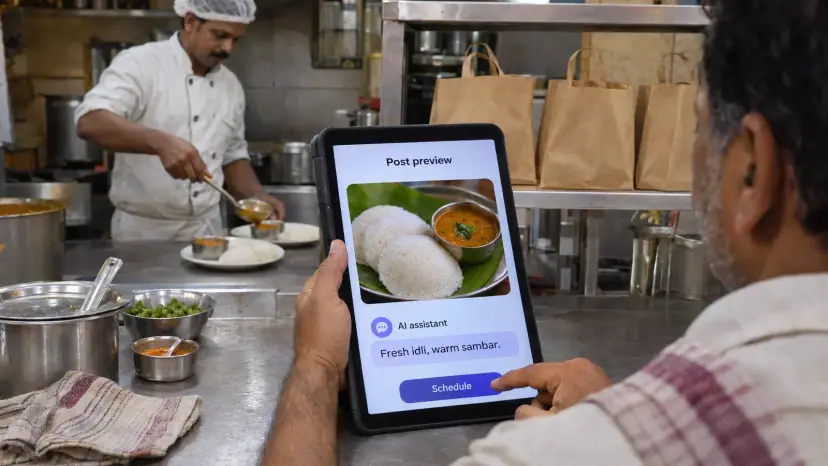
Chennai outlets: accurate menus by location and order states your staff have confirmed
A busy kitchen can sell out of a dish by lunchtime, and a chatbot that has not heard will keep offering it. For Restaurants and Food teams serving Chennai, this guide covers outlet-specific menu information and order states you can stand behind. It explains what to record, which local source to read, what an assistant may handle and when a person must approve the next step. All the workflows are planning examples, and they do not report client results of ours. Scope depends on your real outlets, data and permissions.
Chennai audience, outlet address and collection point
Administrative and public-service information comes from the Chennai district portal. Treat a Chennai customer audience as different from the exact address used for a visit, collection or delivery. Before you point a customer to an official office, check the district entry for that address.
Consult Chennai district for administrative context alone. It is not evidence of market demand or of commercial availability, nor an endorsement of a private food business. Note the Chennai operating address and the collection point here, and hold them against the approved business record. Differences go to a reviewer before the page or assistant says anything about directions, coverage or a reservation.
What the Chennai outlet brief should record
Fill in the fields below as your working brief, and do not print the city’s name beside an unrelated national offer. Connect each statement about food or service to a source and a reviewer. An unknown stays recorded as a gap and goes to someone on the team, so the model has no chance to invent an answer.
- Actual outlet address: Write the outlet’s operating address and its collection point, rather than the part of the city you advertise to.
- Approved current menu and item availability: Hold the current approved menu with each item’s availability, so a sold-out dish is not offered.
- Dietary/allergen information owner: Identify the person responsible for dietary and allergen answers, and refer every gap to them.
- Delivery PIN code and service limits: Set out which PIN codes the outlet delivers to and its limits, based on the current approved list.
- Reservation/order enquiry: Separate table requests from order questions, note the next step wanted and pull aside anything unsupported.
- Outlet or kitchen reviewer: Record which outlet manager or kitchen reviewer can confirm the action before a next step is offered.
With an illustrative Chennai request, the location check and the approved menu and item availability check come first. Nothing commercial or professional should be suggested until both pass. A failed check is left unresolved in the handoff, and that gives the outlet a clear question to answer in place of a falsely qualified lead.
Letting AI answer on hours and tables while the kitchen confirms
Your starting point is the exact restaurant or kitchen outlet and a current approved menu. AI may find opening information, set up a table request or recognise an order question, while the outlet confirms live availability and delivery reach. Hold a reservation request apart from a confirmed table, and an order enquiry apart from one that is paid, accepted and fulfilled. Hours and menus from one outlet do not carry over to the rest.
Authorise connections before you make them, and limit them to an approved knowledge pack, the relevant operational system and a CRM or intake route where needed. Each reply to a diner should show the source version used. Try access permissions and content-editing rights before using live customer data. A draft, prediction or extracted field is a help to the reviewer and never a commitment by itself.
Food safety and registration boundaries
Food operators should use the official FoSCoS resources to verify registration and licensing information where it applies. An image or automated answer cannot tell you about allergen safety, dietary suitability or hygiene certification. Hand any question requiring kitchen confirmation to the responsible staff member.
For an independent view, consult the FSSAI FoSCoS portal. Look over its current instructions, and ask the responsible professional to confirm whether they apply to what you plan.
Tamil and English, Chennai listings and booking stages
Where diners need Tamil and English, ask competent speakers to go over terminology, locality names and the proposed next step. Decide on these languages with the business. We do not claim that every customer uses them or that we supply every translation. Page and records must share one actual address and contact route, without extra offices or profiles built to simulate presence in Chennai.
Diners in Chennai may be ordering from an outlet in another locality, so split the audience’s location from the location where the order is filled. Your approved serviceable area should steer both content and routing. Measure each stage by itself: menu enquiry → availability/serviceability check → accepted booking/order → fulfilled/cancelled. Keep rejected, cancelled and unsupported requests in the results, as a click or conversation does not feed anyone.
Your tests should include a sold-out item, a stated allergy, a closed outlet and an address outside the verified delivery area. Before more budget goes in, hold reviewed outcomes against the business’s baseline. Review search queries for mismatched intent, and repair the answer or handoff concerned. No one can guarantee rankings, a place in AI answers, the number of leads or a return on investment.
One allergy question, and who answers it
This is a planning example, not a real guest. A diner messages in Tamil before booking a table for six. One of them is allergic to groundnuts, and she asks whether a particular dish is safe.
The assistant does not say yes or no. A confident wrong answer about an allergen is the worst thing a food business can send. It replies that the kitchen manager will confirm, and it passes on the dish, the allergen and the booking details. The kitchen manager checks the recipe and the preparation area, replies and decides whether to note the allergy on the booking. The reply goes back through the same thread.
The menu pack should carry an allergen line for every dish, approved by the kitchen and dated, so most questions never reach the manager. When a dish is missing a line, the assistant's answer is the same: the kitchen will confirm. Count how often that happens, since each case is a gap in the pack to fill.
Reading on, and meeting with us
The scope for food businesses is at Restaurants & Food solutions. Ecommerce Development in India (2026): Platform Choice, Cost and What Breaks offers implementation detail on a related workflow, and it is no evidence of work with a Chennai client.
In Chennai you may also want E-Commerce or Travel & Hospitality. You can compare official references through Chennai and other city guides.
A free consultation will go faster with your actual outlet address, your approved current menu and item availability, approved source material and the reviewer who decides the next step. We support Chennai from our Noida office, without a branch in the city. Scope, integrations and on-site work are decided according to your outlets.
We looked at local and sector resources on 5 October 2026, so check the current instructions yourself before campaign changes. The photographs illustrate the subject and are not verified images of local offices, customers or facilities.