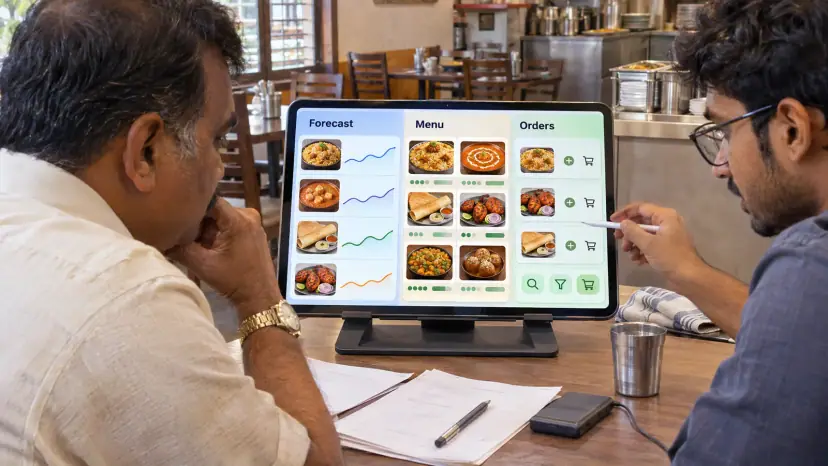
AI for restaurants turns the data you already collect, from POS sales and online orders to stock counts and reviews, into daily help: how much to prep, what to order, which dishes earn their menu place and what guests complain about. Brainguru builds these tools for restaurant groups, quick-service chains, cloud kitchens and caterers, and managers approve every change.
Quick-service chains, fine dining rooms, cloud kitchens, multi-brand groups and caterers all run differently, so the right mix of tools differs too. Below are six common starting points, what each needs, and how to tell whether it is working.
Why AI for restaurants matters now
Restaurants run on small margins, and small daily inefficiencies add up: an extra tray of prep thrown away, a supplier order placed on gut feel, a slow ticket during the lunch rush. Waste is the clearest example. The UN Environment Programme's Food Waste Index Report, released in March 2024, estimated that 1.05 billion tonnes of food were wasted in 2022, with food services responsible for 28% of it.
Guests also decide where to eat online. In BrightLocal's 2026 Local Consumer Review Survey, 97% of consumers said they read reviews for local businesses, and 74% said they only care about reviews from the last three months. A restaurant that reads and answers its reviews every week learns faster than one that checks them once a quarter.
Six AI solutions for restaurants
Ingredient forecasting and inventory
A forecasting model predicts covers and dish sales by day and service from your POS history, reservations, holidays, local events and weather. From that, it suggests prep quantities and purchase orders for the ingredients each dish uses. Comparing what the recipes say you should have used with what you actually used highlights waste, portion drift or missing stock. The kitchen manager approves orders before they go to suppliers. Models of this kind sit behind our AI for sales forecasting work.
Menu pricing and engineering support
A pricing model combines dish costs, sales volume, contribution margin and how often items are ordered together to show which dishes to keep, reprice, reposition or drop, using the methods on our AI for pricing optimisation page. For delivery menus, it can suggest time-of-day offers. Prices should change on a planned cycle, be shown clearly before ordering and stay fair: guests notice and resent prices that seem to move with no reason.
Guest analytics and personalisation
Where guests have opted in through a loyalty programme or online ordering, models can group them by visit frequency, spend and preferences and suggest relevant offers. Keep the data you collect to what the programme needs, honour opt-outs and do not infer sensitive traits. Our AI for personalisation page explains the approach in more detail.
Kitchen order flow
Connected to a kitchen display system, a scheduling model can sequence tickets by preparation time and station load, so dishes for the same table finish together, and warn the team before a predicted rush so prep starts in time. The head chef can override any suggestion; the tool should never slow down service while people wait for it.
Delivery planning
For restaurants with their own riders, a dispatch tool can batch orders, assign riders and estimate delivery times from preparation time, distance and traffic. For aggregator orders, it can help decide when to pause listings because the kitchen is at capacity. Estimated times shown to guests should be honest, not optimistic.
Review analysis and response drafts
Natural language processing can read reviews from Google, delivery apps and social media, sort comments by topic such as food quality, wait time, packaging, hygiene and price, and track trends by outlet. The system can alert managers to serious complaints and draft replies for a person to edit and post. Replies should never be fully automated, and nobody should post or buy fake reviews. Owner responses matter to readers: in the BrightLocal survey, 37% of consumers counted a business owner's reply as an important review factor.
Which tools suit which kind of restaurant?
- Quick-service chains: Demand forecasting and kitchen order flow to keep speed and quality consistent across outlets.
- Fine dining: Ingredient forecasting for premium stock and guest analytics for regulars, with a light touch.
- Cloud kitchens: Delivery planning, menu engineering across brands and review analysis per aggregator.
- Multi-brand groups: Shared reporting to compare outlets and brands on the same measures.
- Caterers: Event-level forecasting and purchasing, where one wrong estimate is expensive.
Chatbots and ordering assistants: keep a person in reach
An AI assistant on WhatsApp or your website can answer opening hours, menu and allergen questions from approved information, take simple orders and table bookings, and pass anything else to staff. Allergen answers must come only from a reviewed source, and the assistant should hand over to a person whenever it is unsure. Many guests are wary of AI service: a Gartner survey published in July 2024 found that 64% of customers would prefer companies did not use AI in customer service. Make the human option easy to find. Our AI chatbot development team builds this kind of assistant.
Data you need before you start
- Sales history: Item-level POS data with dates, times and outlet, ideally covering more than one season.
- Recipes and costs: Standard recipes with ingredient quantities and current purchase prices.
- Stock records: Regular counts and wastage logs, even if they start on paper.
- Online orders: Exports or APIs from your ordering and delivery platforms.
- Reviews: Access to the review sources you want analysed.
Many POS and ordering systems offer APIs or data exports, but access and licence terms vary by vendor and plan. We check what your systems allow before scoping an integration. Guest data, such as phone numbers and order history, falls under the Digital Personal Data Protection Act, 2023; under the DPDP Rules notified in November 2025, the main duties apply from 13 May 2027.
How to measure whether restaurant AI works
- Forecasts: Compare predicted and actual covers and dish sales against your current method, by outlet and day of week.
- Waste: Track wastage logs and food cost percentage before and during the pilot.
- Kitchen: Measure ticket times during peaks, not only on quiet days.
- Reviews: Check that topic tags match what a manager would say, and track response times.
- Adoption: Ask whether managers actually use the suggestions. A tool the team ignores saves nothing.
Set these measures before the pilot starts. In July 2024, Gartner predicted that at least 30% of generative AI projects would be abandoned after proof of concept by the end of 2025, with unclear business value among the causes. A restaurant pilot with agreed measures avoids that trap.
What affects the cost of restaurant AI?
- Number of outlets and brands: More locations mean more data cleaning and more testing.
- Data quality: Clean item-level POS data costs less to use than inconsistent menus and manual records.
- Integrations: Each POS, inventory, ordering or delivery platform adds work.
- Tools in scope: One forecasting model is far smaller than a combined forecasting, pricing and review system.
- Support: Menus, suppliers and seasons change, so models need regular updates.
For marketing rather than operations, such as winning more orders and bookings, see AI marketing for restaurants and food businesses and our local SEO services. For multi-step automation across systems, see AI agent development.