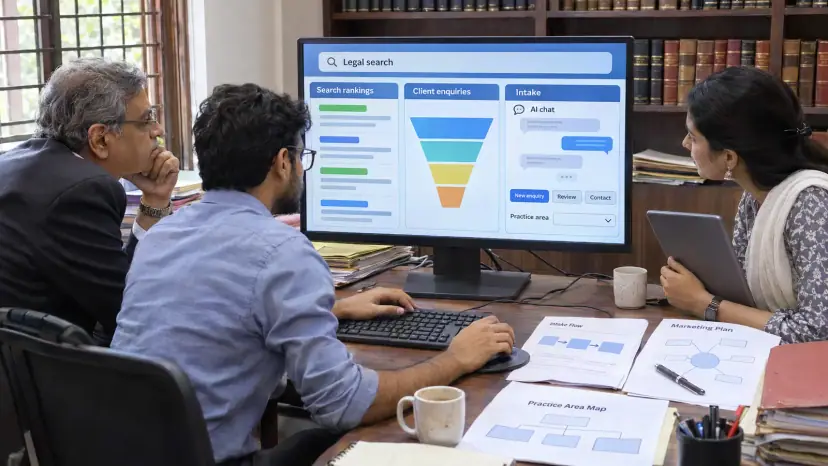
AI marketing for law firms means using AI and automation to publish accurate practice information, explain legal topics in plain language and handle enquiries well, within the professional conduct rules that bind lawyers. For advocates in India those rules are strict, so the work is about being findable and clear, not about advertising or soliciting clients.
Why legal marketing starts with the conduct rules
For a legal practice, the first question about any communication is whether it is permitted at all. Methods that suit an ordinary commercial service often cannot be transferred to advocates.
In India, the Bar Council of India's rules are clear. Under the heading "Rules on an Advocate's Duty Towards Fellow Advocates", the Bar Council of India states that an advocate shall not solicit work or advertise in any manner, and shall not promote himself through circulars, advertisements, touts or personal communications. The same rules say a sign-board, name-plate or stationery should not indicate that the advocate specialises in any particular type of work.
That rules out paid client-acquisition campaigns, ranking promises, testimonials and lead-generation workarounds for advocates practising in India. What remains is still useful: an accurate website, clear information about how to get in touch, lawyer-reviewed educational writing on legal topics, and a well-run enquiry process. Your State Bar Council, or your own counsel, should confirm what your website may carry before anything is published.
Firms in other countries work under different rules. In the United States, the American Bar Association's Model Rules allow lawyer advertising but prohibit false or misleading communications, and in England and Wales the Solicitors Regulation Authority sets its own standards. Each jurisdiction needs its own review.
Where AI marketing for law firms can help
AI is good at organising information, drafting and routing. It is not able to judge what a regulator will accept, so a lawyer must review anything that goes public. These are the areas where it helps most.
Accurate practice information: AI can check that the firm's name, address, phone number, qualifications and enrolment details are consistent across the website and the listings the firm is allowed to have. Inconsistent details confuse people looking for a lawyer they were referred to.
Educational publishing: Plain-language explainers on legal topics, such as how a process works or what documents are usually needed, drafted with AI help and checked by a lawyer. These should inform at a general level, never give personalised advice, describe invented outcomes or compare the firm with others.
Search visibility for that content: Good structure, clear headings and accurate page titles help people searching for a legal topic find the firm's explainer. This is ordinary search work, covered in more detail on our SEO services page, but for advocates in India it must stay informational.
Enquiry administration: A form or chat that collects the minimum needed, such as the person's name, contact details and the general area of the question, and routes it to the right person in the practice. It should not promise representation or ask for confidential details of the matter. Our AI chatbot development work covers how such assistants are built and limited.
Internal knowledge tools: Search across the firm's own approved templates, published articles and FAQs, so staff answer routine administrative questions consistently. The wider options are on our AI solutions for the legal industry page.
Confidentiality and data protection
Confidentiality is part of a lawyer's professional duty, and it should shape every marketing tool a firm uses. A few rules of thumb help:
- Keep matters out of marketing: Case details, client names and documents never go into marketing tools or AI prompts without a documented basis.
- Separate systems: Keep enquiry tools apart from case management and privileged files.
- Careful replies: Where a firm replies to a public comment, the reply should not confirm or deny that the person is a client.
- Personal data: India's Digital Personal Data Protection Act, 2023 covers the personal data that enquiry forms collect. Its rules were notified in the Gazette of 13 November 2025, and most duties, including notice and security safeguards, apply from 13 May 2027.
AI tools also make mistakes. The Stanford AI Index 2026 reports that documented AI incidents rose to 362, up from 233 in 2024. For legal content, where a wrong statement can mislead a reader about their rights, human review is not optional.
Professional profiles and social media
Many lawyers write on LinkedIn or speak at events. Commentary on a new judgment or a change in the law can be educational, but the same conduct rules apply: no solicitation, no claims about results and no undisclosed paid promotion. Disclosure is a live issue for professionals generally. In its 2024-25 complaints report, the Advertising Standards Council of India detected 121 violations on LinkedIn where professionals failed to disclose paid partnerships, and issued an advisory for the platform.
A workflow for a legal practice
This is a planning outline for partners and whoever handles the firm's communications. It is not a case study and promises no results.
- Agree the boundaries: Decide with the practice what it is permitted to publish, and who signs it off.
- Practice information: Publish only approved details, kept accurate, rather than generated promotional claims.
- Educational publishing: Use lawyer-reviewed material to explain topics at a general level.
- Enquiry administration: Route each enquiry to the right person without promising representation, and keep conflict checks inside the practice's own intake process.
- Measurement: Review information accuracy and how quickly enquiries reach the right lawyer, not a target for client acquisition. Accepting a matter is always the practice's own decision.
For a first conversation, bring the information the practice has approved for publication, the way enquiries reach a lawyer today, a description of the data involved and the name of the lawyer who reviews content.
What affects the cost?
Each engagement is quoted after a free consultation. The main factors are the size of the existing website, how much educational content the firm wants, the number of jurisdictions whose rules must be checked, the languages needed, and whether an enquiry tool must connect to practice management software.
Questions to ask before hiring anyone
- Rules: Which conduct rules apply to us, and how will every piece be checked against them?
- Review: Will a lawyer from our side approve each page before it goes live?
- Confidentiality: Which of our data will your tools see, and where is it stored?
- Claims: Will anything you write describe outcomes, rankings or comparisons? It should not.
Local Legal Services Planning Guides
Choose a city for official local references, enquiry information and a reviewed workflow. Each guide covers legal practices we serve from Noida; these cities do not have branch offices of ours.