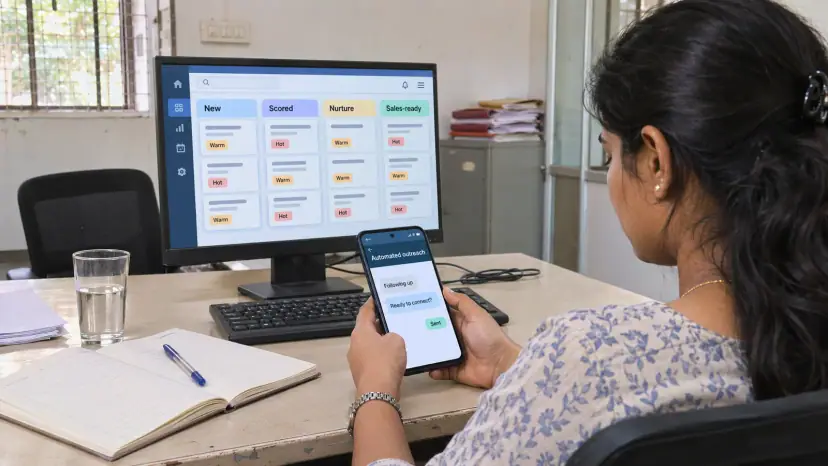
AI for lead generation helps you find likely buyers, score them by how ready they are, follow up at the right moment and hand sales-ready leads to your team. Brainguru builds these systems around your CRM, combining prospect research, predictive lead scoring, chatbot capture, automated email and WhatsApp follow-up, and reporting that ties every lead to revenue.
Why traditional lead generation stalls
Buying lists, running broad ads and waiting for enquiries fills a pipeline with contacts who were never going to buy. Sales teams then spend their time sorting rather than selling. In Salesforce's State of Sales research, released in July 2024 from a survey of 5,500 sales professionals in 27 countries, reps reported spending 70% of their time on non-selling tasks.
Buyers have changed too. A Gartner survey of 632 B2B buyers, published in June 2025, found that 61% prefer an overall rep-free buying experience, and 73% actively avoid suppliers who send irrelevant outreach. Generic sequences now do more harm than good. The task is to find the people who are actually looking, and to say something relevant when you reach them.
What an AI lead generation system includes
Prospect research: AI tools search business directories, company websites, social profiles and industry databases for organisations and roles that match your ideal customer profile, then enrich records with firmographic and technology details. Contacts are verified before they enter your pipeline.
Predictive lead scoring: Models trained on your own won and lost deals weigh website visits, content downloads, email replies, company size and other signals, and give each lead a score that updates as they engage. Sales works the highest scores first.
Chatbot lead capture: An AI chatbot on your website answers questions, asks a few qualifying questions, books meetings and sends complete records to the CRM, with a clear handover to your team.
Email and WhatsApp follow-up: Automated sequences adapt to each response, pause when someone replies, and stop when someone opts out. Messages are personalised from real data, not just a first-name tag.
Intent signals: Content consumption, search behaviour and visits to pricing or comparison pages show which accounts are researching now. These signals feed scoring and outreach timing.
Lead nurturing: Most leads are not ready to buy on day one. Behaviour-triggered journeys send useful content and offers based on interest and stage, through our AI marketing automation setup.
CRM routing: Qualified leads are created in the CRM, assigned by territory, industry, workload or score, and tracked through the sales cycle. Our CRM automation solutions handle the integration.
Attribution and reporting: Dashboards show lead volume, quality, conversion and cost by channel and campaign, using AI marketing analytics to connect leads to closed revenue.
How we build AI for lead generation
- Discovery and data audit: We study your lead data, customer profiles, sales process and tools, define the ideal customer profile and find data gaps.
- Model development: We build scoring and targeting models on your historical conversions, so predictions reflect your market rather than generic averages.
- Integration: We connect the CRM, marketing automation, email, WhatsApp and website, and test data flows and routing rules in a controlled setting.
- Launch: We start prospecting, chatbot capture and sequences, and watch early results closely to adjust targeting and messages.
- Improve: Models are retrained as new outcomes arrive, and we review performance with your team regularly.
AI lead generation versus traditional methods
| Area | Traditional approach | With AI |
|---|---|---|
| Finding prospects | Manual research and purchased lists | Prospects matched to your ideal customer profile and verified |
| Qualifying leads | Judgement of individual reps | Scores based on behaviour and past conversions |
| Timing | Fixed schedules | Follow-up triggered by each prospect's actions |
| Response time | Depends on team availability | Instant chatbot replies and automatic routing |
| Reporting | Spreadsheets, often incomplete | Attribution from first touch to closed deal |
Measures to track
- Qualified lead rate: The share of leads that sales accepts.
- Cost per qualified lead: Spend divided by accepted leads, not raw form fills.
- Speed to lead: Time from enquiry to first meaningful response.
- Conversion by score band: Whether high-scoring leads really close more often; if not, the model needs work.
- Pipeline and revenue by source: Which channels produce customers, not just contacts.
We set a baseline for each measure at the start and report against it, since results vary by industry, process and market.
Outreach rules and data protection
Automated outreach has to follow the rules of each channel. For email, Google's sender guidelines require spam rates in Postmaster Tools below 0.3%, and senders of more than 5,000 messages a day to Gmail must authenticate with SPF, DKIM and DMARC and offer one-click unsubscribe. Cold sequences that ignore this end up in spam. Commercial calls and SMS in India follow TRAI's rules on registration, consent and opt-outs, and WhatsApp messages need opt-in and approved templates.
Lead data is personal data. In India, the Digital Personal Data Protection Act, 2023 applies, and the DPDP Rules notified in November 2025 set an 18-month phased timeline, with the main duties applying from 13 May 2027. Collect only what you need, explain how it will be used, and make opting out easy.
Common lead generation mistakes
- Volume over quality: Rewarding marketing for lead count encourages cheap, weak leads. Agree with sales what a qualified lead is, and measure that.
- Scoring without feedback: A score model trained once and never checked drifts out of date. Feed won and lost outcomes back into it.
- Slow follow-up: A good lead who waits days for a reply often goes cold. Route hot leads instantly and alert the owner.
- Over-automation: Long automated sequences to people who never engaged damage your sender reputation and your brand. Stop sequences early when there is no response.
- Disconnected tools: Ads, website, chatbot and CRM that do not share data make attribution guesswork.
How lead generation connects with paid media and content
Lead generation does not start with outreach. Paid campaigns bring in much of the traffic, and they work better when optimised towards qualified leads instead of form fills, as explained on our AI for ad optimization page. Landing pages and offers that adapt to the visitor's industry or interest convert more of that traffic; our AI for personalization page covers how. Useful content, such as guides, calculators and comparisons, gives prospects a reason to share their details and gives scoring models better signals about what each person cares about.
The pieces reinforce each other. Better targeting brings better leads, better leads train better scoring models, and better scores tell paid media which audiences to find more of.
Where AI lead generation is used
- Real estate: Matching buyers to projects, scheduling site visits and following up enquiries.
- Education: Admissions enquiries, course recommendations and multi-channel follow-up.
- Healthcare: Appointment booking and consent-based follow-up for clinics and providers.
- Financial services and insurance: Scoring loan, investment and policy enquiries with compliant messaging.
- B2B technology and SaaS: Account-based targeting, product-qualified leads and demo booking.
- E-commerce: Purchase intent prediction and re-engagement of browsers.
- Manufacturing: Finding procurement decision-makers and nurturing long B2B cycles.
India's online audience is large: DataReportal counted 806 million internet users in the country in January 2025. Reaching the right few among them is what scoring and targeting are for.