Practice information and confidential intake for Lucknow legal teams
What may a Lucknow law practice say publicly, and how should a first enquiry be handled without exposing confidential facts? This guide answers those two questions for Legal Services teams. It covers the information to collect, the local source to use, the tasks an assistant may perform and the point where a person approves what happens next. Treat each workflow as a planning example, because none is a reported Brainguru client result. Services follow the actual practice, its data and its permissions.
Directory entries in Lucknow are not recommendations
Administrative setup and public utility contacts are published on the Lucknow district portal. Choose the relevant entry from the actual business address, then verify commercial availability with the practice itself. An entry in a public directory is neither a recommendation nor an availability feed.
The page to read before all others is Lucknow district. It offers local administrative context only, and proves nothing about market demand, commercial availability or the endorsement of a private practice. Note the Lucknow locality and the verified directory entry, and check them against the approved business record. Where they conflict, a reviewer has to settle the matter before the page or assistant says anything about directions, coverage or appointments.
The details a Lucknow practice should collect, and leave out
Take these fields as your working brief, since legal pages should never be a city name set beside a national offer. Trace each statement to its source and reviewer. Gaps in the information go on record and then to a person, with no assumption filled in by the model.
- Actual practice contact/location: Enter the practice’s actual contact details and Lucknow locality, backed by the verified directory entry.
- Permitted public-information fields: Set out which details may appear publicly and the current reference that supports each one.
- Practice-area information approved by counsel: Use descriptions that counsel has cleared, and refer anything else for review before it goes live.
- Enquiry type without unnecessary case documents: Record what kind of enquiry this is, without asking for case documents the first step does not need.
- Conflict-check route: Spell out where a conflict check happens and what information it requires, and divert requests that do not belong there.
- Responsible advocate or legal reviewer: State which advocate or legal reviewer has authority to confirm the answer before any next step appears.
Any illustrative Lucknow request has to pass the location check and the permitted public-information check first. Only then may a commercial or professional next step be suggested. Whatever fails remains open in the handoff, which hands the legal team a concrete question to answer in place of a falsely qualified lead.
What AI may organise for an advocate, and what it never answers
An advocate or legal team needs to decide first which public information and administrative functions are permitted. Within that, AI may help organise approved contact information and an intake summary. It must not create an advertising or solicitation funnel. Confidential facts or documents move to the lawyer’s approved channel, leaving the initial enquiry minimal. Substantive legal answers come from the responsible professional, as a generated response is no client engagement or legal opinion.
Use only the sources and systems the practice has authorised, typically an approved knowledge pack, the relevant operational system and a CRM or intake route if it is needed. Each reply should carry a record of the source version used. Live client data waits until you have tested access permissions and who can revise the content. Drafts, predictions and extracted fields assist the reviewer without making any commercial commitment.
Advertising and solicitation limits that apply to advocates
The professional conduct rules of the Bar Council of India restrict advertising and solicitation. We will not offer advocates paid client-acquisition campaigns, ranking promises, testimonials or lead-generation workarounds. Have counsel review any proposed website information and intake process. No technology support can certify that marketing is legally permitted.
See Bar Council professional conduct resources as your independent reference. Recheck the current instructions there, and ask the responsible professional whether they apply to the proposed activity.
Hindi and English wording, Lucknow search and what gets counted
For an audience needing Hindi and English, competent speakers must review terminology, locality names and the proposed next step. They are language options to assess with the practice. We do not claim that every client uses them or that we supply every translation. Address and contact route should match across the page and business records, and no extra office or profile should be made to simulate a local presence.
A person reading in Lucknow may need a service fulfilled somewhere else, so keep those two locations distinct. Approved serviceable area decides page wording and enquiry routing. Count these stages independently: administrative enquiry, conflict or engagement review, permitted next step, professional handling. Do not take rejected, cancelled or unsupported requests out of the evaluation, as clicks and conversations are not revenue.
Good test cases include someone asking for a guaranteed case outcome, a conflicting matter, confidential uploads and a promotional message that has to be refused. Before spending more, compare reviewed outcomes with the practice’s own baseline. Search queries will reveal mismatched intent, and the affected answer or handoff is what needs improving. Neither rankings nor inclusion in AI answers, lead volume or return on investment can be guaranteed.
Who owns what in a small practice
A small practice usually has an advocate who decides what may be said, a clerk or junior who answers the phone, and someone who looks after the website. Enquiries fall through the gaps between them. The clerk answers a question about fees from memory. The webmaster adds a line about practice areas the advocate never approved. Nobody notices until a client repeats it back.
Write down three owners before anything goes live. The advocate owns the wording of every public line and the decision to take a matter. The clerk owns the intake summary and the conflict-check handoff, and does not answer questions about the merits. The website owner changes nothing without a dated approval from the advocate. Add one more rule: if an assistant or a staff member is unsure, the safe reply is that the advocate will respond. That sentence costs nothing, and it keeps confidences and professional rules intact.
Other resources and how to begin
To see the industry scope, read Legal Services solutions. To go into implementation detail, read AI Contract Review for Indian Legal Teams: Playbooks, Citations and Confidentiality. It is about a related workflow, so it does not stand as evidence of a Lucknow client engagement.
Also useful for Lucknow are our planning tasks for SaaS and HR & Recruitment. Use Lucknow and other city guides when comparing supported information with official references.
Please bring to a free consultation the actual practice contact and location, your permitted public-information fields, approved source material and the reviewer able to decide the next step. Our Noida office handles delivery, and no Lucknow branch is being claimed. Scope, integrations and on-site work, if any, are talked through for each practice.
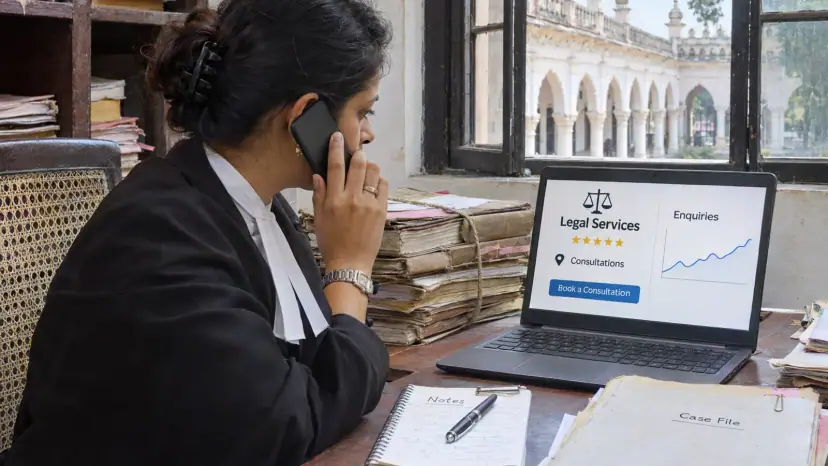
Our resource check, local and sector, is dated 5 October 2026, and instructions should be rechecked before campaign changes. Photographs are illustrative topic images, which do not verify any local office, client or facility.