Varanasi legal teams: what a practice may publish and how to keep intake confidential
This guide speaks to Legal Services teams in Varanasi whose needs are permitted practice information and confidential intake administration. You will see what to collect and which local source to consult, then what an assistant may do and at what point a person must approve the next step. Read each intake workflow as a planning example, because none is a reported Brainguru client result. Any service would be scoped to the actual practice, its data and its permissions.
Varanasi, Banaras, Kashi and a single documented address
The district’s own name is Varanasi, but enquiries may also say Banaras or Kashi. Tie these names to one documented address so no duplicate establishments appear. Visitors’ destination information should come from current district resources and from the actual operator’s access instructions.
Your local source is Varanasi district. It provides administrative context and stops there, without establishing market demand or commercial availability for legal services or endorsing a private practice. Log the Varanasi, Banaras and Kashi aliases with the actual address, and check that entry against the approved business record. Any disagreement needs a reviewer’s decision before the page or assistant shares directions, coverage information or an appointment instruction.
Keeping the Varanasi enquiry brief short and safe
Do not put a city name beside an unrelated national offer and call it local. A working brief built from these fields is the better route, with every statement linked to its source and reviewer. Missing information becomes a recorded gap for a person to handle, and the model is not allowed to assume it.
- Actual practice contact/location: Enter the practice’s real contact along with the Varanasi, Banaras and Kashi aliases and the actual address. The operating location counts here, not the audience for any advertising.
- Permitted public-information fields: Set out which fields may be public, what limits apply to each and the current reference for them.
- Practice-area information approved by counsel: Include practice-area wording only after counsel approves it, and capture what is needed to check it. Anything missing goes back as a review question.
- Enquiry type without unnecessary case documents: Classify what the enquiry is about without collecting case documents, and retain the approved evidence and its current version. Photographs and city names do not meet this need.
- Conflict-check route: Show how the enquiry reaches a conflict check, the next step sought and the information required. Keep unsupported or misrouted requests apart.
- Responsible advocate or legal reviewer: Say which advocate or legal reviewer confirms the answer or action before anyone offers a next step.
Only after a sample Varanasi enquiry passes the location check and the permitted public-information check may someone suggest a commercial or professional next step. A failed check goes into the handoff as unresolved, leaving a concrete question and not a falsely qualified lead.
Limits on the assistant in a legal setting
Start by defining which public information and administrative functions are permitted for the advocate or legal team. Within those bounds, AI may help organise approved contact information and an intake summary, though it must not create an advertising or solicitation funnel. The first enquiry stays minimal, with confidential facts or documents moved to the lawyer’s approved channel. Substantive legal answers require the responsible professional, as a generated response is not a client engagement or a legal opinion.
Connections stop at what the practice has authorised, namely an approved knowledge pack, the relevant operational system and a CRM or intake route where needed. For each reply about the practice, keep the source version on record. Access permissions and content-revision rights should be tested before live client data is involved. Reviewers can use a draft, prediction or extracted field as an aid, but none of these is an automatic commercial commitment.
Name an owner for the conflict check. In many offices it is an associate who knows the client list. When nobody owns it, intake summaries wait unread, or someone replies without checking, and a conflict surfaces only after the person has told the practice their story.
Professional conduct rules for advocates
Advertising and solicitation are restricted by the professional conduct rules of the Bar Council of India. That rules out paid client-acquisition campaigns, ranking promises, testimonials and lead-generation workarounds for advocates. Any proposed website information and intake process should go to counsel for review, because technology support cannot certify that marketing is legally permitted.
The Bar Council professional conduct resources are the independent sector reference to use. Check current instructions again and ask the responsible professional to review their applicability to the proposed activity.
Hindi and English, listings and each stage of intake
If your audience needs Hindi and English, competent speakers review terminology, locality names and the proposed next step. Treat these as options to assess with the practice, as we make no claim that all clients use them or that we supply all translations. Across the page and business records, the actual address and contact route should match, with no extra offices or profiles created to simulate a local presence.
An audience in Varanasi and the location where a requested service is fulfilled are two different things, so separate them and draw on the approved serviceable area for page content and enquiry routing. Measure each stage independently: administrative enquiry, conflict or engagement review, permitted next step, professional handling. Rejected, cancelled and unsupported requests remain part of the evaluation, since neither a click nor a conversation is revenue.
Try these cases: a request for case-outcome guarantees, a conflicting matter, confidential uploads and a promotional message requiring rejection. The practice’s own baseline is the comparison for reviewed outcomes before spend increases. Legal search queries with mismatched intent point you to the answer or handoff to improve. You will get no guarantee from us of rankings, inclusion in AI answers, lead volume or return on investment.
In the first weeks, read what people actually send. If many messages include case documents despite the notice, the wording of the form needs to be plainer and the first question shorter. If many ask for a prediction of the result, the page probably invites it and counsel should look at how the practice areas are described. Either pattern should change the plan before anything else does, because both put confidential material or advice-seeking in the wrong place.
Where to read further and how to talk to us
See Legal Services solutions for the industry scope and AI Contract Review for Indian Legal Teams: Playbooks, Citations and Confidentiality for implementation detail. The article explains a related workflow, and it is no evidence of a Varanasi client engagement.
You may also find Varanasi planning tasks under SaaS and HR & Recruitment. Open Varanasi and other city guides for a comparison of supported information and official references.
Bring these to a free consultation: the actual practice contact and location, the permitted public-information fields, approved source material and the reviewer who can decide the next step. Our work comes from our Noida office, and we claim no branch in Varanasi. Scope, integrations and possible on-site work are looked at per case.
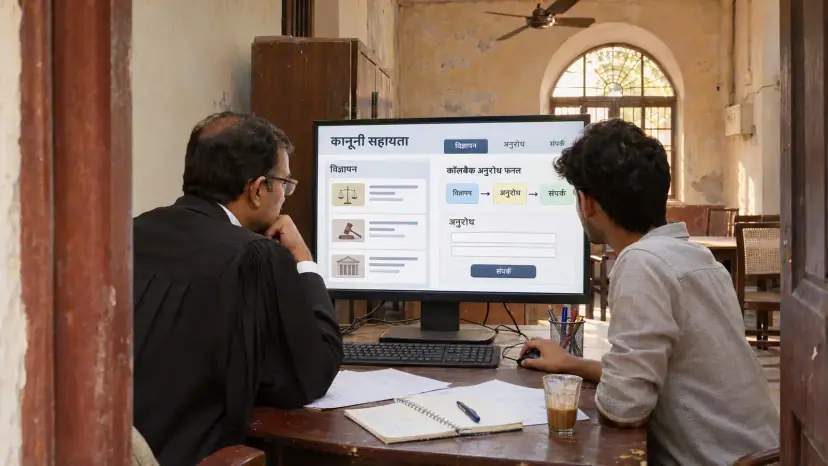
Our last review of local and sector resources was on 5 October 2026, and you should recheck current instructions before campaign changes. Photographs here are illustrative of the topic and are not verified as local offices, clients or facilities.