Permitted information and confidential intake for Nagpur legal practices
AI marketing for Legal Services in Nagpur has a narrow, useful job: publishing only the practice information an advocate is allowed to show, and handling the first enquiry in confidence. This guide sets out what to collect, which local reference to use, what an assistant may do and where a person must approve the next step.
The workflows below are planning examples. They do not describe Brainguru client results. Our services are scoped to the actual practice, its data and its permissions, and nothing here replaces advice from the responsible advocate.
The Nagpur site and the destinations beyond it
Nagpur district resources cover district administration and public services. Treat a Nagpur customer's address and any wider Central India destination as two different fields. The exact operating or meeting site decides which official reference applies and who answers a business enquiry.
For administrative context, use the Nagpur district portal, and only for that. The portal describes the district as having 14 talukas, so a city name on its own does not tell you where a person or a meeting site sits. Its Administrative-setup and Tahsil sections show how the district is divided. The resource proves no market demand or commercial availability, and it endorses no private practice.
Log the Nagpur site, keep Central India destinations in their own field, and compare both with the approved business record. If the two disagree, a reviewer decides which is right, and only then may the page or the assistant offer directions, say what area is covered or suggest a meeting time. The same portal describes Nagpur as a commercial and political centre of the Vidarbha region, which is one more reason to record where the enquirer actually is, and not assume it from the page they landed on.
The Nagpur intake brief, field by field
Build from this brief, so the page is more than a city name beside a national offer. Each statement on it needs a source and a reviewer. Where a detail is unknown, write down the gap and send it to a person: a legal page cannot rest on something the model assumed.
- Actual practice contact and location: Record the Nagpur site and contact that really exist, with Central India destinations kept apart from them.
- Permitted public-information fields: List the details counsel has allowed on public pages, any limits on them and the current reference for each.
- Practice-area wording approved by counsel: Hold only the practice-area text counsel has signed off. Missing wording becomes a review question, not a guess.
- Enquiry type, without case documents: Note what kind of enquiry it is and ask for no case papers. A city name or a photograph adds nothing at this stage.
- Conflict-check route: Show how the enquiry reaches a conflict check and which step was asked for. Set aside anything unsupported or misrouted.
- Responsible advocate or legal reviewer: Name the person who confirms an answer or action before any next step is offered.
A sample Nagpur request must pass the location check and the permitted public-information check before anyone mentions a professional next step. If either check fails, the request is handed over still open. The practice then has a specific question to answer, and nobody is wrongly counted as a qualified lead.
Administrative help from AI, legal judgement from the advocate
First, the advocate or legal team defines which public information and administrative tasks are permitted. AI can then help organise approved contact details and an intake summary. It must never turn into an advertising or solicitation funnel. Keep the first enquiry short, and move confidential facts or documents to the lawyer's approved channel. Substantive legal answers need the responsible professional: a generated reply is neither a client engagement nor a legal opinion.
The practice decides what the assistant may read: usually its approved knowledge pack, the system the office already runs on, and a CRM or intake route where one is needed. Keep a record of which version of the source each answer came from. Check who can see and who can edit each connection before real client data goes anywhere near it. A draft, a prediction or an extracted field exists to help the reviewer, and it creates no automatic commitment.
In practice, the assistant's useful tasks are few and plain. It can answer office-hours and address questions from the approved pack. It can tell an enquirer which documents not to send yet. It can sort an enquiry into a practice area counsel has approved, or into a "not handled here" queue. It can draft a summary for the reviewer in a fixed format. It should not estimate the strength of a matter, suggest a likely outcome, quote a fee or say that an advocate will take the case.
Before anything goes live, run a short checklist with the responsible advocate. Is every public statement on the site in the approved list? Does the intake form collect only what the first conversation needs? Is the notice on the form clear about what the information will be used for, in line with the DPDP Act 2023? Who deletes a declined enquiry, and when? Record the answers and the date. A practice that cannot answer the last question should settle it before launch, because declined enquiries are the easiest ones to forget in a CRM.
On timing, the Act's duties start on 13 May 2027, so a form built now should already carry a plain notice and a clear route for withdrawing or correcting data. Our guide to the DPDP Act 2023 for digital marketing covers notice wording and retention in more detail.
Bar Council limits on advertising and solicitation
The Bar Council of India's professional conduct rules restrict advertising and solicitation. So we do not offer advocates paid client-acquisition campaigns, ranking promises, testimonials or lead-generation workarounds. Counsel should review any proposed website information and intake process. Technology support cannot certify that a piece of marketing is legally permitted.
An independent sector reference is the Bar Council professional conduct resources page. Recheck what is current there, and have the responsible professional decide whether it applies to the activity proposed. Under its rules on an advocate's duty towards fellow advocates, the page says an advocate shall not solicit work or advertise in any manner. It lists the routes that rule closes: circulars, advertisements, touts, personal communications, interviews other than through personal relations, inspired newspaper comment, and photographs published in connection with cases the advocate has handled.
Several everyday marketing habits fall straight into that list, which is why each one needs counsel's view before it is used:
- Outbound messages: A WhatsApp or email blast to a contact list reads as a circular or a personal communication. The assistant should only reply to people who wrote in first.
- Case photographs: Pictures of court visits, signed documents or a client after a matter belong to the excluded category. Use neutral images or none.
- Specialist claims: The same page says a sign-board, name-plate or stationery should not indicate that the advocate specialises in any particular type of work, or has been a Judge, an Advocate General or a Bar Council member. Ask counsel whether the website should follow the same limits, and word practice areas plainly.
- Use of the advocate's name: The page also says an advocate shall not let their name be used to promote unauthorised practice of law. A directory listing or partner site that offers "legal help" through the advocate's name needs the same review.
None of this is a legal opinion on what a Nagpur practice may publish. It is the list of questions to bring to the responsible advocate before any page, profile or assistant is switched on.
How AI marketing for Legal Services in Nagpur handles language and search
When an audience needs Marathi, Hindi and English, competent speakers must review terminology, locality names and the proposed next step. The Nagpur district portal itself lists Marathi and Hindi as the district's languages. Assess the language options with the practice; naming them is no claim that every client uses them or that we can supply every translation. Keep the actual address and contact route the same across the page and the business records. A practice must not create extra offices or profiles to look local, and the same rule applies to the address on any local search listing.
The person enquiring may be in one place in or around Nagpur while the service is delivered in another. Keep those locations apart and apply the approved serviceable area to page content and to enquiry routing. Track each stage on its own:
- Administrative enquiry received.
- Conflict and engagement review completed.
- Permitted next step offered.
- Professional handling by the advocate.
Rejected, cancelled and unsupported requests stay in the evaluation, because neither clicks nor conversations are fee income or revenue.
Test a request for a promised case outcome, a conflicting matter, confidential uploads and a promotional message that has to be refused. Compare reviewed outcomes with the practice's own baseline before increasing spend. Where a search query shows the wrong intent, rework the answer or the handoff behind it. We give no promise of ranking, AI-answer inclusion, lead volume or return on investment.
Common mistakes on legal pages for a city
Most problems on legal city pages come from copying habits that suit other sectors. These are the ones a reviewer should look for first:
- Superlative titles: Page titles that rank the practice against others in the city. Describe the service instead.
- Reviews and ratings: Star ratings or client quotes placed on the page or in its structured data. Leave them out.
- Case wins: Summaries of matters won, even without names. They work as advertisements of results.
- Over-long forms: A first form that asks for the full story and the documents. It collects confidential material before a conflict check has happened.
- Promised callbacks: An auto-reply that says an advocate will call within a set time. Promise only what the practice has agreed it can do.
- Endless retention: Declined enquiries kept in the CRM with no end date. Set a deletion rule and a named owner.
What to ask any provider before you start
Whether the practice works with us or with someone else, a few questions show quickly whether a provider understands legal work. Ask who approves each published sentence, and whether that approval is stored. Ask where enquiry data is held, who can read it and how it is deleted. Ask what the assistant does when someone uploads a document it should not receive. Ask how the provider stops outbound messages. Ask which numbers will be reported: a provider that reports only clicks or chats has not understood the stages above. If the practice already uses AI for legal work such as document review, ask how the marketing data is kept apart from matter files.
Next steps for a Nagpur practice
You will find the industry scope in AI Marketing for Legal Services and implementation detail in AI Contract Review for Indian Legal Teams: Playbooks, Citations and Confidentiality. That article covers a related workflow, so it cannot serve as evidence of a Nagpur client engagement.
Other Nagpur planning tasks are in AI Marketing for SaaS in Nagpur and AI Marketing for HR and Recruitment in Nagpur. The Nagpur and other city guides page shows supported information and official references for comparison.
For a free consultation, bring the practice contact and location, the permitted public-information fields, approved source material and the name of the reviewer who can decide the next step. Delivery is provided from our Noida office, and no Nagpur branch is claimed. Scope and integrations are discussed according to each practice's position.
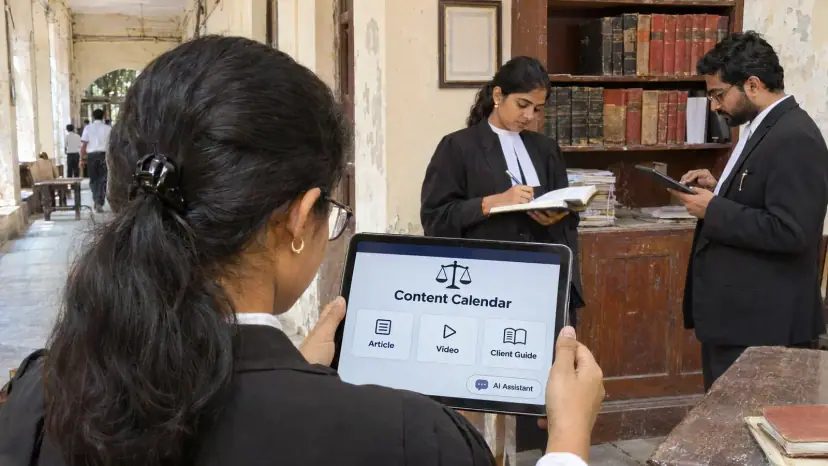
These local and sector resources were checked on 5 October 2026, so verify current instructions before a campaign change. Both sources were opened again on 3 November 2026 for this revision, and each still says what this guide attributes to it. Photographs are general topic images, not verified photographs of local offices, customers or facilities.
After launch, read the review log once a month. If most declined enquiries concern matters the practice does not take, change the approved practice-area wording before changing anything about reach. If enquiries stall before the conflict check, look at who is assigned to run it and how quickly it happens.