Chennai Legal Practices: Permitted Information and a Confidential Intake
For advocates, the first question is what may be said in public at all. Legal Services teams serving Chennai can use this guide to organise permitted practice information and handle intake administration confidentially. It sets out what to gather, the local source to check, how little an assistant may do and where a person must approve the next step. Treat each workflow as a planning example; none reports a Brainguru client result. Anything we provide is scoped around your actual practice, its data and its permissions.
Client Audience and Practice Address in Chennai
Clients being in Chennai is one fact. The exact operating address used for a visit or for collecting or delivering documents is another, and the two should be recorded apart. The Chennai district portal supplies administrative and public-service information, so look up the district entry for that address before pointing anyone to an official office.
Begin your checks with Chennai district. It is useful for local administrative context, and it establishes neither demand for legal services, nor commercial availability, nor approval of a private firm. Note the Chennai operating address and any collection point, then match that location to your approved business record. A reviewer clears any disagreement before a page or assistant gives directions, coverage information or an appointment instruction.
A Careful Enquiry Brief for a Chennai Practice
Publishing a city name beside an unrelated national offer is the wrong model for a legal practice. These fields form a working brief, with a source and reviewer attached to every statement. If you do not have a piece of information, record the gap and take it to a person; the model is not to assume.
- Actual practice contact/location: Give the real contact details, the Chennai operating address and any collection point, not a location chosen to match an advertising audience.
- Permitted public-information fields: List exactly which public details the practice may show, with any limits and the current reference.
- Practice-area information approved by counsel: Include only practice-area wording counsel has approved; anything else waits for review.
- Enquiry type without unnecessary case documents: Note only the kind of enquiry, using current approved wording, and leave case documents out, because a photograph or city name adds nothing here.
- Conflict-check route: Record how a conflict check will be run and what it needs before the next step, keeping misrouted or unsupported requests separate.
- Responsible advocate or legal reviewer: Name the advocate or reviewer who confirms any answer or action before it is offered.
An illustrative Chennai request has two checks ahead of it: location and permitted public-information fields. No professional next step is suggested until it has passed both. A failure stays visible in the handoff as unresolved, giving the responsible advocate a concrete question in place of a falsely qualified lead.
AI for Administration Only, Never Legal Answers
Begin by defining the public information and administrative functions that are permitted for the advocate or legal team. Within that boundary, AI may help organise approved contact information and an intake summary. What it must not do is build an advertising or solicitation funnel for the practice. Ask very little in the first enquiry, and take confidential facts or documents across to the lawyer’s approved channel. A substantive legal answer can come only from the responsible professional. Nothing generated by the system counts as a client engagement or legal opinion.
Connect nothing the practice has not authorised. That leaves an approved knowledge pack, the relevant operational system and, where needed, a CRM or intake route. Log the source version used for an answer. Test access permissions and who can change the content before any live client data is involved. A draft, prediction or extracted field only assists the reviewer and does not create any automatic commercial commitment.
Bar Council Rules Come First
Professional conduct rules from the Bar Council of India restrict advertising and solicitation. For that reason, do not offer advocates paid client-acquisition campaigns, ranking promises, testimonials or lead-generation workarounds. Have counsel review any proposed website information and the intake process. Technology support is in no position to certify that marketing is legally permitted.
See Bar Council professional conduct resources as the independent sector reference. Go through its current instructions again, and have the responsible professional review how they apply to the proposed activity.
Tamil and English, Local Search and Matter Handling
Tamil and English are language options to assess with the practice, not a claim that every client uses them or that we supply every translation. If the audience needs them, competent speakers review terminology, locality names and the proposed next step. Show the actual address and one contact route consistently on the page and in business records. Do not create extra offices or profiles to give the impression of a local presence.
An audience in Chennai may not match the place where the requested service is fulfilled, so enter those locations separately. Base both page content and enquiry routing on the approved serviceable area. Keep the stages independent: administrative enquiry → conflict/engagement review → permitted next step → professional handling. Rejected, cancelled and unsupported requests stay in your evaluation, because a click or conversation is not revenue.
Try out a request for case-outcome guarantees, a conflicting matter, confidential uploads and a promotional message that should be rejected. Look at reviewed outcomes next to the practice’s own baseline before any increase in spend. Inspect search queries for mismatched intent, then correct the answer or handoff it points to. Neither rankings, AI-answer inclusion, lead volume nor return on investment is guaranteed.
One intake message, handled with the least information
This is a planning example, not a real client. A person writes in Tamil and asks whether the practice handles a family matter and whether a first meeting is possible next week. They begin to describe what happened.
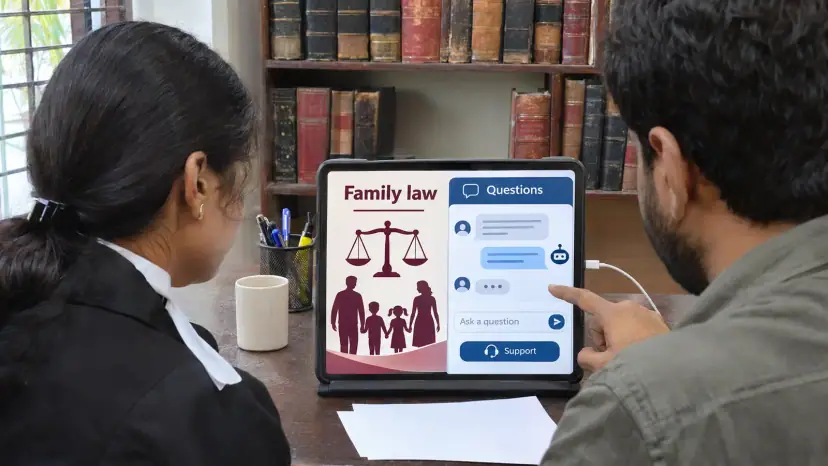
The assistant stops them politely. It says it cannot give legal advice, and it asks for only four things: a name, a contact number, a preferred language and the general area of law. It tells them not to send documents or the facts of the dispute in the chat. It then passes the message to the responsible advocate or the office reviewer, who decides whether the area is one the practice takes and arranges the meeting.
The conflict check is run by the practice, using names the advocate collects through the practice's own channel. The marketing record keeps nothing more than the enquiry type, the date and the outcome, whether booked, declined or referred elsewhere.
Further Resources for Chennai Legal Teams
Our Legal Services solutions page gives the industry scope. AI Contract Review for Indian Legal Teams: Playbooks, Citations and Confidentiality gives implementation detail on a related workflow, but does not evidence a Chennai client engagement.
For other Chennai planning tasks, there are SaaS and HR & Recruitment guides. Browse Chennai and other city guides and you can compare supported information and official references.
At a free consultation, it helps to have the practice contact and location, the permitted public-information fields, approved source material and the reviewer who can decide the next step. We deliver from Noida, and there is no Chennai branch claimed. Scope, integrations and on-site work, if any, are agreed case by case.
Local and sector resources were reviewed on 5 October 2026; review current instructions again before changing a campaign. Pictures are illustrative topic images and are not verified photographs of local offices, clients or facilities.