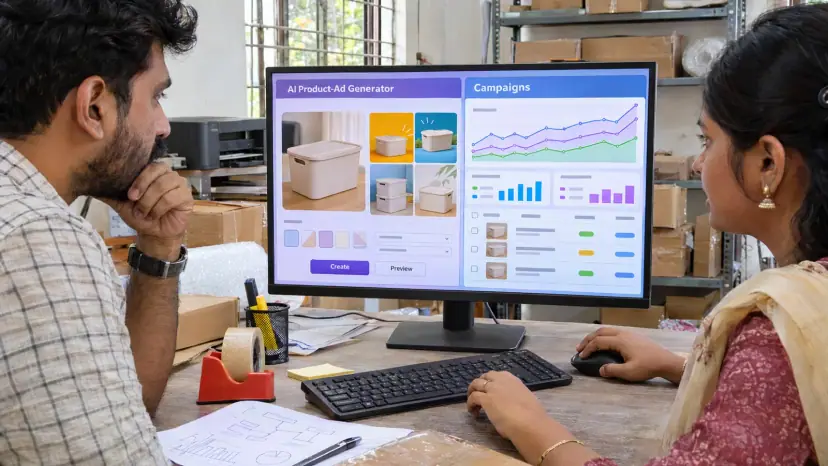
AI marketing for ecommerce uses your catalogue, order and customer data to recommend products, set prices, send timely emails and messages, recover carts and run better ads. Brainguru sets this up for online stores on Shopify, WooCommerce, Magento and custom platforms, and measures it on fulfilled orders, margin and repeat purchases rather than clicks.
Why online stores need more than good photos
Shoppers compare prices across sites in seconds, expect fast delivery and leave when checkout is slow. Large marketplaces have set those expectations. A smaller store competes by knowing its own customers better, showing each visitor relevant products and keeping in touch after the first order.
The market is growing quickly. IBEF reports that India's online retail market reached approximately US$ 80 billion in FY26, with 21% year-on-year growth, and that the online shopper base reached nearly 290 to 300 million in 2025, with tier-2 and smaller cities making up around 65% of new shoppers.
Advertising is following the money. The FICCI-EY report of March 2026 found that e-commerce and point-of-sale ads surged 50% to INR 220 billion in 2025. More stores bidding for the same shoppers makes every wasted rupee of ad spend more costly.
What AI marketing for ecommerce covers
Product recommendations: Engines analyse browsing, past orders, cart contents and what similar shoppers bought, then suggest products on the homepage, product pages, cart and order emails. We choose collaborative, content-based or hybrid methods based on catalogue size and data. Recommendations respect live stock, so out-of-stock items are not pushed. For on-site personalisation more widely, see AI for personalization.
Dynamic pricing: Models look at competitor prices, stock levels, demand and past promotions to suggest prices for each product. They can run in advisory mode, where your merchandising team approves changes, or within limits you set. The aim is better margin on popular items and faster sale of slow stock.
Email, SMS and WhatsApp: Welcome, browse abandonment, post-purchase, replenishment and win-back flows, triggered by what each customer does. AI helps choose send times, subject lines and product blocks, and limits frequency to avoid fatigue. Our AI for email marketing page covers this channel in more detail.
Inventory-aware campaigns: When ad spend is connected to stock data, campaigns can slow down for items close to selling out and push products with too much stock. This stops paying for clicks on products you cannot deliver.
SEO for product and category pages: For large catalogues, AI drafts product descriptions, title tags and meta descriptions, and checks structured data, internal links and category pages. Editors review the output so descriptions stay accurate and do not repeat the same text across hundreds of products.
Ads on Meta, Google Shopping and Pinterest: AI tools test creative, adjust bids and move budget towards the best-performing products and audiences. Dynamic product ads show each shopper items they viewed. We judge results on orders that were actually paid and kept.
Customer segmentation: Beyond recency, frequency and spend, models group customers by category interest, price sensitivity, channel and predicted lifetime value, so each group gets the right offers and messages.
Cart abandonment: recover and fix
Most carts never become orders. Baymard Institute's 2026 cart abandonment page calculates an average documented rate of 70.22% from 50 studies. Many abandoners were only browsing, but among those who left for another reason, 40% said extra costs such as shipping, tax and fees were too high.
Recovery flows by email, SMS, push and retargeting win back some of these shoppers. AI can tailor the message to the likely reason: a reminder for the undecided, delivery details for the cost-conscious. The bigger gain often comes from fixing the checkout itself, by showing total cost early, allowing guest checkout and cutting unnecessary form fields.
Platforms we work with
Shopify and Shopify Plus: Personalisation, flows and reporting through Shopify's apps, Shopify Flow and APIs, working within your theme rather than replacing it.
WooCommerce: Plugin and API integrations on WordPress stores, with room for custom recommendation, segmentation and pricing logic.
Magento and Adobe Commerce: Catalogue-level personalisation, segmentation and pricing across multi-store and multi-currency set-ups.
Custom platforms: Stores built on frameworks such as Laravel, Django, Next.js, Java or .NET, connected through APIs and data pipelines.
Marketing tools that commonly sit alongside these, such as Klaviyo, Mailchimp, Omnisend, Meta Ads, Google Ads, Google Analytics 4 and Mixpanel, can be connected too. The AI stack for ecommerce brands page explains how the pieces fit.
AI marketing workflow for ecommerce
The campaign must connect to the product catalogue and order system. A channel that reports revenue without returns, discounts or stock can look profitable while selling products at a loss or products you cannot ship. Choose the commercial measure before choosing a tool.
This is a suggested planning workflow, not a case study or a promise of results. It helps merchandising, marketing and operations staff agree on catalogue, checkout and repeat-purchase work first.
Catalogue and discovery: Keep product names, variants, prices and stock consistent between the store and product feeds. AI can organise attributes and draft descriptions, but product claims need merchandising approval.
Purchase completion: Track checkout failures and delivery limits before raising ad spend. Send abandoned-checkout follow-up only through a contact channel the shopper has agreed to.
Repeat purchases: Group customers by category bought and reorder pattern where the data supports it. Exclude cancelled and returned orders when judging repeat-purchase results.
What to measure: Compare fulfilled orders, contribution after variable costs and repeat purchases. Keep new-customer and returning-customer revenue separate, and never invent scarcity or discounts.
To begin, bring your approved promotion, your current cart and checkout flow, a summary of your catalogue and order data, and the person who approves product content.
Data and privacy
Shopper data must be collected and used lawfully. India's Digital Personal Data Protection Act, 2023 applies, and its main duties start on 13 May 2027. For European shoppers, GDPR applies. We use only the data each task needs, keep each client's data separate and plan consent and opt-outs into your store and messaging flows.
Local E-Commerce Planning Guides
Choose a city for official local references, enquiry information and a reviewed workflow. Each guide covers online retailers we serve from Noida; a guide does not mean we keep a branch office in that city.