AI marketing for D2C brands uses your store, ad and customer data to find buyers, personalise offers, recover carts and bring customers back, while keeping discounts, shipping costs and returns in view. Brainguru plans and runs this work for direct-to-consumer brands in India, judging every channel on fulfilled orders and margin, not only on attributed revenue.
The D2C market in India: room to grow, hard to win
Selling direct gives a brand its own customer data, pricing and relationship. It also means paying for every customer. IBEF reports that India's D2C market is projected to grow at a 40% CAGR to reach US$ 60 billion by 2030, so the number of brands competing for the same shoppers keeps rising.
Ad competition is rising with it. The FICCI-EY report of March 2026 found that e-commerce and point-of-sale advertising surged 50% to INR 220 billion in 2025, and that INR 363 billion of digital advertising came from over a million small and medium businesses and long-tail advertisers. Many of those are D2C brands bidding for the same audiences on Meta and Google.
A D2C brand can grow attributed ad revenue and still lose money on discounts, delivery and returns. The brands that last usually win on repeat purchases, owned channels and margin discipline. That is where AI helps most.
AI marketing services for D2C brands
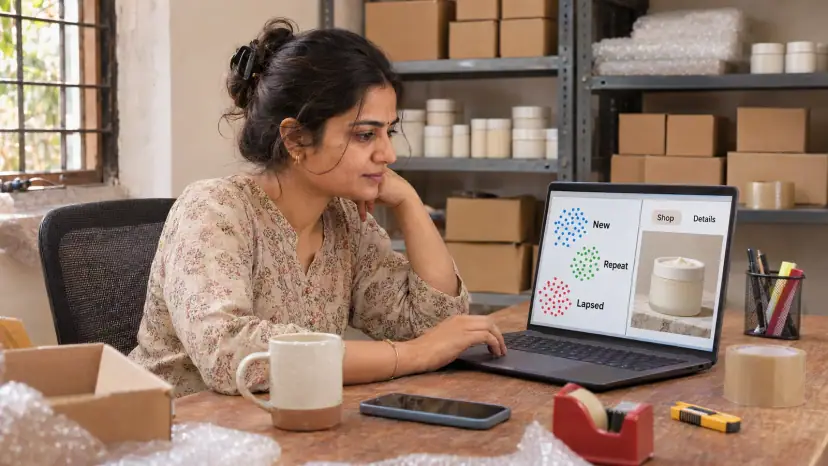
Customer segmentation: Models group customers by what they buy, how often, at what price and through which channel, and estimate lifetime value. Instead of one campaign for everyone, you can treat loyal buyers, deal seekers, gift buyers and lapsing customers differently. Segments update as behaviour changes.
Product recommendations: Recommendation engines suggest products based on browsing, purchases and what similar customers bought, on the website, in emails and in WhatsApp messages. Good recommendations respect stock levels and do not push items that are out of stock or often returned.
Social commerce: Instagram, Facebook and YouTube are where most D2C brands are discovered. AI helps plan content, draft captions, test creative and manage ad budgets, and shoppable posts link straight to products. We read results against real orders from your store, not only platform-reported sales. See also our page on AI for social media marketing.
WhatsApp marketing automation: WhatsApp is often the most direct channel to Indian shoppers. Through the WhatsApp Business Platform, brands can send order updates, cart reminders, reorder prompts and launch news to customers who have opted in, and answer questions with a chatbot that hands over to staff. Messages are personalised from purchase history, and every customer can stop promotional messages easily.
Influencer identification: Tools search creators by audience, engagement quality and fit, flag suspicious follower growth, and track links and codes so you can see which creators bring real sales. Every brief includes the required ad disclosure and approved claims.
Pricing and promotions: Models estimate how sensitive each product and segment is to price, so offers go to customers who need a reason to buy, not to those who would pay full price anyway. For sales events, they help decide which products to discount and by how much. Our AI for pricing optimization page covers this in more depth.
Cart recovery and checkout
Abandoned carts are normal in online shopping. Baymard Institute's 2026 cart abandonment page puts the average documented rate at 70.22%, based on 50 studies. Among shoppers who left for a reason other than just browsing, 40% said extra costs such as shipping, tax and fees were too high.
That points to two kinds of work. Recovery messages by email, SMS or WhatsApp bring some shoppers back. Fixing the causes, such as surprise delivery charges, forced account creation or a long checkout, recovers more. AI can sort abandoners by likely reason so each gets the right message, but the checkout itself should be fixed too.
Advertising rules for D2C brands
Product claims need care, especially in beauty, personal care, food and wellness. The Advertising Standards Council of India's 2024-25 complaints report listed personal care at 5.7% of cases, and said ASCI investigated 1,015 influencer ads, of which 98% required modification. AI-written copy can repeat claims a brand cannot prove, so every claim is checked against approved product information before it goes live.
Customer data rules apply too. India's Digital Personal Data Protection Act, 2023 governs how you collect and use shopper data, and its main duties start on 13 May 2027. Clear notices, opt-ins for marketing messages and easy opt-outs are worth building into your store and WhatsApp flows now.
What D2C brands work towards
- Lower acquisition cost: Spend focused on audiences and creative that bring profitable first orders.
- Higher lifetime value: More customers coming back for a second and third order.
- Larger orders: Relevant bundles and add-ons that customers actually keep.
- Less dependence on paid ads: More revenue from email, WhatsApp, search and repeat buyers.
For tools that fit together for a direct brand, see the AI stack for D2C brands.
AI marketing workflow for D2C brands
Acquisition must be connected to inventory, fulfilment and contribution margin. The first brief should name the commercial limit, such as margin, stock or delivery capacity, rather than simply asking for more traffic.
This is a suggested planning workflow, not a case study or a promise of results. It lets founders, growth and operations staff agree the work around orders and margin before anyone picks a tool.
Creative and product fit: Link campaign creative to the product's real use, price and availability. Compare messages within the same product category and keep product and health claims subject to brand approval.
Order quality: Join campaign data to paid, fulfilled, cancelled and returned orders. Separate new buyers from repeat customers before deciding whether a channel brings new business.
Lifecycle follow-up: Build reorder and cross-sell messages from actual purchases and preferences. Do not promote an unavailable product, and make it easy to stop promotional messages.
What to measure: Track contribution from fulfilled orders, return rates and repeat purchases alongside acquisition cost. Keep platform-attributed revenue and reconciled order revenue separate. An attribution tool supports decisions; it does not prove extra sales on its own.
To get started, bring your approved offer, your current checkout and order process, a summary of your store and campaign data, and the person who signs off brand content. Before any store or ad account is connected, agree who grants access and which order event counts as the result.
Local D2C Brands Planning Guides
Choose a city for official local references, enquiry information and a reviewed workflow. Each guide covers D2C brands we serve from Noida; none of them points to a local branch office.