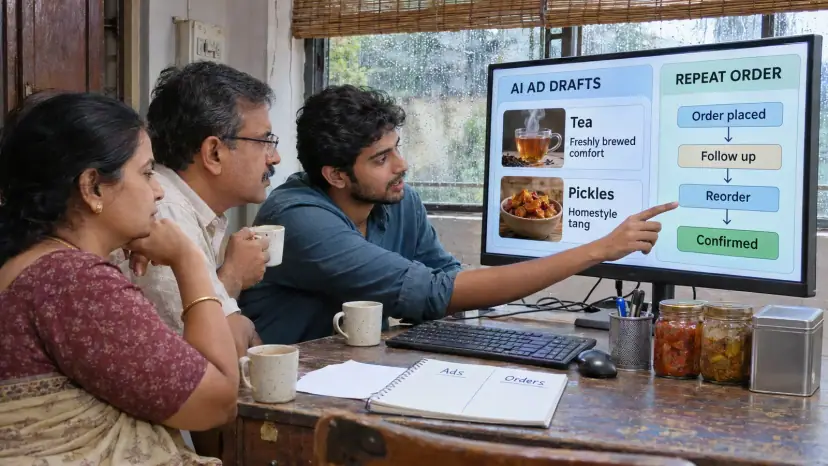
Guwahati D2C brands: the evidence behind positioning and an honest repeat-purchase count
Two jobs sit at the centre of this guide for D2C teams with Guwahati customers: showing the evidence behind product positioning, and measuring repeat purchase honestly. You will see which details to gather, where the local source lives, which tasks an assistant can take on and which decisions stay with a person. Read the workflows as planning examples, because they do not report results for any Brainguru client. Anything we offer would be scoped to your real business, data and permissions.
Kamrup Metropolitan first, then the wider Northeast
For official Guwahati local information, the starting point is the Kamrup Metropolitan administration. Never merge a Guwahati city audience with every destination labelled Northeast India. A pickup, meeting or operating address also needs to stay apart from a wider regional service request.
The source to open is Kamrup Metropolitan district. Use it for administrative context only; it proves no market demand or commercial availability and endorses no private business. In the D2C record, enter the Guwahati address and list any Northeast destination on its own line. After that, compare the location with the brand’s approved business record. A reviewer clears any mismatch before a page or assistant gives directions, coverage information or an appointment instruction.
What a Guwahati product enquiry brief should hold
Printing a city name next to an unrelated national offer helps no one, so let these fields form a working brief. Every statement in it should trace to a source and a reviewer. Unavailable details get recorded and sent to a person, never filled by an AI assumption.
- Product and variant: Say which product and variant the buyer means, with the Guwahati address on one line and any Northeast destination on another. Use the address where the brand truly operates, whoever the ads reach.
- Approved benefit/ingredient evidence: Hold the approved wording for each benefit or ingredient, its limits and the reference it currently rests on.
- Delivery and return limits: List the details needed to confirm whether this order can be delivered or returned. Unknowns become review questions, not assumed answers.
- Customer preference/permission: File the buyer’s stated preference with approved evidence of it and its latest version, because neither a photograph nor a city name proves consent.
- Support or replenishment enquiry: Capture what the buyer wants done next and the facts needed, and file unsupported or misrouted requests separately.
- Brand/fulfilment reviewer: Show who in brand or fulfilment signs off the answer or action, so no next step is offered without them.
A commercial or professional next step reaches an illustrative Guwahati buyer only after the location check and the approved benefit or ingredient evidence check have passed. A failure stays open in the handoff, giving the receiving team a concrete question, not a falsely qualified lead.
Giving AI the catalogue work and people the decisions
First line up the claimed benefit with the real product and the buyer’s permitted question. From there, AI can organise catalogue discovery, draft copy for a reviewer to read and point out support requests nobody has resolved. Acquisition, a first paid order, a fulfilled order and a repeat purchase each need their own count. Replenishment reminders honour the customer’s preferences, and one order gives no licence to send every promotional sequence forever.
Limit connections to sources and systems the brand has authorised: the approved knowledge pack, the operational system that applies and a CRM or intake route if one is needed. Each variant or return answer should carry its source version. Live customer data waits until access permissions and editing rights have been tested. Think of a draft, prediction or extracted field as help for the reviewer, never as a commercial promise.
Picture a customer who orders a snack box, finds one item broken and asks for a refund. Under a loose count, the order would appear as a purchase and the refund as a support cost, and the brand might later send her a reminder for the same box. A cleaner record marks the order as returned, keeps the reason, and holds the reminder until someone checks it. The assistant can draft the apology, but support approves the refund wording and decides whether a replacement is possible from the delivery PIN code.
Lines a D2C brand should not cross
Health benefits, sustainability credentials, celebrity endorsements and review volume must all be real, never invented. False countdowns and subscription enrolment with no explanation have no place either. Assess repeat purchase after allowing for returns and cancellations, because an ad click is not brand loyalty.
Assamese and English, local presence and what to measure
If your audience needs Assamese and English, ask competent speakers to review the terms, locality names and proposed next step. Assess these languages together; we do not claim that all customers use them or that we supply each translation. The actual address and a single contact route should match on the page and in business records, with no extra offices or profiles added to fake a Guwahati presence.
A Guwahati shopper may be in one place while the requested service is fulfilled in another, so separate the two. Enquiry routing and page wording should rely on the approved serviceable area. Follow five stages independently: product enquiry, delivery or product check, paid order, fulfilled order, then permitted repeat purchase. Leave rejected, cancelled and unsupported requests in the numbers, since a conversation or click earns nothing by itself.
Try the workflow on a changed formulation, a negative fit question, a cancelled subscription and a customer turning down further promotions. Hold spend steady until reviewed outcomes have been compared with the brand’s own baseline. When a search query carries the wrong intent, fix the answer or handoff it leads to. We give no assurance on rankings, AI-answer inclusion, lead volume or return on investment.
Where Assamese product names or descriptions are used, ask a customer who reads the language to say back in her own words what the pack contains. If the answer differs from the label, the copy needs fixing before it is repeated in advertising. In the first weeks, watch whether complaints cluster around one claim or one delivery area. A pattern like that should change the plan before spend increases.
Further reading and your first conversation
For the industry scope, read D2C Brands solutions. For implementation detail, see GA4 Setup for Indian eCommerce (2026): Step-by-Step Configuration, Ecommerce Events + Consent Mode V2, which covers a related workflow but does not show any Guwahati client engagement.
In Guwahati you can also plan around E-Commerce or Logistics & Supply Chain. The Guwahati and other city guides put supported information and official references side by side.
For a free consultation, have four things ready: the actual product and variant, your approved benefit or ingredient evidence, approved source material and the reviewer with authority over the next step. The delivery work happens at our Noida office, and we claim no branch in Guwahati. Scope, integrations and on-site work are agreed for each case.
Local and sector resources date from a check on 5 October 2026; look again at current instructions before a campaign change. Images here are illustrative of the topic and do not verify any local office, customer or facility.