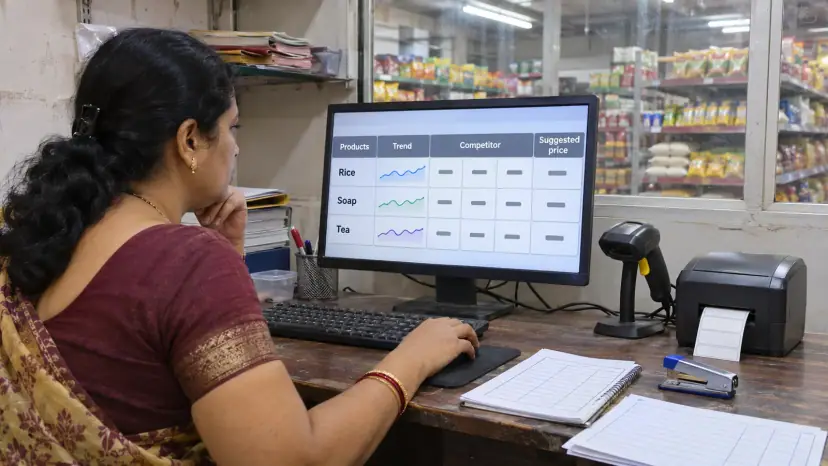
AI for pricing optimization uses your sales, cost, competitor and demand data to recommend prices that meet a goal you choose, such as margin, revenue or market share. This page covers dynamic pricing, competitor price tracking, demand-based pricing, bundles, price elasticity and margin control, for companies pricing many products or negotiating B2B deals, plus the rules that keep pricing fair.
Why pricing deserves better data
Price is one of the fastest levers on profit, because a small change flows straight to the bottom line when volumes hold. Yet many companies still set prices with cost-plus formulas, occasional competitor checks or instinct. Those methods ignore how demand actually responds, and they cannot keep up with thousands of products, several channels and competitors who change prices often.
Competition makes this harder. In Crayon's 2025 State of Competitive Intelligence report, sellers were up against competitors in 68% of deals. Pricing is usually one of the first things a buyer compares.
AI pricing tools process transaction history, competitor prices, seasonality, inventory and customer behaviour, and test many pricing scenarios faster than any team can. They recommend; your pricing rules and people decide. Adoption is now mainstream: the Stanford AI Index 2025 reports that 78% of organisations used AI in 2024, up from 55% the year before.
AI for pricing optimization: six capabilities
Dynamic pricing: Prices adjust as demand, stock, time and competitor activity change. Platforms such as PROS, Pricefx and Zilliant run models across many products, segments or regions at once. The essential part is the guardrails: minimum and maximum prices, limits on how often a price can change, and rules that keep a customer's price stable during a session.
Competitor price tracking: Tools such as Prisync, Competera, Intelligence Node and Price2Spy collect prices from competitor websites and marketplaces, match products even when names and pack sizes differ, and normalise for shipping, bundles and offers. Alerts tell your team when a competitor makes a significant move. Our AI for competitor analysis page covers the wider monitoring that this feeds into.
Demand-based pricing: Forecasting tools such as Blue Yonder, o9 Solutions and Anaplan model demand by product, location and period, using sales history, promotions, events and weather. Prices then follow demand, which matters most where capacity is limited and perishable, such as hotel rooms, event tickets and transport.
Bundle optimisation: Transaction data shows which products are bought together. Models test bundle combinations and discount levels to raise basket size without giving away margin, and can suggest bundles to individual customers at checkout, using the same customer profiles described on our AI for personalization page.
Price elasticity analysis: Elasticity, how demand changes when price changes, is the core of pricing. Machine learning estimates it by product, segment, channel and period, including cross-effects where one product's price changes demand for another. Causal methods separate the effect of price from seasonality and advertising, so you can see where you have pricing power and where a lower price would raise total profit.
Margin optimisation: Cost data from your ERP joins pricing and demand models, so recommendations target profit, not just revenue. Price waterfall analysis shows which discounts, rebates and concessions erode margin between list and net price, and deal desk tools give sales real-time margin guidance during negotiations.
Pricing rules you must respect
Regulators watch automated pricing closely, and fairness rules apply even when an algorithm sets the number.
- India: The Central Consumer Protection Authority issued the Guidelines for Prevention and Regulation of Dark Patterns, 2023 on 30 November 2023, listing 13 specified dark patterns, among them drip pricing and false urgency. In November 2025, 26 leading e-commerce platforms declared compliance after self-audits to remove dark patterns. Show the full price early, and do not invent scarcity.
- UK example: After the Oasis ticket sale, the UK Competition and Markets Authority opened a case on 5 September 2024 into how so-called dynamic pricing may have been used. On 15 September 2025 Ticketmaster signed undertakings to tell fans 24 hours in advance if tiered pricing will be used, give more price information in online queues, and report to the CMA for the next 2 years.
- Competition law: Pricing tools must not become a way to coordinate prices with competitors, for example by sharing confidential price data through a common vendor.
- Personal data: Prices based on personal data raise privacy questions. In India, the Digital Personal Data Protection Act, 2023 applies to the customer data used.
How Brainguru implements AI pricing optimization
- Pricing diagnostic: We review your current prices, price architecture, discount policies, competitive position and profitability to find where better pricing would matter most.
- Design: We choose the methods and tools that fit your business and data, building custom models only where existing tools fall short.
- Integration: We connect pricing models to your e-commerce platform, ERP and sales tools, with guardrails agreed with your team.
- Phased rollout: We test new prices on a subset of products or regions against a control group before wider rollout.
- Change management: We help train sales teams and plan communication with channel partners and customers, since pricing changes affect many people.
- Ongoing refinement: We monitor results, retrain models and adjust rules as costs and markets change.
Phasing matters because many AI projects stall after the first test. In July 2024, Gartner predicted that at least 30% of generative AI projects would be abandoned after proof of concept by the end of 2025, citing poor data quality, weak risk controls, rising costs or unclear business value. Clear goals and clean data from the start reduce that risk.
Choosing the right approach for your business
E-commerce and retail: Competitor tracking, elasticity and bundle optimisation usually come first, with dynamic pricing on fast-moving lines. Checkout is where price surprises hurt most: the Baymard Institute puts the average documented cart abandonment rate at 70.22%, based on 50 studies, in a list updated in September 2025. Our AI solutions for ecommerce cover the wider store setup.
SaaS: Packaging, plan limits and discount discipline matter more than frequent price changes. Test prices with new customers before changing them for existing ones, and watch renewal behaviour closely; AI for customer retention covers the churn signals to monitor.
Hospitality, events and travel: Demand-based pricing for limited capacity, with clear rules on how prices are shown.
B2B with negotiated prices: Price guidance by deal type, discount bands and margin alerts at the deal desk give the fastest gains, because inconsistent discounting is often the largest leak.
Pricing works well alongside demand planning; see AI for sales forecasting for the forecasting side.
Common pricing mistakes with AI
- No guardrails: Letting a model move prices without limits invites errors and customer anger.
- Optimising revenue, not profit: Without cost data, models may push volume at a loss.
- Ignoring customer perception: Frequent, unexplained changes erode trust even when each change is small.
- Skipping control groups: Without a comparison, you cannot tell whether a pricing change caused the result.