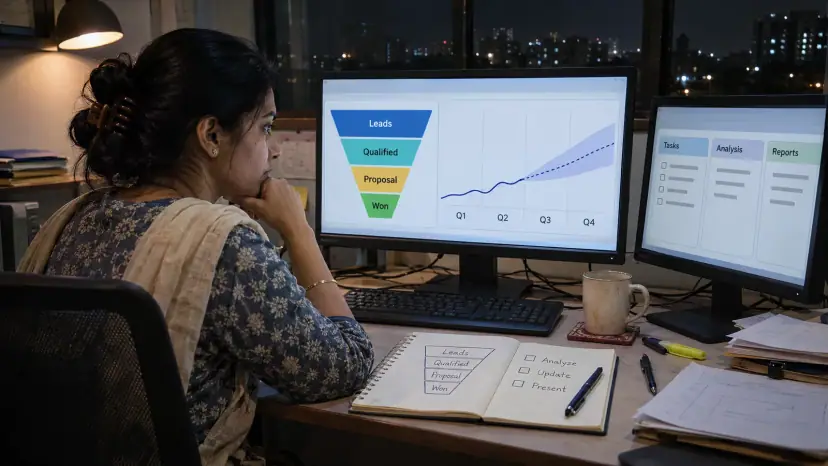
AI for sales forecasting uses your CRM history, current pipeline and outside signals to estimate how much revenue will close, and when. Brainguru builds these forecasting models for sales and finance leaders who plan hiring, budgets and cash on the numbers, so the forecast rests on data and the sales manager's judgment rather than on optimism alone.
Why manual sales forecasts miss
Most forecasts still start with each rep saying which deals will close. That estimate is honest but subjective. Optimistic reps count deals too early, cautious reps hold them back, and new reps have little history to judge by. When those calls are added up into one company number, the errors rarely cancel out.
Stage-based probabilities in a CRM do not fix this on their own. A rule that says every deal in "proposal" has a 50% chance treats a deal with an engaged budget holder the same as one that has gone quiet for three weeks. The forecast looks precise, but it is only as good as the stage definitions and how strictly reps follow them.
The cost shows up elsewhere in the business. Hiring is planned for growth that does not arrive, stock is bought for demand that does not appear, and leadership loses confidence in the number, so it starts adding its own buffers. A better forecast does not remove uncertainty. It measures it, so you can plan around it.
Sales teams already have AI tools in reach. In the Salesforce State of Sales 2026 survey of 4,050 sales professionals, 87% of sales organisations said they use some form of AI for tasks such as prospecting, forecasting, lead scoring or drafting emails. Using a tool and trusting its forecast are different things, which is where careful model building matters.
How AI for sales forecasting works
A forecasting model learns from deals you have already won and lost. It looks at what those deals had in common at each stage, then scores open deals against the same patterns. The main pieces are:
- Deal scoring: Each open deal gets a close probability based on its own signals: stage history, time in stage, deal size, number and seniority of contacts, activity in email and meetings, and how similar deals ended.
- Revenue ranges: Instead of one number, the model gives a likely range for the period, with best, expected and worst cases based on the real spread in your history.
- Timing: The model estimates when a deal is likely to close, not only whether it will, which matters for monthly and quarterly plans.
- Seasonality: Repeating patterns such as financial year ends, festival seasons, budget cycles or summer slowdowns are learned from several years of data where you have it.
- Team effects: New hires ramp up, territories differ and some reps are stronger in certain segments. The model can weight deals by who owns them and where they sit.
- Outside signals: Where it adds accuracy, the model can include market data such as price changes, economic indicators or website demand. Each signal is tested before it is kept.
The output is a forecast leaders can question. If the number drops, the system should show which deals moved and why, for example a stalled deal with no next meeting booked, or a large deal whose close date slipped twice.
What data does a forecasting model need?
Data quality decides the result more than the choice of algorithm. A model trained on a CRM where close dates are never updated and lost deals are never marked lost will learn the wrong lessons.
This is a common problem. In the same Salesforce 2026 survey, 51% of sales leaders with AI said disconnected systems were slowing their AI work, and 74% of sales professionals said they were focusing on data cleansing. High performers were more likely to prioritise data hygiene: 79%, against 54% of underperformers.
Before modelling, we check these points with your team:
- Deal history: At least 12 months of deals with creation dates, stage changes, close dates and outcomes. Two years or more captures seasonality better.
- Volume: Enough closed deals, won and lost, for the model to see patterns. A few dozen deals a year needs a simpler approach than a few thousand.
- Stage definitions: Clear entry and exit rules for each stage, applied the same way by every rep.
- Activity data: Emails, calls and meetings logged against deals, either automatically or by habit.
- Finance data: Booked and invoiced revenue, so the forecast can be checked against what actually arrived.
Where the data has gaps, the first piece of work is often fixing CRM hygiene and automating data capture through CRM sales automation, so the model has something reliable to learn from.
How a forecasting project runs
- Discovery: We learn your sales process, deal types and planning cycle, review data quality across the CRM and finance systems, and agree how accuracy will be measured.
- Model building: We test several modelling approaches on your history and pick the one that performs best on periods it has not seen. This backtesting shows how the model would have done in past quarters before anyone relies on it.
- Integration: Forecasts appear inside the CRM or reporting tool your team already uses, alongside the rep-submitted forecast, so the two can be compared.
- Calibration: In the first months, forecast and actual results are reviewed together with sales leaders, and the model is adjusted where it is consistently off.
- Ongoing support: Markets, products and teams change, so the model is retrained on a schedule and monitored for drift.
The models themselves are built by our AI model development team, using the same testing discipline we apply to other predictive work.
AI forecasting and the sales manager's judgment
A model sees patterns across hundreds of deals. A manager knows that a customer's CFO just changed or that a competitor dropped its price last week. Both views matter, and the best forecasts combine them.
In practice, the model handles the volume: scoring every deal, flagging risk and producing the base forecast. Managers spend their time on exceptions, the deals where they know something the data does not. When a manager overrides the model, the reason is recorded, and over time you learn whose judgment adds accuracy and where the model is stronger.
This also changes the forecast meeting. Instead of asking every rep to talk through every deal, leaders can focus on the deals the model marks as at risk or uncertain. That matters because selling time is scarce: the Salesforce survey found the average seller spends 40% of their time selling.
Common mistakes to avoid
- Skipping the data audit: Training a model on messy CRM data produces confident numbers that are wrong.
- Judging on one quarter: Accuracy should be measured over several periods and by segment, not on a single lucky or unlucky month.
- Hiding the reasons: A forecast nobody can explain will not be trusted. Show the deals and signals behind each change.
- Leaving finance out: The forecast should reconcile to booked revenue, so finance needs to agree the definitions from the start.
- Set and forget: A model trained before a price change or a new product launch will drift unless it is retrained.
What affects the cost of a forecasting project?
We quote after scoping, because effort varies widely. The main factors are the number of systems to connect, the state of your CRM data, how many products, regions and segments need separate forecasts, whether outside data is included, and how much ongoing monitoring and retraining you want. A focused first version for one sales team and one product line is usually the sensible start.
Questions to ask before you start
- Accuracy: How will forecast accuracy be measured, and against which baseline?
- Explanation: Can the system show which deals and signals drive the number?
- Ownership: Who owns the model, the code and the data at the end of the project?
- Fit: Will forecasts appear in the tools your team already uses?
- Upkeep: How often is the model retrained, and who watches for drift?
Forecasting often sits alongside lead quality work, and B2B teams with long sales cycles may also want to read about AI marketing for B2B. We are happy to talk through your data and goals in a free consultation.