An AI marketing strategy should explain which business problem is being addressed, why an AI-assisted approach is worth testing and how the result will be evaluated. It should also say where better measurement, a simpler workflow or a human decision is preferable. Brainguru scopes strategy around those choices rather than promising predictable revenue from an algorithm.
This service is the planning layer of AI marketing solutions. Marketing automation implements agreed workflows; marketing analytics supplies measurement and analysis. A strategy engagement should connect those workstreams without treating a tool subscription or dashboard as the strategy itself.
Start with a decision the business can act on
Define one objective and the constraint around it. A B2B team may need more suitable sales conversations, a retailer may need better repeat-purchase communication, or an operations team may need to reduce repetitive campaign administration. These are different problems with different evidence. “Use AI to grow” does not identify the audience, acceptable cost, decision owner or success measure.
- Objective: the specific business outcome and the process it depends on.
- Audience: the customer or account group and the task they need help with.
- Baseline: how the current workflow performs, including failures and exclusions.
- Constraint: budget, data access, staff capacity, brand or specialist review needs.
- Owner: the person who can approve an experiment, interpret evidence and stop unsuitable work.
Audit the measurement before forecasting a result
Map the path from source visit to enquiry, qualification and eventual outcome. Check event definitions, duplicate submissions, CRM statuses and the delay between first contact and a sale. A form submission can be a spam message, an existing customer asking for support or a genuine prospect. Combining these into one conversion makes campaign comparisons unreliable.
Use authorised access to the relevant analytics, advertising and CRM records. Start with aggregated or minimised data where it is sufficient; do not collect additional personal information just because a model could consume it. Google Analytics event documentation describes event measurement. Business outcomes still require agreed definitions and reconciliation with the operational system.
Check how far back the data goes, too. Google's data retention help page shows that a standard GA4 property keeps user-level data for either 2 months or 14 months. A strategy that depends on comparing seasons or years needs raw data exported to a store the business controls.
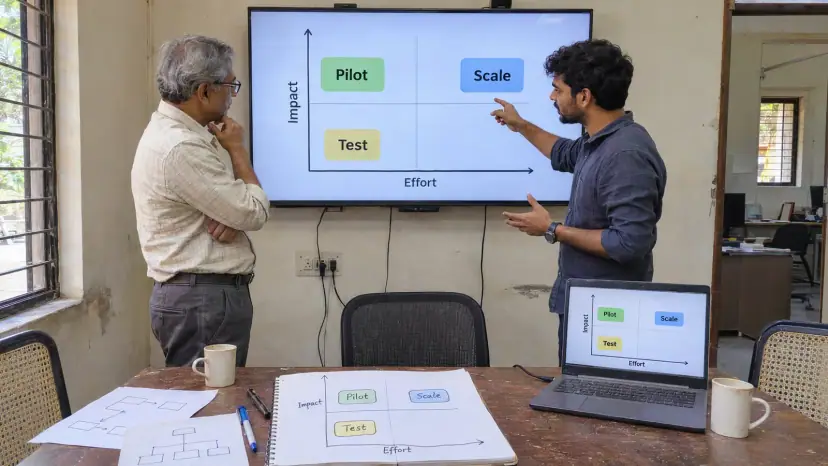
Prioritise use cases by evidence and implementation effort
Many AI projects stall between the demo and daily use. In July 2024, Gartner predicted that at least 30% of generative AI projects would be abandoned after proof of concept by the end of 2025, citing poor data quality, inadequate risk controls, escalating costs or unclear business value. Ranking use cases on evidence and effort is how a strategy avoids that pattern.
- Knowledge-assisted enquiry routing: useful when approved answers and handoff owners exist. Evaluate incorrect answers and unresolved questions as well as speed.
- Content assistance: useful for drafts, variants or classification with editorial review. Factual accuracy and usefulness need checking before publication.
- Audience or lead scoring: consider whether historical labels are reliable and whether the output improves the actual staff decision.
- Forecasting and budget modelling: consider data volume, campaign changes, seasonality and whether predictions can be evaluated on later outcomes.
- Workflow automation: begin with a bounded task and a rollback or manual route when dependencies fail.
Keep an option to use a simpler process. A rules-based routing change may be easier to maintain than a model when the enquiry types are few and well-defined. The prioritisation document should state the assumed benefit, required data, risks, reviewer and evidence that would justify further work.
Illustrative B2B experiment: improve the sales handoff
A software supplier receives many enquiries but sales staff repeatedly ask for the same missing project information. A proposed experiment adds a clearer brief and assisted classification to one landing-page journey. The hypothesis is that more requests will contain the information needed for a useful first conversation, not that a chatbot will automatically increase revenue.
Agree the qualification fields and review a sample manually. Measure completed briefs, suitable sales handoffs, false classifications, staff corrections and eventual outcomes. Keep comparable audience and campaign conditions where possible. A before-and-after increase can be influenced by spend, seasonality or a different offer; attribution reports alone do not establish causation. This example is a planning exercise, not an aggregated client result.
Budget scenarios should show assumptions and uncertainty
Budgets are rarely growing to make room for AI. Gartner's 2025 CMO Spend Survey, reported by Campaign Asia, found marketing budgets holding at 7.7% of company revenue, with half of CMOs at 6% or less. AI work usually has to be funded from existing spend, so the scenarios need to show what it replaces.
Separate implementation cost, platform charges, human review and ongoing operation from media spend. Create scenarios tied to plausible traffic, qualification and downstream conversion assumptions. Label unknowns clearly and examine what happens if a key assumption is worse than expected. A precise spreadsheet output is not proof that the forecast is accurate.
Use model forecasts only where data and an evaluation justify them. Record the comparison baseline and how later results will be used to reassess the recommendation. Do not treat predicted ROI, AI-generated content volume or a change in click rate as proven commercial value. Marketing service cost planning helps frame the scope discussion; actual commitments require an agreed proposal.
What a scoped strategy engagement can deliver
- A current-state audit with measurement gaps, data-access constraints and a documented baseline.
- A prioritised set of hypotheses with audience, channel, evidence needs and accountable owners.
- A proposed experiment plan: success criteria, negative cases, review points and stop conditions.
- A budget scenario sheet with assumptions, external costs and uncertainty separated.
- An implementation roadmap that sequences dependencies, approval gates and handoffs.
- A reporting specification with business outcomes and operational measures defined separately.
The proposal should identify which deliverables are included and whether implementation, dashboards, integrations or ongoing review are separate work. The roadmap should reflect actual dependencies rather than promising that every organisation needs the same 12-month plan or fixed 30/60/90-day rollout.
Review, then expand only what the evidence supports
Run the agreed pilot with the necessary approvals and review its results against the baseline. Check who benefited, which requests were excluded and whether staff had to correct the system. Decide to continue, revise or stop. Record the reason so that a disappointing result can improve the next decision rather than disappear from the presentation.
For an early-stage team, read the startup AI marketing strategy guide. If you are still weighing the change itself, traditional marketing vs AI marketing sets out where each approach fits. Fintech marketing and manufacturing marketing illustrate why review and buyer intent differ by sector; their workflows should not be copied indiscriminately into another business.
What an AI marketing strategy consultant does, and does not do
An AI marketing strategy consultant helps a business decide where AI is worth testing in its marketing, what evidence is needed and how the work will be governed. The useful output is a set of decisions, not a list of tools. Access to AI is no longer the hard part: the Stanford AI Index 2026 reports that organisational adoption reached 88%. Using it well is. A consultant should:
- Review objectives, funnel definitions, data access and team capacity before recommending anything.
- Separate problems that need better measurement or process from problems where AI could help.
- Prioritise a small number of experiments with owners, success measures and stop conditions.
- Flag data-protection, brand and accuracy risks, and the human review each use case needs.
- Leave the internal team able to run and judge the experiments, rather than dependent on the consultant.
A consultant should not promise revenue, rankings or lead volume, resell a single tool as the strategy, or ask for raw customer data before there is a clear purpose and an agreement covering it.
A typical shape for a strategy engagement
| Phase | What happens | Output |
|---|---|---|
| Discovery | Interviews with marketing, sales and leadership; review of goals, channels and constraints | Agreed objective, scope and decision owner |
| Measurement and data audit | Check analytics events, CRM stages, consent and data access | Baseline and list of measurement gaps |
| Opportunity prioritisation | Score candidate use cases by value, evidence, effort and risk | Short list of hypotheses with owners |
| Pilot design | Define the experiment, sample, review steps and stop rules | Pilot plan and reporting specification |
| Roadmap | Sequence dependencies, budget scenarios and approval gates | Implementation roadmap |
The duration depends on the size of the business, how much data is accessible and how quickly stakeholders can meet. A focused engagement for one team or product line is often a matter of weeks; a multi-brand organisation takes longer. The proposal should state the phases, deliverables and review points rather than an open-ended retainer.
In-house team, consultant or agency?
| Option | Best when | Limits |
|---|---|---|
| In-house team | You have analytics and marketing operations skills and need ongoing ownership | Can lack an outside view of options and risks |
| Strategy consultant | You need an independent plan, prioritisation and pilot design | Implementation is usually separate work |
| Agency | You want planning and execution from one partner | Check that recommendations are not limited to services the agency sells |
If you mainly need help choosing and governing AI across the business, not only in marketing, our AI consulting services cover that wider scope.
A practical combination is a consultant-led strategy and pilot design, with implementation by the in-house team or an AI marketing agency, and the consultant reviewing results at agreed points.
How to choose an AI marketing strategy consultant
- Ask for an example of a pilot they stopped, and why. Honest answers show judgement.
- Ask how they handle personal data and which access they need at each phase.
- Check that deliverables are named and owned by you, including any prompts, workflows and dashboards.
- Ask how results will be measured against a baseline rather than reported as tool activity.
- Confirm who does the work: the people in the pitch or a different team.
Data protection in India
AI marketing often touches personal data: customer lists, CRM records, chat transcripts and website behaviour. India's Digital Personal Data Protection Act, 2023 requires a lawful purpose and, in most cases, consent that is free, specific and informed, along with data minimisation and reasonable security safeguards. The Digital Personal Data Protection Rules, 2025 phase in most obligations, with the bulk applying from 13 May 2027. A strategy should therefore state which personal data each use case needs, the purpose it was collected for, which vendors process it and how long it is kept. Governance often lags behind use. IBM's Cost of a Data Breach Report 2025 found that only 37% of organisations in India reported having AI access controls in place, and nearly 60% either had no AI governance policy or were still developing one. A strategy should name who may use which AI tools with which data. For EU or UK audiences, GDPR obligations apply as well. This is planning guidance, not legal advice; confirm specific obligations with counsel.
Prepare for a strategy consultation
Bring the business objective, current funnel definitions, a summary of available data, campaign constraints and the decision-maker for implementation. You do not need to send raw customer records through a public contact form. We deliver from Noida; strategy, implementation and ongoing support are agreed separately, and we do not promise rankings, lead volume or ROI.