In this article
- The Post-Funding-Winter Reckoning: Why Indian EdTech Marketing Has to Change
- Segment-Specific AI Marketing Approaches
- Five AI Plays That Tend to Work for Indian EdTech in 2026
- The Indian EdTech AI Marketing Stack (Three Tiers)
- Benchmarks: How to Think About Your Numbers
- An Illustrative (Hypothetical) Turnaround Scenario
- What NOT to Do: Common AI Marketing Mistakes Indian EdTechs Make
- Cost and ROI: Model Your Own Numbers
- Frequently Asked Questions
- The Bottom Line
- Where Brainguru Can Help
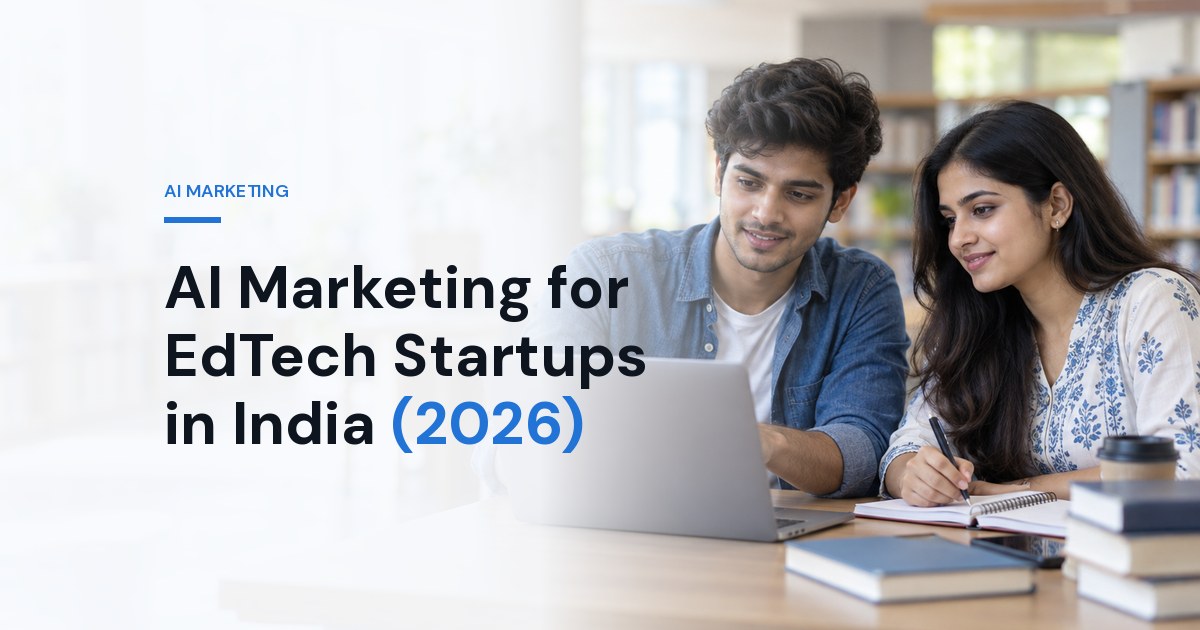
Indian edtech in 2026 looks nothing like Indian edtech in 2021. The funding environment has tightened, several once-dominant brands have pulled back hard on marketing spend, and student acquisition cost has climbed for paid courses. Parents have grown sceptical of "guaranteed results" pitches, and short-form video content is now the price of entry rather than a differentiator.
Yet some Indian edtechs are growing profitably right now. The ones doing it tend to share an approach: they've replaced spray-and-pray performance marketing with AI marketing for edtech, an operating model that uses machine learning to qualify leads before spending media on them, generate regional-language creative at scale, and nurture parent-student decision dyads with personalisation.
This is a practical 2026 playbook for K-12, test-prep, upskilling, and B2B edtech founders. It's specific to the Indian market (parent decision-makers, vernacular audiences, mobile-first) and structured so a small marketing team can implement it.
The Post-Funding-Winter Reckoning: Why Indian EdTech Marketing Has to Change
Three structural shifts have made the old edtech playbook untenable.
The funding climate compressed unit economics. When growth-at-all-costs capital was abundant, edtechs could tolerate a CAC higher than near-term LTV, with burn justified by topline growth. Today, investors want a much shorter payback horizon. CAC has to come down, or LTV has to go up. Usually both.
Trust eroded faster than brand could rebuild. Aggressive sales tactics across parts of the sector poisoned the well. Parents now research multiple alternatives before any purchase, read community threads and reviews, and ask for free demos as a screening filter. Your funnel got longer, even as runway got shorter.
The Bharat-tier audience went mobile-first and vernacular. A large and growing share of new edtech users come from tier-2 and tier-3 cities. They watch Reels in Hindi or regional languages, transact in WhatsApp, and often don't engage with English landing pages. If your funnel was built for English-speaking metro buyers, you may have been quietly bleeding pipeline.
AI marketing isn't a silver bullet for any of these. But it's a credible operating system to address all three at once: predictive scoring for unit economics, personalisation for trust, and generative regional content for the Bharat audience.
Segment-Specific AI Marketing Approaches
The biggest mistake Indian edtech CMOs make is treating "edtech" as one segment. K-12 marketing has little in common with adult upskilling. Here's how each segment tends to behave.
K-12 (Parent-Driven, Vernacular, WhatsApp-First)
K-12 in India is typically a parent purchase, not a student purchase. The student influences but usually doesn't decide. That changes everything about your funnel.
What tends to work: WhatsApp-first acquisition (parents are on WhatsApp, not Discord), regional language video creative (Hindi for Bharat tier; Tamil/Telugu/Kannada/Marathi for southern and western markets), and AI-personalised follow-ups timed to school holiday cycles.
What tends not to work: Reels chasing the student, English-only landing pages, and "study from anywhere" hooks; parents generally want structured outcomes, not flexibility.
Test Prep (JEE, NEET, CAT, UPSC, GATE)
Test prep is high-intent, comparison-heavy, and content-driven. Aspirants often spend many months researching before purchasing. The AI plays here differ from K-12.
What tends to work: AI-assisted comparison content, free-content-led acquisition (mock tests, doubt-solving), a Telegram and YouTube ecosystem (where serious aspirants congregate), and AI-personalised study planners as a hook.
A high-converting acquisition pattern for test prep is a free AI-powered diagnostic test that produces a personalised study plan, followed by a paid-course pitch. Diagnostic-led flows generally convert better than generic free-trial flows because they demonstrate value before asking for payment.
Upskilling and Professional Courses
Upskilling buyers are effectively B2B2C; they're individuals buying career outcomes. Some pay personally; many get reimbursed by employers. The marketing motion is closer to B2B SaaS than B2C edtech.
Channel mix: LinkedIn ads (where professionals are), founder-led content on LinkedIn (often very effective), AI-personalised outreach to L&D heads at target companies, and partnerships with corporate HR teams. AI plays focus on lead scoring (who's actually likely to enrol vs. just window-shopping) and outcome-led nurture content.
For an adjacent perspective on B2B-style marketing motions, see SaaS Marketing Services India and AI Lead Generation for B2B Startups in India.
B2B EdTech (Selling to Schools, Colleges, Corporates)
The B2B edtech market is heating up; many schools want a digital platform, and many L&D teams want a corporate learning solution. This is account-based marketing (ABM) territory.
What tends to work: AI-driven account research (estimating which schools or companies are most likely to buy), founder-led LinkedIn outreach, multi-touch nurture sequences, and conference and event presence.
Bharat-Tier / Vernacular EdTech
This is among the largest growing segments, with a very large pool of potential vernacular learners across tier-3 and tier-4 India.
AI plays: AI-generated regional language video creative at scale, WhatsApp-led acquisition with vernacular bot interactions, and creator partnerships with regional micro-influencers (often at modest per-partnership rates).
Five AI Plays That Tend to Work for Indian EdTech in 2026
1. Predictive Enrolment Scoring
Most edtechs spend the same media budget on every form-fill. A predictive scoring model trained on historical CRM data can rank new leads by probability-to-enrol, letting you bid harder on top-quartile leads and starve bottom-quartile leads. The result is more efficient media spend rather than more spend.
Practical implementation: pull a year or more of CRM data, train a gradient-boosted model in Python, and plug the score into your Meta CAPI and Google Ads bidding via API. Results generally take several weeks of data accumulation before they stabilise.
2. AI-Generated Regional Language Video Creatives at Scale
The Bharat-tier audience watches video more than it reads. Manually producing Hindi/Tamil/Telugu/Marathi videos at scale has historically been expensive per video. With tools such as Synthesia and ElevenLabs plus a script-generating LLM, per-video cost can fall substantially, making it feasible to produce many more variants.
What this enables: a much larger library of regional video creatives per month, A/B tested across segments. Cost-per-view for vernacular audiences can drop meaningfully versus English-only creatives.
3. WhatsApp Chatbots for Trial-to-Paid Nurturing
In edtech, the gap between free trial and paid conversion is where most leads die. A well-designed WhatsApp chatbot, with parent-persona and student-persona modes, can recover a portion of trial drop-offs that would otherwise be lost.
The key pattern: the chatbot asks "who's deciding?" early. If parent, it shifts to outcome-focused messaging (results, structured curriculum, teacher quality). If student, it shifts to engagement (peer success stories used with written consent, gamification). Same lead, two different journeys.
For implementation details, see our AI Chatbot Development Services in India guide.
4. Programmatic SEO for Course × City × Exam Combinations
Indian edtech search is fragmented across thousands of long-tail intents: "JEE coaching in Kota", "CAT online classes Hindi", "12th physics tuition Hyderabad". Manually building landing pages for each is impractical. Programmatic SEO, generating templated pages at scale from a structured data source, is designed to capture this fragmented intent.
A well-executed programmatic SEO build can rank for a large set of long-tail keywords over time and contribute a meaningful share of organic traffic. The unit economics tend to work because long-tail intent often converts well at a low cost per visit compared with paid traffic. Note that programmatic SEO takes months to reach scale and must be built with genuine, useful page content to avoid thin-content risk.
5. AI-Driven Retention Modelling
Edtech often has a refund-window problem. Many courses offer short refund windows, and a share of paid users initiate refunds within that period if they don't see value early. A retention model that flags likely churn, based on usage patterns in the first few days, lets you intervene before the refund request.
The intervention: an AI-personalised email or WhatsApp message highlighting features the user hasn't explored, or scheduling a call with a customer-success rep. Done well, early intervention can reduce in-window refund rates.
The Indian EdTech AI Marketing Stack (Three Tiers)
What you need depends on stage. The cost figures below are indicative planning ranges, not quotes; actual spend varies with team size, tooling choices, and usage.
| Tier | Stage | Stack | Indicative Cost (₹/mo) |
|---|---|---|---|
| Tier 1 | Pre-Seed / Seed (early ARR) | WhatsApp Business API (AISensy/WATI), Meta + Google Ads (basic), GA4, ChatGPT, Canva Pro | ~50,000 |
| Tier 2 | Series A | Add: predictive scoring (in-house), Synthesia + ElevenLabs, HubSpot Starter, vernacular content team | ~1,50,000 |
| Tier 3 | Series B+ | Add: attribution platform, programmatic SEO infrastructure, Salesforce/HubSpot Professional, AI creative ops team | 3,00,000+ |
Benchmarks: How to Think About Your Numbers
The ranges below are indicative planning guidance to help you sanity-check your own funnel, not measured outcomes from any specific client. Your real numbers will depend on course price, segment, and channel mix. Measure your own.
| Segment | Indicative CAC (₹) | Indicative Trial → Paid | Typical Course Price (₹) |
|---|---|---|---|
| K-12 | lower | moderate | varies widely |
| Test Prep | moderate | moderate–higher | varies widely |
| Upskilling | higher | lower–moderate | varies widely |
| B2B EdTech | highest (deal-based) | account-led | varies widely |
| Vernacular / Bharat tier | lowest | moderate | varies widely |
The pattern that matters more than any single figure: vernacular and Bharat-tier acquisition is generally the cheapest per lead but lowest in ticket size, while B2B edtech is the most expensive to acquire but carries the largest deal value and longest sales cycle. Build your funnel economics around the segment you're actually in.
An Illustrative (Hypothetical) Turnaround Scenario
The following is a hypothetical, illustrative walkthrough to show how the plays above might be sequenced. It is not a real client and contains no claimed results; use it as a template for your own plan, not as a promise of outcomes.
Imagine a JEE-focused test-prep startup with a blended CAC it considers too high, modest free-trial-to-paid conversion, and an uncomfortable in-window refund rate. A staged four-month approach might look like this:
- Month 1: Build predictive enrolment scoring on existing CRM data and begin bidding harder on top-quartile predicted leads.
- Month 1–2: Launch a free AI diagnostic test as the new lead magnet (a short adaptive test producing a personalised study plan).
- Month 2–3: Replace English-only Reels with a batch of vernacular creatives across the relevant languages, using AI video and voice tooling.
- Month 3–4: Add a WhatsApp drip with parent and student persona modes, plus a refund-prevention sequence for users with low early-week usage.
The point of sequencing this way is that each play compounds: better lead quality lowers wasted spend, the diagnostic improves intent, vernacular creative widens reach affordably, and persona-aware nurture protects conversions already won. Whether, and how much, these move your metrics depends entirely on your starting point and execution. Measure before and after each change.
What NOT to Do: Common AI Marketing Mistakes Indian EdTechs Make
Over-reliance on AI-generated English creative for Bharat-tier audiences
If your audience speaks Hindi or a regional language at home, English ad creative will hit a ceiling on relevance. Use AI to generate at-scale regional content, not at-scale English.
Skipping DPDP and child-data protections
Edtech marketing often involves under-18 user data. The DPDP Act 2023 (whose children's-data provisions apply from May 2027) requires verifiable parental consent before processing minors' data and prohibits tracking, behavioural monitoring and targeted advertising directed at children; breaches of the children's-data obligations can attract penalties of up to ₹200 crore. Get a qualified compliance review. This is a legal matter, not a marketing one.
Treating WhatsApp like SMS
WhatsApp tends to earn far higher engagement than SMS, but only if you don't spam. Use it for value-add (study reminders, doubt-solving links), not promotional blasts.
Lazy AI personalisation
Generic AI-generated outputs sound like generic AI-generated outputs. Bharat-tier audiences are highly attuned to authenticity. Pair AI generation with brand-voice tuning and human review for top-funnel content.
Ignoring the parent persona in K-12 funnels
If your funnel treats the lead as a student, you'll likely convert poorly in K-12. Always ask early: "Who's making the decision?", and adjust the journey accordingly.
Cost and ROI: Model Your Own Numbers
A useful rule of thumb for early-stage Indian edtech is to aim for an LTV:CAC ratio of 3:1 or better, with a payback period your investors will accept. If you're meaningfully worse than that, improving acquisition efficiency through AI marketing is usually a higher-priority intervention than adding new channels. Model these figures with your own historical data rather than relying on industry averages.
Frequently Asked Questions
What drives student acquisition cost for Indian edtechs in 2026?
CAC varies widely by segment and is shaped mainly by course price, audience, and channel mix. Vernacular and Bharat-tier acquisition is typically the cheapest per lead, K-12 and test prep sit in the middle, and B2B edtech (selling to schools or companies) is the most expensive because it's deal-based with a long sales cycle. The most reliable number is the one you measure in your own funnel.
Can AI replace performance marketers at an edtech startup?
No, but it increases per-marketer leverage. An AI-enabled marketing team can cover more ground than a traditional one because AI handles creative generation, predictive scoring, and personalisation while humans handle strategy, brand voice, partnerships, and crisis management. The marketer's role shifts from execution to orchestration.
How do you market K–12 edtech to parents using AI?
The working approach: WhatsApp-first acquisition with vernacular content, AI-personalised follow-up timed to school cycles, parent-persona chatbot interactions that emphasise structured outcomes (not flexibility), and social proof from other parents. Avoid student-targeted creative for K-12; it generally converts poorly.
Is AI-generated content legal for marketing courses to minors in India?
AI generation itself isn't prohibited, but both the ads and the data use are regulated. Ads that address or target children must meet the CCPA's 2022 guidelines on misleading advertisements, and coaching ads must follow the CCPA's 2024 coaching-sector guidelines. On data, the DPDP Act 2023 (whose children's-data provisions apply from May 2027) requires verifiable parental consent before processing under-18 data and prohibits tracking, behavioural monitoring and targeted advertising directed at children. Consent flows should capture parent-level consent, not just student opt-in. Best practice is to design parent onboarding to explicitly include marketing consent with granular control, and to confirm the details with a qualified advisor.
What's the best CRM for an Indian edtech startup?
For pre-Series A: HubSpot Starter or Zoho CRM (affordable, fast to set up, integrate with WhatsApp). For Series A–B: HubSpot Professional or LeadSquared (LeadSquared is built for Indian high-volume lead businesses like edtech). For Series B+: Salesforce if you have a B2B motion, LeadSquared if you're pure B2C. The right answer depends on your motion, not just your stage.
How long does it take to see results from AI marketing in edtech?
It varies. Quick experiments such as WhatsApp drips and AI creative variants can be deployed in a few weeks. Predictive scoring needs enough data to stabilise, typically a couple of months. Programmatic SEO usually takes several months to reach scale. Treat any timeline as conditional on your data, execution, and starting point.
The Bottom Line
Indian edtech in 2026 is not a winner-take-all market; it's a "win-where-you-specialise" market. Generic playbooks fail because K-12, test prep, upskilling, B2B edtech, and Bharat-tier all behave differently. AI marketing is the multiplier that lets a tight team execute segment-specific playbooks at scale.
The moves that consistently help: predictive scoring to qualify before spending, vernacular creative ops at scale for Bharat tier, WhatsApp and persona-aware chatbots for nurturing parent-student dyads, and programmatic SEO for the long tail. Compliance-aware data practices for minors are the floor, not the ceiling. Get DPDP right or you'll pay for it.
If you'd like a conversation on which of these would have the biggest impact at your stage and segment, talk to our team or call us at +91-8010010000.
Where Brainguru Can Help
See AI marketing for EdTech for the channel-level detail, AI marketing for education for institution-side work, and education technology solutions if the constraint is the platform rather than the marketing. For budgeting, AI marketing pricing sets out how engagements are structured, and the AI marketing ROI calculator lets you model payback against your own numbers before committing spend.
Related Articles
AI Marketing for D2C Brands in India (2026): The Stage-by-Stage Playbook
Stage-by-stage AI marketing playbook for Indian D2C brands: channel plays, retention loops, category guidance, an indicative AI stack and an illustrative scenario.
Read More
How Much Does AI Marketing Cost in India? Complete 2026 Pricing Guide (Freelance vs Agency vs In-House)
What AI marketing actually costs in India in 2026 agency fees, tool subscriptions, in-house hiring. Indicative ₹ tables for SaaS, D2C, B2B & SMEs. Calculators included.
Read More
AI Marketing for Healthcare in India: A DPDP-Aware Playbook for Hospitals, Clinics & HealthTech
Privacy-conscious AI marketing for Indian hospitals, clinics, diagnostic labs, healthtech apps & D2C wellness in 2026: a playbook with medical-ethics, telemedicine and DPDP checkpoints and an illustrative clinic scenario.
Read More
Comments
Be the first to share your thoughts on this article.