In this article
- Key takeaways
- What the DPDP Act Requires and When
- Eight Obligations Every Marketer Should Understand
- DPDP Compliance for Each Digital Marketing Channel
- A Cookie Banner That Meets the Consent Standard
- Consent Management: Buy or Build?
- A CRM Design You Can Defend
- The Fourteen-Point DPDP Marketing Checklist
- Common Myths and Traps
- Sector Notes
- The Bottom Line
- Frequently Asked Questions
DPDP compliance for digital marketing in India means changing how you collect consent, write notices, upload audiences and delete data before the Digital Personal Data Protection Act's main duties start on 13 May 2027. This practical guide explains each obligation for each marketing channel and ends with a fourteen-point checklist your team can run against its own setup.
This article is general information for marketers, not legal advice. Check the details against the official Act and Rules linked below, and take advice from qualified counsel before making compliance decisions.
It is written for the people who make the day-to-day choices: your performance marketer, your CRM admin and your developer. It covers what each duty means in practice, a cookie banner specification, a CRM design you can defend, and the myths that lead teams astray.
What the DPDP Act Requires and When
The Digital Personal Data Protection Act, 2023 received the President's assent on 11 August 2023. Its working detail comes from the DPDP Rules, 2025, published in the Gazette on 13 November 2025, and from the Data Protection Board of India. The dates are staged:
- From publication: definitions and the rules on the Data Protection Board.
- From 13 November 2026: rule 4, on the registration and duties of Consent Managers, one year after publication.
- From 13 May 2027: the duties that matter most to marketers, including notice, security safeguards, breach intimation, retention, children's data and the rights of individuals. Rule 1(4) brings these in eighteen months after publication, which is 13 May 2027.
A separate commencement notification of 13 November 2025 brings the Act's own core sections into force on the same eighteen-month timetable. That covers most of sections 3 to 17, which hold the consent, notice and Data Fiduciary duties, and sections 28 to 34, which cover the Board's procedure, appeals and penalties. Treat everything below as preparation for that date.
Penalties are set in the Act's Schedule. They may extend to ₹250 crore for failing to take reasonable security safeguards, ₹200 crore for failing to notify a breach, ₹200 crore for breaching the children's data duties, and ₹50 crore for breaching any other provision, which covers most consent and notice failures. Under section 33, the Board weighs the nature, gravity and duration of the breach, whether it was repeated, and what was done to reduce the harm.

Eight Obligations Every Marketer Should Understand
1. Consent of the Right Quality
Section 6(1) says consent must be free, specific, informed, unconditional and unambiguous, with a clear affirmative action, and limited to the personal data needed for the stated purpose. In marketing terms:
- Free: do not make marketing consent a condition of using a service that does not need it.
- Specific: ask separately for each purpose. Bundled "accept everything" consent is risky, because consent extends only to the data needed for the specified purpose.
- Informed: show the notice with or before the request, as section 5(1) requires.
- Unconditional: do not tie consent to unrelated terms.
- Unambiguous: use an active opt-in. Pre-ticked boxes and "by using this site you agree" banners do not show a clear affirmative action.
Every lead form, WhatsApp opt-in, email sign-up and loyalty programme needs to be checked against this standard.
2. A Clear Notice in the User's Language
Under section 5, the notice must tell people what personal data you will process and why, how to exercise their rights, and how to complain to the Board. Rule 3 adds that the notice must make sense on its own, in clear and plain language, with an itemised description of the data and the specific purpose.
Sections 5(3) and 6(3) require that people can read the notice and the consent request in English or any language in the Eighth Schedule to the Constitution, such as Hindi, Bengali, Marathi, Tamil or Telugu. The consent request must also give contact details of a Data Protection Officer, where one applies, or another person who can answer questions. If many of your users prefer an Indian language, an English-only notice is a weak link.
A notice hidden in small grey footer text will be hard to defend. Make it prominent, readable and shown before the decision.
3. Withdrawal as Easy as Consent
Section 6(4) gives people the right to withdraw consent at any time, with the ease of doing so comparable to the ease of giving it. Rule 3(c) requires the notice to explain how. If sign-up took one click, opting out should not take five steps.
Once consent is withdrawn, section 6(6) requires you to stop processing within a reasonable time and make your Data Processors stop too, unless the law requires or allows the processing. In practice your email platform, WhatsApp provider, CRM and ad audiences all need to receive the opt-out.
4. Erasure and Retention
Under section 8(7), you must erase personal data when consent is withdrawn or once the purpose is no longer served, unless another law requires you to keep it, and make your processors erase it too. Section 12(3) gives people the right to ask for erasure. Rule 8(3) adds a floor: personal data, traffic data and logs of processing must be kept for at least one year for the purposes in the Rules' Seventh Schedule, and then erased unless another law needs them longer.
Your data stack therefore needs a deletion process that reaches every copy: CRM, marketing automation platform, customer data platform, analytics warehouse, ad-platform audiences, email lists and backups.
5. Children's Data
A child under the Act is anyone under eighteen. Section 9 requires verifiable consent from a parent before you process a child's personal data, and bans tracking, behavioural monitoring and targeted advertising directed at children. Rule 10 says you must check that the person giving consent is an identifiable adult, using reliable identity and age details you already hold, details the parent provides, or a virtual token from an authorised entity such as a Digital Locker service.
A simple age checkbox does not meet that standard. Edtech, gaming and brands selling children's products carry the most exposure.
6. Transfers Outside India
Section 16 lets the government restrict transfers of personal data to countries it notifies. Rule 15 adds that transfers must meet any requirements the government sets for making data available to a foreign State or its agencies. Many marketing tools are hosted abroad, so keep a record of where each tool stores data and check the position again as notifications are issued.
7. Breach Intimation
Section 8(6) requires you to tell the Board and each affected person about a personal data breach. Rule 7 sets the detail: tell affected people without delay, in plain language, what happened, the likely consequences, what you are doing and what they can do; tell the Board without delay and send a detailed report within seventy-two hours.
The Act defines a breach broadly, including unauthorised processing and accidental disclosure. For marketers that can mean a leaked lead sheet, an email blast with every address in the CC line, or a tracking tag that sends personal data where it should not go. Write your incident plan now, with those timelines built in.
8. Significant Data Fiduciaries
The government may notify a business as a Significant Data Fiduciary based on factors such as the volume and sensitivity of the data it handles and the risk to people's rights. Under section 10, such a business must appoint a Data Protection Officer based in India and an independent data auditor, and carry out periodic Data Protection Impact Assessments and audits. Rule 13 makes the assessment and audit yearly. Check whether a notification covers you rather than assuming either way.
DPDP Compliance for Each Digital Marketing Channel
| Channel | What is affected | What to change |
|---|---|---|
| Meta audiences and lookalikes | Customer list uploads, retargeting, lookalike seeds | Upload only contacts whose consent covers ad targeting on that platform, named as a purpose in your notice |
| Google Customer Match and analytics audiences | List uploads and audience-based campaigns | The same rule: consent must cover ad targeting through Google |
| Email marketing | Old lists, sign-up flows, segments | Keep proof of consent for each contact, since section 6(10) puts the burden of proof on you; make unsubscribing simple |
| SMS | Promotional and service messages | TRAI's commercial communication rules still apply; DPDP adds consent quality and notice |
| WhatsApp Business | Opt-ins, template messages, recipient lists | A clear opt-in with notice; do not message CRM numbers that never agreed to WhatsApp |
| Push notifications | Operating-system permission and in-app consent | The operating-system prompt is not enough; add consent in the app that meets the Act's standard |
| CRM and marketing automation | Purpose limits, retention, deletion | Purpose tags, consent records and scheduled deletion |
| Cookies and tracking tags | Analytics and advertising tags | A banner with active consent for non-essential cookies and an equally visible "Reject all" |
| Lead forms | Notice text and consent boxes | Plain notice, separate consent per purpose, nothing pre-ticked |
| Influencer campaigns | Entries and content submitted by users | Get consent for any personal data you receive from entrants |
If you run Google Analytics on an Indian store, our GA4 set-up guide for Indian e-commerce covers the consent settings in more depth.
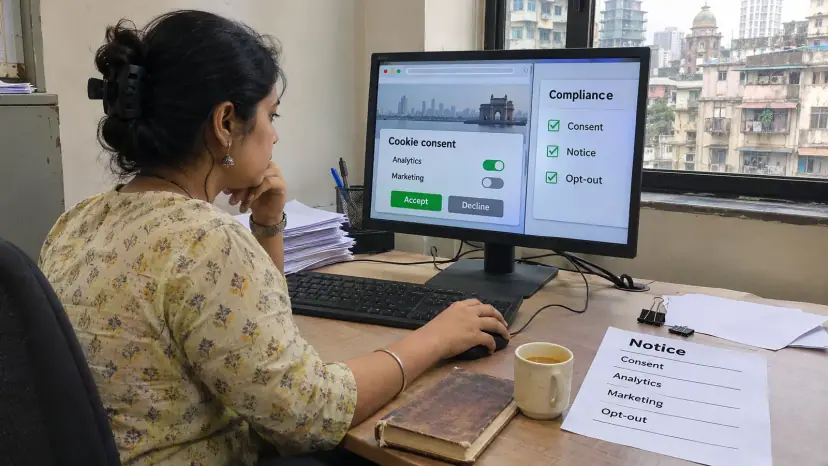
A Cookie Banner That Meets the Consent Standard
Neither the Act nor the Rules mention cookies. This specification simply applies the Act's consent standard to the banner.
- Notice first: show plain-language text, in English or the user's language, before any choice. List the cookie categories and their purposes.
- Separate choices: separate consent for essential, analytics, marketing and personalisation cookies.
- Equal buttons: "Reject all" as visible as "Accept all". A large green accept button with reject hidden in a menu is hard to defend as free and unambiguous consent.
- Nothing pre-ticked: every non-essential category starts switched off.
- Easy to change: a "Cookie preferences" link in the footer that reopens the choices, so withdrawal is as easy as consent.
- A record: log each choice on the server with time, choices and the notice version, so you can show consent if the Board asks.
Sample banner text you can adapt:
Your privacy choices
This site uses cookies and similar technologies. Essential cookies are needed for the site to work. Analytics cookies help us understand how the site is used. Marketing cookies are used to show you relevant ads on other sites. You can accept all, reject all or choose by category. You can change your choices at any time through the "Cookie preferences" link in the footer.
[Choose] [Reject all] [Accept all]
Privacy notice and data protection contact
Consent Management: Buy or Build?
Many consent platforms were designed first for Europe's GDPR. They cover the basics but may need work for India, especially notices in Indian languages and consent records that match the Act's wording.
Buy: a commercial consent platform, configured for Indian notices and languages, suits teams that want someone else to maintain the tool.
Build: a light in-house tool with its own consent records suits companies with many systems to connect and the engineering time to maintain it.
From 13 November 2026, rule 4 also lets registered Consent Managers operate, giving users a single place to give, manage and withdraw consent. Watch how these develop before you commit to a long contract.
A CRM Design You Can Defend
Purpose Tagging
Tag every personal data field with the purpose it was collected for. An email address collected for a newsletter and one collected for order updates are the same field with two purposes and two consent states. Most CRMs let you add custom properties to hold these tags, and workflows can then block processing outside the purpose.
Consent Records
For every consent, record who gave it, when, what purposes it covered, how it was given (form, banner, app or chat) and which version of the notice they saw. Store the record so it cannot be edited. Section 6(10) means you must be able to prove both the notice and the consent if a question arises.
Scheduled Deletion
Run scheduled jobs that find data past its documented retention period and erase it across every system, while keeping the processing logs that rule 6(1)(e) and rule 8(3) require for at least one year. This is usually the hardest engineering task, because marketing data spreads across many tools.
The Fourteen-Point DPDP Marketing Checklist
Run this against your current setup. Each "no" is a gap to close before 13 May 2027.
- The cookie banner has "Reject all" as visible as "Accept all".
- The cookie banner has no pre-ticked non-essential boxes.
- The privacy notice appears before the consent decision, not only behind a footer link.
- The notice and consent request can be read in English or any Eighth Schedule language, at the user's choice.
- Lead form consent is separate for each purpose and nothing is pre-ticked.
- Email unsubscribe takes one click and is processed promptly.
- WhatsApp opt-in is clear and comes with a notice; opting out takes one message.
- SMS lists have recorded consent for each contact, not just a do-not-disturb check.
- Audience uploads to Meta and Google use only contacts who consented to ad targeting.
- The CRM has purpose tags on personal data fields.
- Consent records are stored unedited with time, channel and notice version.
- Scheduled deletion runs across all systems on a defined timetable.
- A written breach plan matches rule 7's timelines.
- If you process data of under-18s, you have verifiable parental consent flows.
Common Myths and Traps
"We sell B2B, so DPDP does not apply"
Wrong. The Act defines personal data as any data about an identifiable individual. A named contact at a company is personal data. One exclusion, in section 3(c)(ii), covers data the person has made publicly available themselves, but that does not cover every business card or scraped list.
"Lookalike audiences contain no personal data"
A lookalike is built from a seed list of real people. The safer reading is that the seed list needs consent that covers this use.
"Existing customers have already agreed"
Not automatically. Section 5(2) says that where someone consented before the Act's commencement, you must send them a notice as soon as reasonably practicable, and you may keep processing until they withdraw. Where you have no evidence of any consent, ask again.
"DPDP is just GDPR-lite"
The two share ideas but differ. The Act relies heavily on consent. Its section 7 lists specific "legitimate uses", such as data a person gives voluntarily for a purpose, rather than a broad legitimate-interest basis. Its children's rules apply to everyone under eighteen, and its notice language rule is specific to India.
"Our CRM is in the US, so Indian law does not apply"
Wrong. Section 3(b) applies the Act to processing outside India when it is connected with offering goods or services to people in India. A US-hosted CRM holding Indian customers' data is covered, and transfer rules apply too.
Sector Notes
Fintech: regulated lenders and payment firms also follow their regulator's rules, so consent for identity checks, credit checks and loan marketing should be separate flows. Our guide to marketing for fintech in India covers the wider picture.
Healthcare: the Act has no separate category for sensitive data, but health data deserves extra care. Section 44(2) removes section 43A of the Information Technology Act, 2000 from 13 May 2027, under the same commencement notification. Hospital and clinic teams should have counsel review patient marketing flows; see our DPDP-aware playbook for healthcare marketing.
Edtech: children's data is the main exposure. Verifiable parental consent is essential and targeted ads at children are banned. Our edtech marketing strategy guide shows how to market with these limits.
D2C brands: the common risk is old email lists collected without clear consent and used for promotions. Send the section 5(2) notice where you can show earlier consent, ask again where you cannot, and expect the list to shrink.
The Bottom Line
The DPDP Act is not a law to ignore until a Board notice arrives. With penalties set in the Schedule and the reputational cost of a public inquiry, building consent, notice and deletion into your marketing systems now costs far less than fixing them under pressure. Most of the work is a focused project: clear notices, honest consent, records you can show and deletion that reaches every copy.
Frequently Asked Questions
When does the DPDP Act start applying to digital marketers?
The Act was passed in 2023 and the DPDP Rules were published on 13 November 2025. Consent Manager registration starts on 13 November 2026. The duties that matter most to marketers, including notice, consent, withdrawal, security, breach intimation, children's data and individual rights, apply from 13 May 2027, eighteen months after publication.
Does the DPDP Act apply to B2B marketing in India?
Yes. The Act covers personal data of any identifiable individual, whether the context is business or consumer. A decision-maker's name, work email and work phone number are personal data. Data the person has made public themselves is excluded, but most purchased or scraped lists will not fall within that exclusion.
What is the difference between a Data Fiduciary and a Data Processor?
A Data Fiduciary decides the purpose and means of processing: that is your brand. A Data Processor processes data on your behalf, such as your CRM, email or ad tools. Section 8(1) makes the Fiduciary responsible for processing done for it, and section 8(2) requires a valid contract with each processor.
Can I still run Meta lookalike audiences under the DPDP Act?
Likely yes, if the seed list contains only people whose consent covers ad targeting on that platform. Lookalikes built from contacts who never agreed carry risk. The safer approach is to keep a separate "consented for ad targeting" segment in your CRM and use only that segment as the seed.
What is the DPDP penalty for marketing without proper consent?
Consent and notice failures fall under the Schedule's general entry, up to ₹50 crore, if the Board finds the breach significant. Security failures can reach ₹250 crore and children's data breaches ₹200 crore. Section 33 lists what the Board weighs, including the nature, gravity and duration of the breach. These provisions apply from 13 May 2027.
Want help with this?
Talk to our team about digital marketing.
Read next

Digital Marketing Agencies in Delhi NCR: How to Choose the Right One
Skip paid top 10 lists. Shortlist from referrals, verify agencies in 15 minutes, ask who does the work and keep every ad account in your own name.
Read article
SaaS Marketing Services in India: From MVP Launch to Scale
Copying a later-stage playbook is the usual founder error. Match channels, team and budget to each stage from pre-launch and MVP to scale.
Read article
Digital Marketing Agency Pricing in India: What Drives the Cost
Retainer, project, hybrid or hourly: how Indian agencies price their work, what pushes a quote up, the extras to check and how to set a budget.
Read article
Comments
Be the first to share your thoughts on this article.