In this article
AI image generators have made product shots, social posts, banners and illustrations far cheaper to produce than a photo shoot. But the price on a tool's pricing page is rarely what a business ends up paying. Rejected images, retries, editing and review time often cost more than the generation itself.
This guide explains the three ways to pay for AI images in India, what a single image costs through an API in 2026, the hidden costs most budgets miss, why animation and video cost more, and the rules to keep in mind before you publish.
Three Ways to Pay for AI Images
- Subscriptions. Design and image tools sell monthly or yearly plans with a quota of generations or credits, usually per user. They suit a designer or marketer making images by hand, a few at a time. Check what a plan allows for commercial use, since free and entry plans can carry tighter terms.
- APIs. Model providers charge per image or per unit of output, and you pay only for what you generate. This suits volume work and automation, such as images for hundreds of product pages, but needs a developer to set up.
- Agencies and freelancers. You pay for finished, reviewed images rather than generations. This costs the most per image but includes the prompting skill, the rejects and the editing.
Many businesses mix them: a subscription for day-to-day social posts and an API or agency for larger batches.
What One Image Costs Through an API
API prices are set in US dollars and change often, so treat these as examples, checked on 11 November 2026:
- Google's Gemini API pricing page lists its Nano Banana 2.1 image model at the equivalent of $0.0336 for a 1K image, $0.0504 for a 2K image and $0.113 for a 4K image.
- OpenAI's API pricing page prices its image models per million image tokens, so the cost of one image depends on its size and quality setting.
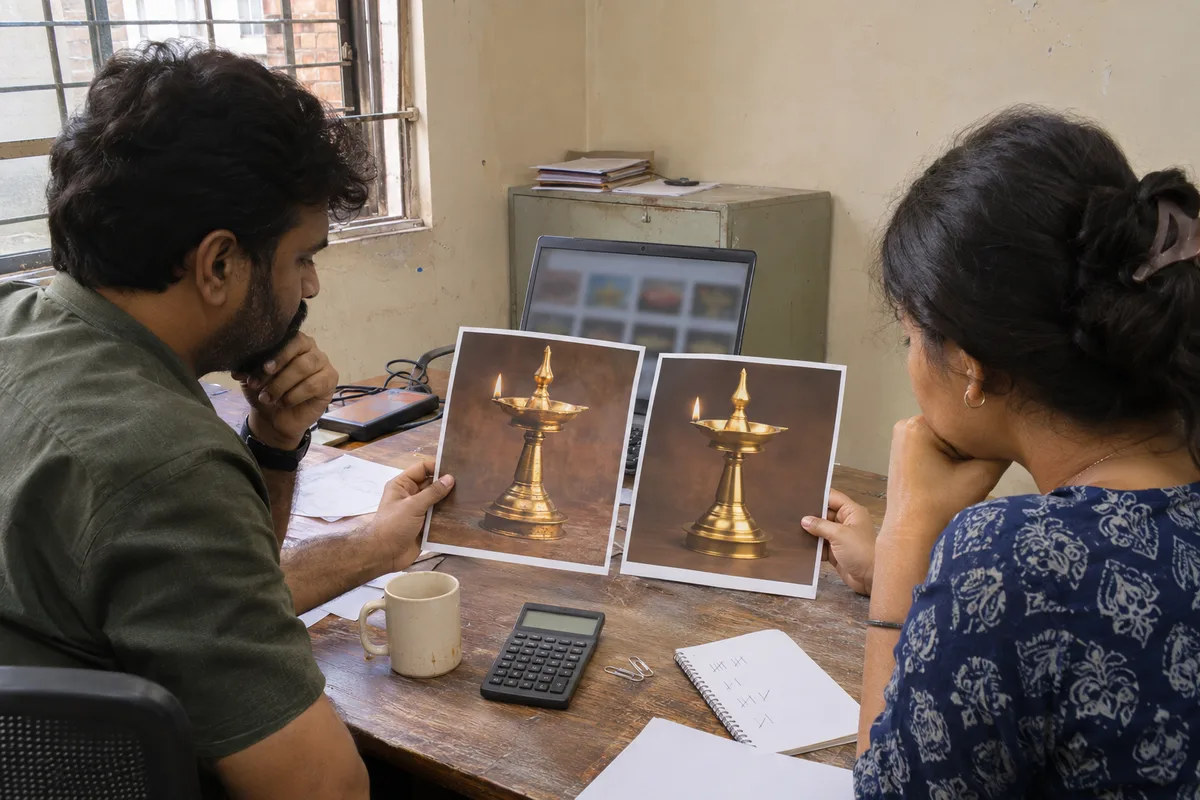
Our own figures give a sense of real-world cost. We generated the photos used across this website through an API gateway, at about 1536 by 1024 pixels. Each photo has cost between about ₹4 and ₹7, depending on the model version, and each took between about 35 seconds and a little under two minutes to arrive. The four photos made for this article on 11 November 2026 cost just under ₹4 each. Around one request in twenty failed briefly and had to be retried.
So the raw cost of one generated image is a few rupees. The real question is how many generations it takes to get one you can use.
The Costs Most Budgets Miss
- Rejects. Many generations are unusable: wrong details, odd hands, extra objects or a scene that says nothing about your product. When we reviewed our own photos, the most common reject was a person at a laptop with nothing tying the image to the page's topic.
- Garbled text. Image models still produce misspelt or nonsense lettering on signs, screens and packaging. We ask for images with no text at all, and add any headline afterwards in code or design software.
- Review time. Someone has to look at every image before it goes live. We review ours on contact sheets, many images per sheet, and check for near-duplicates. For a large batch this takes hours.
- Editing and resizing. A banner, a square social post and a product page each need a different crop and file size. Plan for conversion to modern formats such as WebP so pages stay fast.
- Prompt writing. A good prompt names the place, the people, the action and what to leave out. Writing and refining prompts is skilled work, whether you do it or pay someone.
An illustrative example: you need 40 usable product images, and one in three generations is good enough. That means about 120 generations, which at ₹7 each comes to ₹840, at the top of our own range. If review and light editing take five minutes per usable image, that is over three hours of someone's time, which will usually cost more than the generations.
Why Animation and Video Cost More
Animated clips and AI video are priced differently from still images. Providers usually bill by the second of output, renders take longer, and a single clip is far more likely to have a flaw somewhere, such as a hand that changes shape or a face that drifts between frames. Keeping a character or product consistent across several clips is still hard, so expect more retries than with stills.
For most businesses, short loops, simple motion on a still image, or AI-generated scenes cut together with real footage give a better result per rupee than fully generated video. Check the provider's current per-second rate before you plan a campaign, since video prices have moved quickly.
Rights and Rules in India
- Read the terms. Each provider's terms decide whether you may use outputs commercially and what they claim over them. Keep a record of which tool and plan made each image you publish.
- Labelling. In February 2026 the government amended the IT Rules to cover "synthetically generated information", meaning audio, images and video made or altered by computer to look real. As the law firm Khaitan & Co summarises the amendment, platforms must label such content and large platforms must ask users to declare it. If you post realistic AI images on social media, expect to declare them.
- Do not mislead. An AI image must not show your product doing something it cannot, or pass off generated results as real customer outcomes. Advertising rules on misleading claims apply whatever tool made the picture.
- No real people or brands. Do not generate images of real people without their consent, or images carrying other companies' logos.
On our own site, every generated photo is labelled as illustrative and released under the terms on our image licence page.
Choosing the Right Option
| Your situation | Usually the best fit |
|---|---|
| A few social posts and banners each week | A subscription for the person who makes them |
| Hundreds of similar images, such as product or category pages | An API with a simple review step |
| A launch, a campaign or brand-critical visuals | An agency or experienced freelancer |
| Animation or video | A short test first, then budget by the second of output |
If you are weighing AI images as part of a larger AI project, our AI cost calculator helps estimate the cost of the text models that often sit alongside them.
Budgeting for AI Images
The generation itself is cheap: a few rupees per still image through an API. What decides the real cost is how many images you reject, how long review and editing take, and whether you need motion. Start with a small test batch, count how many generations it takes to get one usable image, and multiply from there. Keep text out of the images, label what you publish as required, and keep a record of the tool and terms behind each one.
Frequently Asked Questions
How much does it cost to generate an AI image in India?
Through an API, a single still image usually costs a few rupees. On 11 November 2026, Google listed its Nano Banana 2.1 model at the equivalent of $0.0336 for a 1K image. Our own generations at about 1536 by 1024 pixels have cost ₹4 to ₹7 each. Rejects, review and editing usually add more than the generation itself.
Is a subscription or an API cheaper for AI images?
A subscription is usually cheaper and simpler for one person making a few images by hand. An API is cheaper per image at volume, such as hundreds of product images, but needs a developer to set up and a review step.
Why do AI animation and video tools cost more than image tools?
They are usually billed by the second of output, take longer to render and are more likely to have a flaw somewhere in a clip, so you pay for more retries. Keeping a character or product consistent across clips is also harder than with still images.
Do I need to label AI-generated images in India?
The IT Rules amendment of February 2026 requires platforms to label realistic synthetic images, audio and video, and large platforms ask users to declare such content when they upload it. If you post realistic AI images on social media, expect to declare them. For advertising or legal decisions, take legal advice.
Can I use AI-generated images commercially?
It depends on the provider's terms and your plan. Many paid plans allow commercial use, while some free plans are more limited. Read the terms for the tool you use, avoid real people's likenesses and other companies' logos, and keep a record of how each image was made.
Read next
ChatGPT for Marketing: A Practical Guide for Indian Businesses
Twelve marketing jobs ChatGPT can draft, prompts to copy, what each plan costs in India, and which data to keep out of personal accounts.
Read article
How Much Does AI Marketing Cost in India? A Budget Planning Guide
Compare freelance, agency and in-house options by company stage, plus the hidden costs such as data work and failed tests.
Read article
AI Marketing for Healthcare in India: A Playbook for Hospitals and Clinics
Doctors may not boast of cases or cures. See five AI plays, from doctor-reviewed patient education to WhatsApp booking, that fit the rules.
Read article
Comments
Be the first to share your thoughts on this article.