In this article
- The Indian B2B Lead Generation Problem
- AI Lead Generation Strategies That Work in India
- Building an AI Lead Gen Stack for Under ₹50K/Month
- What an AI Lead Gen System Looks Like in Practice
- The Key Metric Indian B2B Startups Must Track
- Top 10 AI Lead Generation Tools for Indian B2B Startups in 2026
- How to Build an AI-Powered Lead Scoring System
- Outbound vs Inbound: Which AI Strategy Works for B2B in India?
- Measuring Success: AI Lead Generation KPIs and Planning Ranges
- Step-by-Step: Implementing AI Lead Gen in 30 Days
- Frequently Asked Questions
- Related Services
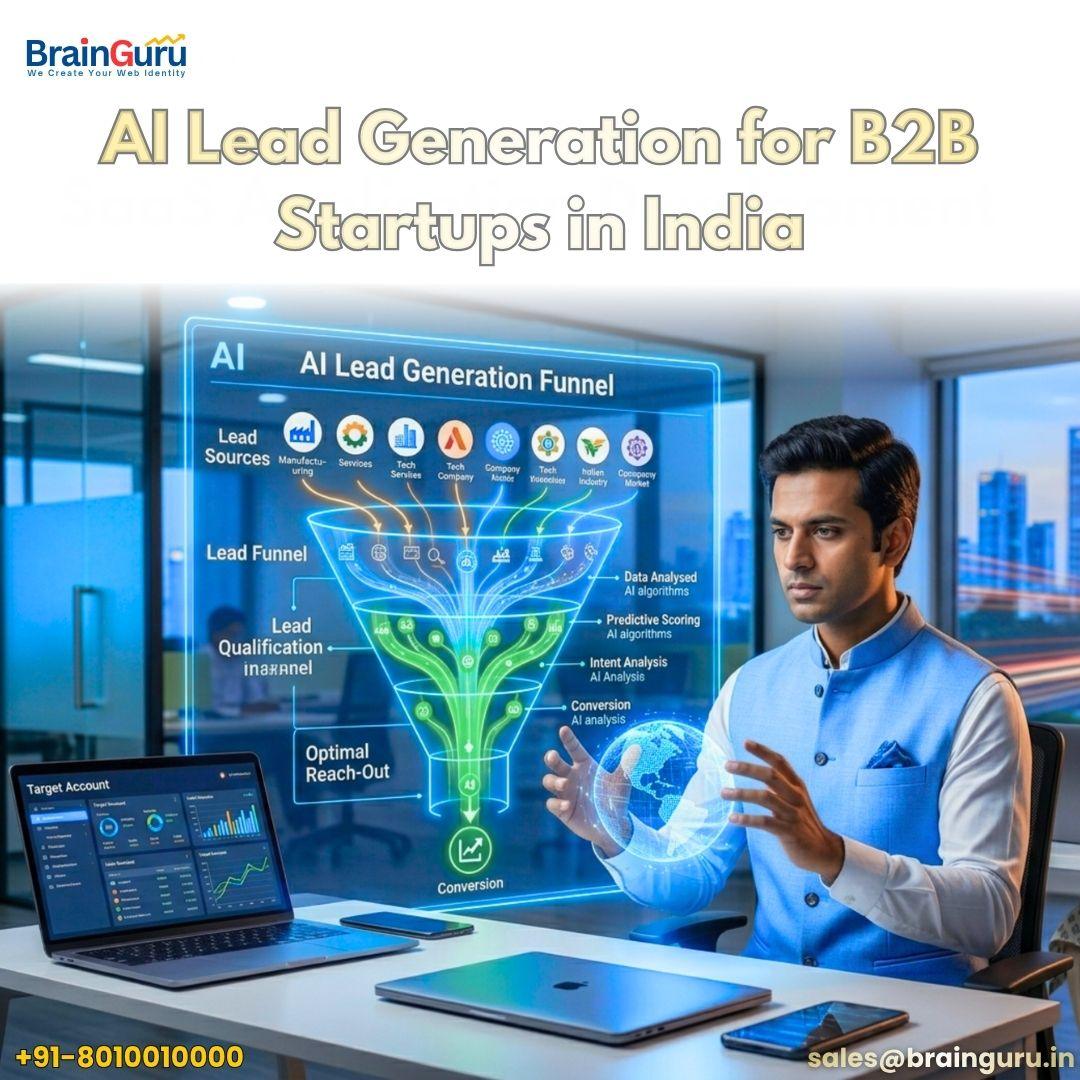

AI Lead Generation for B2B in India is broken for most startups. Cold calls go unanswered. Email open rates are low. LinkedIn outreach gets ignored. And the leads that do come in are often the wrong fit.
AI changes all of this - not by sending more messages, but by sending the right message to the right person at the right time. That's the core promise of AI-powered B2B lead generation.
Here's exactly how Indian B2B startups are using it in 2026 to fill their pipelines.
The Indian B2B Lead Generation Problem
Indian B2B sales is unique. Decision-makers rely heavily on referrals and relationships. The sales cycle is longer than in Western markets. WhatsApp is the preferred communication channel. And budget gatekeepers are multiple layers deep.
Traditional lead generation tactics don't account for any of this. AI-powered approaches do - because they adapt to how Indian buyers actually behave, not how Western sales playbooks assume they do.
AI Lead Generation Strategies That Work in India
Strategy 1: Intent-Based Targeting
Stop targeting demographics. Target behavior. Intent-based targeting uses AI to identify companies and individuals who are actively researching solutions in your space right now - based on their online activity across thousands of websites.
For Indian B2B: tools like Bombora and LinkedIn Sales Navigator (with AI filters) can identify decision-makers at target companies who are in active buying mode. Reach out then - not cold.
Strategy 2: AI-Powered LinkedIn Outreach
LinkedIn is India's #1 B2B platform. But the spray-and-pray approach kills your SSI score and gets you blocked. AI research tools like Clay can help you personalize every message based on the prospect's recent activity, company news, and shared connections, but send the messages yourself: LinkedIn's User Agreement bans bots and other unauthorized automated methods to add contacts or send messages.
Then compare your reply rate with your old generic templates.
Strategy 3: SEO-Driven Inbound Lead Machine
For B2B startups, organic search is the highest-ROI lead generation channel over time. AI SEO tools identify exactly what your ideal customers are searching for, create content that ranks, and capture leads with high-intent landing pages.
Brainguru's digital marketing team has built SEO-driven lead funnels for B2B companies across SaaS, logistics, healthcare, and fintech sectors.
→ Explore Digital Marketing Solutions
Strategy 4: AI Chatbot for Website Lead Capture
Most Indian B2B websites have a 'Contact Us' form and nothing else. An AI chatbot on your website qualifies visitors in real-time, asking the right questions, identifying fit, and routing hot leads to sales instantly.
What to measure: your website-to-lead conversion rate before and after launch.
Strategy 5: Predictive Lead Scoring
Not all leads are equal. AI lead scoring analyzes hundreds of data points (company size, industry, website behavior, email engagement, technographic data) to predict which leads are most likely to close. Your sales team focuses on the top 20% that drive 80% of revenue.
Building an AI Lead Gen Stack for Under ₹50K/Month
Tier 1: Foundation
- LinkedIn Sales Navigator Core (check LinkedIn's current price)
- AI email outreach tool (Instantly or Lemlist): ₹3,000/month
- Basic AI chatbot (Tidio or Freshchat): ₹2,000/month
- CRM with basic automation (Zoho CRM): ₹1,500/month
Tier 2 (₹25,000–40,000/month): Growth
- Intent data platform access
- AI-assisted LinkedIn research and message drafting
- Custom lead scoring model
- WhatsApp Business API integration
- SEO content automation tools
Tier 3 (₹50,000+/month): Scale
- Custom AI outreach system
- Full-funnel automation with predictive scoring
- AI SDR (Sales Development Representative) software
- Real-time intent monitoring and alerting
What an AI Lead Gen System Looks Like in Practice
Here's an illustrative example (hypothetical, not a client case study), a B2B SaaS startup targeting HR managers at mid-size Indian companies:
- AI identifies HR managers at companies 200–2000 employees who recently searched for HRMS solutions
- Personalized LinkedIn connection request referencing their company's recent growth
- After connecting: AI-written message addressing their specific pain point (manual attendance tracking)
- If no response: email sequence triggered after 5 days with a case study relevant to their industry
- Website visit triggers AI chatbot offering a free demo slot
- Hot leads (visited 3+ pages, opened 2+ emails) automatically flagged for immediate sales follow-up
What to measure: qualified demos booked per month and cost per qualified lead.
The Key Metric Indian B2B Startups Must Track
Most startups obsess over the number of leads. The right metric is Cost Per Qualified Lead (CPQL): the cost to generate a lead that actually has buying intent, budget, and authority.
AI doesn't just generate more leads. It generates better leads. That's why the ROI shows up in closed deals, not just lead volume.
Ready to Build Your AI Marketing Engine?
Brainguru Technologies has served 850+ businesses across India and helps them put AI-driven marketing to work.
Or explore our solutions:
Top 10 AI Lead Generation Tools for Indian B2B Startups in 2026
The right tool stack can be the difference between a predictable pipeline and an expensive guessing game. Here are the ten tools Indian B2B founders should seriously evaluate, along with realistic pricing and the specific use case where each tool shines.
- 1. Apollo.io - Starting at Rs 4,500/month per seat. Best for prospecting Indian mid-market and global accounts. Includes a large B2B contact database, email verification, and AI-written sequences. Ideal first tool for a one-person SDR team.
- 2. Clay - Best for advanced data enrichment and list building. Combines many data providers into one workflow; check current pricing on Clay's site. Use when you need to build ultra-targeted lists with custom criteria.
- 3. LinkedIn Sales Navigator - Check LinkedIn's current per-user price. Non-negotiable for B2B founders selling into Indian enterprises. The advanced filters alone justify the price.
- 4. HubSpot Sales Hub (with Breeze AI) - Rs 3,800/month (Starter) to Rs 1,00,000/month (Enterprise). Best all-in-one CRM with AI lead scoring and pipeline forecasting. Generous free tier for early-stage startups.
- 5. Instantly.ai - Rs 3,000-15,000/month. Best cold email automation tool, with built-in deliverability warm-up and AI personalisation. Excellent for sending 5,000+ cold emails per month without burning domains.
- 6. Lemlist - Rs 4,500-12,000/month. Best for multi-channel outreach combining email, LinkedIn, and calls. Test whether its AI-generated personal intros lift your reply rate.
- 7. Wati (WhatsApp Business API) - Rs 2,500-8,000/month. Essential for Indian B2B because WhatsApp wins over email on both open rate and response rate. Integrates with HubSpot and Zoho.
- 8. Cognism - Custom pricing, typically Rs 75,000+/month. Best for accurate phone numbers and GDPR-compliant European data, useful for Indian startups selling to international markets.
- 9. Drift (being sunset) - Clari + Salesloft announced in March 2026 that Drift is being gradually sunset, with existing customers referred to 1mind. If you want AI chat that books meetings on a high-ticket B2B website, shortlist a tool that is still actively developed.
- 10. Crystal Knows - Check current pricing on Crystal's site. Best personality insights tool. Predicts buyer personality from LinkedIn profiles so your outreach matches their communication style.
How to Build an AI-Powered Lead Scoring System
Lead scoring is where most Indian B2B startups unlock immediate ROI. A proper AI scoring system tells your sales team exactly which leads to call first, cutting wasted effort on cold accounts. Here is the blueprint.
Step 1: Define What a "Good Lead" Actually Means
Look at your last 50 closed-won deals. What do they have in common? Industry, company size, geography, job title, tech stack, budget range. These are your firmographic attributes. Then look at behaviour: how many pages did they visit, how many emails did they open, did they attend a webinar? These are engagement signals.
Step 2: Assign Weights to Each Signal
Not every signal is equal. Visiting the pricing page is worth more than reading a blog post. Downloading a case study is worth more than clicking a newsletter link. Start with manual weights (0-20 points each) based on past data, then let the AI refine them.
Step 3: Plug Into an AI Model
Tools like HubSpot's predictive scoring, MadKudu, or a custom model built on top of your CRM can analyse historical close data and recalibrate scores automatically. The AI learns that, for example, CTOs from Series B SaaS companies close faster than heads of marketing from Series A.
Step 4: Set Alert Thresholds
When a lead crosses a certain score - say 80 out of 100 - trigger an instant Slack alert to the sales team. Speed matters: a 2011 Harvard Business Review study of US firms found that those which tried to contact a lead within an hour were nearly seven times as likely to qualify it as those that waited even an hour longer.
Step 5: Review and Retrain Every Quarter
Your ideal customer profile evolves as your product matures. Re-run the analysis every 90 days and adjust signal weights accordingly.
Outbound vs Inbound: Which AI Strategy Works for B2B in India?
There is a long-running debate in Indian B2B circles about whether to focus on outbound (cold outreach) or inbound (SEO, content, paid ads). The truthful answer is: both, but sequenced correctly.
When Outbound Wins
Outbound is faster and better for startups in the first 18 months. You control the targeting, the volume, and the message. If your average deal size is above Rs 2 lakh/year and you have fewer than 5,000 potential accounts, outbound is almost always more efficient than inbound. AI makes it scalable because personalisation can now be automated without losing quality.
When Inbound Wins
Inbound compounds over time. After 12-18 months of consistent SEO and content publishing, organic leads come in with higher intent and zero marginal cost. For B2B SaaS with deal sizes under Rs 1 lakh or self-serve pricing, inbound is the right long-term bet. Once inbound starts producing 30%+ of pipeline, it becomes the cheapest channel you have.
The Hybrid Playbook for 2026
A common pattern is to start around 70/30 outbound/inbound in year one, then move towards 50/50 in year two and 30/70 by year three. AI makes this transition smoother because the content generated for inbound doubles as personalisation fuel for outbound sequences.
Measuring Success: AI Lead Generation KPIs and Planning Ranges
If you cannot measure it, you cannot improve it. These are the metrics every Indian B2B founder should report on monthly, with rough planning ranges (illustrative, not published benchmarks; your own history is the better baseline).
- Cost Per Qualified Lead (CPQL): Rs 800-2,500 for SMB targets, Rs 3,500-8,000 for mid-market, Rs 10,000-25,000 for enterprise.
- Lead-to-Meeting Conversion Rate: Healthy range is 8-15% for cold outbound, 20-35% for inbound.
- Meeting-to-Opportunity Conversion: 40-55% is strong; below 30% means your qualification is too loose.
- Opportunity-to-Close Rate: 18-30% is typical for Indian B2B SaaS; 30%+ is excellent.
- Sales Cycle Length: 45-75 days for SMB, 90-150 days for mid-market, 180-300 days for enterprise.
- Email Reply Rate: 3-6% for cold outbound is average; 8%+ means your targeting and copy are working.
- LinkedIn Connection Acceptance Rate: 25-40% is healthy.
- Pipeline Velocity: The speed at which opportunities move from stage to stage. Track weekly to catch stalls early.
Step-by-Step: Implementing AI Lead Gen in 30 Days
Week 1: Foundation and Ideal Customer Profile
Interview your last five customers. Document who they are, why they bought, and what problem you solved. Build a detailed ICP document. Choose your tools - at minimum you need a CRM, an email sequencing tool, and LinkedIn Sales Navigator.
Week 2: List Building and Enrichment
Use Apollo or Clay to build a target list of 1,000-2,000 accounts matching your ICP. Enrich with firmographic data, decision-maker emails, and LinkedIn URLs. Segment the list into three tiers based on fit.
Week 3: Launch Outreach Campaigns
Write 3-4 email variants with AI-assisted personalisation. Set up a sequence: day 1 email, day 3 LinkedIn connection, day 5 follow-up email, day 8 WhatsApp touchpoint (tier 1 only, and only to contacts who have opted in to WhatsApp messages from you). Launch to 200 accounts per week to preserve deliverability.
Week 4: Measure, Iterate, Scale
Review open rates, reply rates, and booked meetings. Kill underperforming email variants. Double down on what is working. Add predictive lead scoring so the hottest responders get immediate human follow-up.
For a complementary view on building an end-to-end AI marketing engine, see our AI and ML solutions and digital marketing services pages.
Related Reading
Frequently Asked Questions
How does AI improve B2B lead generation?
AI improves B2B lead gen by identifying ideal customer profiles, automating personalized outreach, scoring leads based on buying intent, qualifying via chatbots 24/7, and predicting which leads are most likely to convert.
What is the best AI tool for B2B lead generation in India?
Top AI tools for B2B lead gen in India include Apollo.io for prospecting, LinkedIn Sales Navigator with AI insights, HubSpot AI for lead scoring, WhatsApp chatbots for qualification, and Clay for data enrichment.
Related Services
Related Articles
How Indian Startups Are Using AI to Replace Marketing Agencies
Why Indian startups are ditching traditional marketing agencies and building AI-powered in-house marketing engines. The honest guide for 2026.
Read More
AI Marketing Stack for Startups Under ₹50K/Month (2026)
Build a complete AI marketing stack for under ₹50,000 per month. Best AI tools for Indian startups across SEO, ads, email, and lead generation.
Read More
AI vs Human Marketing Team: What Should Indian Startups Choose? (2026)
AI or human marketing team? The decision-stage guide for Indian startup founders in 2026. Costs, capabilities, and the smart hybrid approach.
Read More
Comments
Be the first to share your thoughts on this article.