In this article
- What Is AI Chatbot Development? (Beyond Basic Bots)
- Types of AI Chatbots Indian Businesses Need
- Top Platforms for AI Chatbot Deployment in India
- Tech Stack for Modern AI Chatbots (2026)
- AI Chatbot Development Process at Brainguru
- Illustrative Use Cases
- AI Chatbot Pricing in India: 2026 Rates
- Common Mistakes When Building AI Chatbots
- How Brainguru Builds AI Chatbots
- Frequently Asked Questions
- Related Services
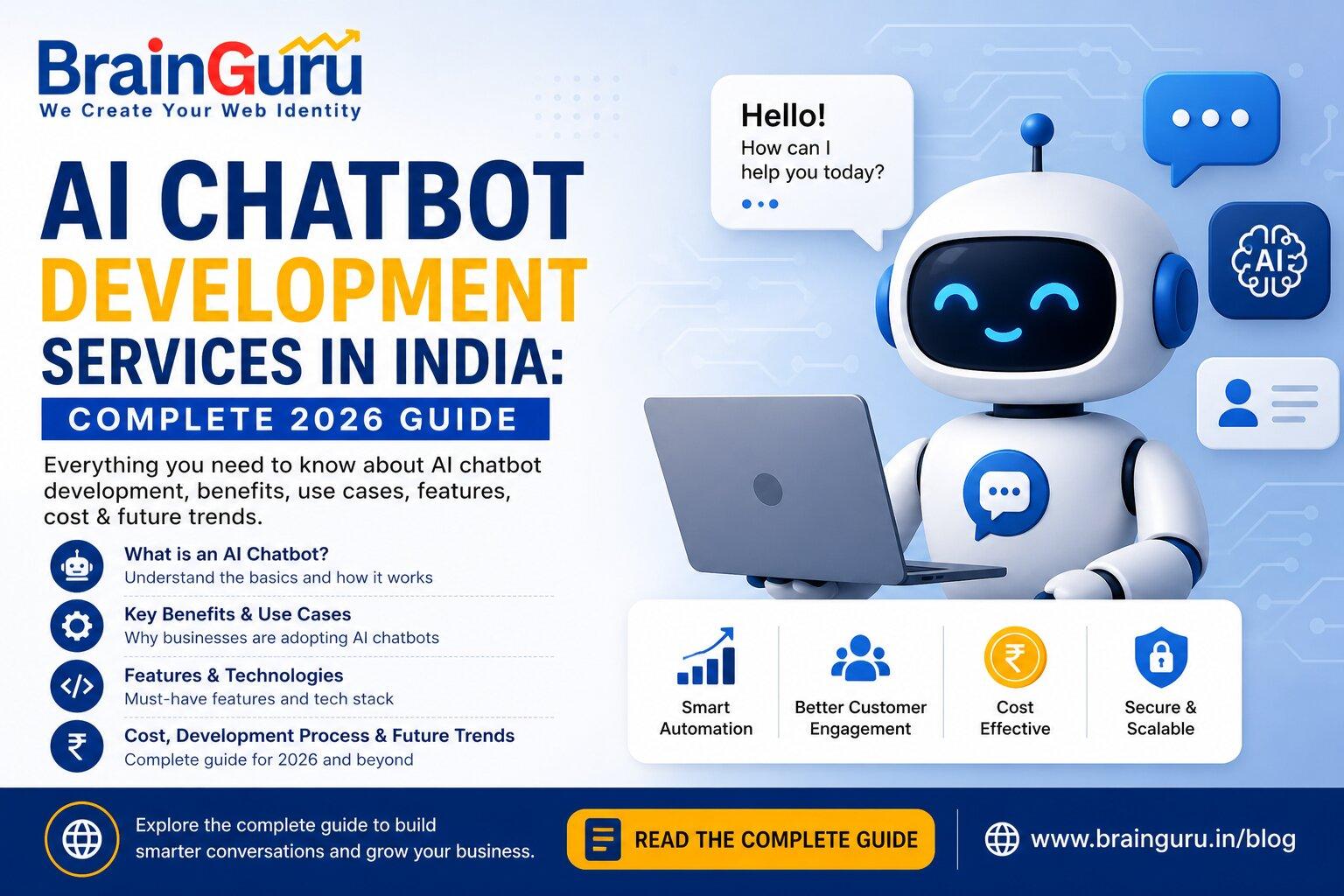
Over the past 24 months, AI chatbots have shifted from experimental curiosities to core operational infrastructure for Indian businesses. What used to be a basic scripted FAQ widget on a website is now, in 2026, a multi-channel conversational layer that qualifies leads, closes sales, resolves support tickets, and connects directly into ERP and CRM systems. Done well, it is one of the highest ROI investments a modern business can make.
This guide is a practical playbook on AI chatbot development services India buyers should understand before commissioning a project. It covers what modern AI chatbots actually do, where they are deployed, the underlying technology stack, realistic pricing, a proven development process, and the mistakes that most commonly derail first-time projects.
What Is AI Chatbot Development? (Beyond Basic Bots)
The phrase "chatbot" today covers three fundamentally different categories of software. Understanding which one you are buying is the single most important decision in the entire project.
Rule-based chatbots are built on predefined flows. The user clicks a button or types a keyword, and the bot follows a deterministic decision tree. These bots are fast to deploy and predictable, but they break the moment a user asks something unexpected. They work for narrow tasks like checking an order status or booking a basic appointment.
Machine-learning-based chatbots add an intent classification layer. Platforms like Dialogflow, Rasa, and IBM watsonx Assistant train on sample utterances to recognize what a user is asking, then route to appropriate responses. These bots handle variation in phrasing much better than rule-based systems, but they still need significant training data per intent and struggle with truly open-ended conversations.
LLM-powered chatbots are the 2024-2026 generation. Built on top of large language models like GPT, Claude, Gemini, Llama, or Mistral, these bots can hold context-rich conversations, reason over documents retrieved from a knowledge base, handle unexpected questions gracefully, and call external APIs to complete tasks. They represent a qualitative leap in user experience.
The reason "AI" matters in 2026 is not marketing hype. It is that users now expect ChatGPT-level conversation quality from any business bot. A rigid flow that forces them to pick from buttons feels dated, and they will abandon the conversation and call a human instead, which defeats the purpose of deploying a bot in the first place.
Types of AI Chatbots Indian Businesses Need
Customer Support Chatbots
Support bots deflect repetitive enquiries, hand off complex issues to human agents with full context, and operate 24x7. For Indian businesses handling high ticket volumes in sectors like telecom, banking, travel, and e-commerce, a well-built support bot can resolve a large share of routine enquiries without human intervention and cut average response times from hours to seconds.
Lead Generation Chatbots
Lead bots replace static contact forms with conversational qualification. They ask the questions your sales team would ask, score the response against your ideal customer profile, and route hot leads to sales reps in real time. For mid-market B2B companies and high-consideration B2C categories like real estate, education, and healthcare, this is often the single highest-ROI chatbot use case.
E-commerce Shopping Assistants
Shopping assistants help users discover products, answer product questions, recommend alternatives, track orders, and handle returns. Integrated with product catalogs and inventory systems, they operate across website, WhatsApp, and Instagram. Well-designed assistants can lift conversion; measure the effect against a control group.
Internal Productivity Bots (HR, IT helpdesk)
Many of the highest-ROI chatbots are not customer facing at all. Internal HR bots answer policy questions, initiate leave and reimbursement workflows, and onboard new hires. IT helpdesk bots reset passwords, provision access, and triage incidents. For larger enterprises with high internal ticket volumes, the payback case is often strongest.
Voice-Enabled AI Bots
Voice bots now use real-time LLM APIs combined with low-latency speech-to-text and text-to-speech stacks to handle inbound and outbound calls at near-human quality. Collections, lead qualification, appointment reminders, and basic support calls are all viable use cases in Indian languages including Hindi, Tamil, Telugu, Marathi, and Bengali. Expect this category to reshape call-centre economics through 2026-2028.
Top Platforms for AI Chatbot Deployment in India
Most businesses do not need a bot in one place; they need the same bot available everywhere their customers are. The most commonly deployed channels in India today are the following.
| Platform | Typical use case | Approximate platform cost |
|---|---|---|
| Website widget | Lead capture, support, product discovery | Hosting only; usually free beyond the build |
| WhatsApp Business API | Broadcasts, two-way support, transactional updates | Per delivered template message since July 2025; in India about Rs 0.86 (marketing) or Rs 0.115 (utility) |
| Facebook Messenger | Lead ads follow-up, commerce | Free within 24-hour window, paid thereafter |
| Instagram DM | Creator commerce, D2C support | Same as Messenger pricing model |
| Telegram | Communities, premium content | Free |
| Slack | Internal productivity, IT helpdesk | Included in existing Slack licence |
| Microsoft Teams | Enterprise productivity, HR self-service | Included in existing M365 licence |
WhatsApp deserves special attention for Indian audiences. With hundreds of millions of users in the country, it is the single most important channel for consumer-facing chatbots. Our earlier write-up at best use cases of whatsapp chatbots india and the pricing breakdown at whatsapp chatbot development cost india cover the platform in depth.
Tech Stack for Modern AI Chatbots (2026)
A modern AI chatbot is a small distributed system, not a single product. The typical stack has four layers.
Large language models form the reasoning core. Choices include proprietary APIs like OpenAI's GPT models, Anthropic's Claude models, and Google's Gemini, as well as open-source alternatives like Meta's Llama and Mistral. Open-source models can be self-hosted for data sovereignty, while proprietary APIs generally offer best-in-class quality.
Application frameworks orchestrate prompts, tools, and memory. LangChain is the most widely adopted for Python and JavaScript projects, with alternatives like LlamaIndex and Semantic Kernel. These frameworks implement patterns such as retrieval-augmented generation (RAG), where the bot retrieves relevant documents from a company knowledge base before generating an answer, and agentic loops, where the bot plans multi-step tasks and calls tools.
Hosting and model infrastructure are now provider-agnostic but typically one of three clouds. AWS Bedrock offers managed access to Claude, Llama, and other models. Azure OpenAI gives enterprise-grade access to the GPT family with Indian data residency options. Google Cloud provides Gemini and a full MLOps stack. Self-hosted deployments on GPU clusters, often using NVIDIA H100 or H200 hardware, are an option for the largest enterprises with strict data control requirements.
Vector databases store the embeddings that power RAG. The leading choices in 2026 are Pinecone, Weaviate, Qdrant, Milvus, and pgvector (Postgres extension). For most Indian mid-market deployments, Qdrant or pgvector strike the right cost-quality balance. Pinecone remains popular for teams that want a fully managed service.
Around these four layers sit peripheral components: speech-to-text and text-to-speech (for voice bots), moderation filters (for safety), analytics and observability (LangSmith, Langfuse, Helicone), and integration middleware to connect to CRM, ERP, and ticketing systems.
AI Chatbot Development Process at Brainguru
We follow a six-phase process for production chatbot deployments.
Phase 1: Discovery and scoping. We work through the exact business problem to be solved, the target users, the success metrics, the integrations required, and the channels the bot will live on. The deliverable is a written scope document and success criteria. This typically takes one to two weeks.
Phase 2: Conversation design. Conversation designers map out the critical user journeys, write the tone guide, draft the core prompts, and define fallback behaviours. This is where most projects succeed or fail. Bad prompts produce bad bots regardless of which LLM sits underneath.
Phase 3: Build. Engineers stand up the technical stack: LLM integration, vector database, RAG pipeline, channel connectors, and integration APIs. For most projects this is a three- to six-week phase.
Phase 4: Training and data ingestion. We ingest the relevant knowledge sources, policy documents, product catalogs, FAQs, and historical support transcripts, then run tuning and evaluation loops. We use automated evaluation suites to test thousands of sample inputs before going live.
Phase 5: Deployment and integration. The bot is connected to production channels, CRMs, and downstream systems. We run a controlled pilot, typically with ten to twenty percent of live traffic, before full rollout.
Phase 6: Optimization. Post-launch, we monitor conversation logs weekly, identify failure patterns, refine prompts, and expand coverage. This phase is open-ended because AI chatbots are never truly done; they improve continuously with use.
Illustrative Use Cases
The following are hypothetical illustrations, not client results. Consider a residential real estate developer whose sales team cannot respond to website enquiries within the first few minutes, when intent is highest. An LLM-powered chatbot on the website and WhatsApp could answer project-specific questions, qualify leads against budget and timeline, book site visits into the sales team's calendar, and hand off qualified buyers to sales reps with a full conversation summary. Site-visit bookings and enquiry-to-sale conversion show whether it is working.
A mid-sized NBFC offering personal loans could build a WhatsApp-first lending journey in which customers check eligibility, upload documents and receive disbursement status updates in a conversational interface, with KYC and lending steps that follow the RBI's digital-lending and KYC rules. Telecalling cost and completion rates on partially filled applications are the numbers to track.
An edtech platform preparing students for competitive exams could deploy an AI tutor chatbot. Students could ask concept-level questions in Hindi or English and receive explanations tailored to their current skill level, with links to relevant videos and practice tests. Daily active usage and the volume of content-query support tickets show whether it is working.
A B2B industrial distributor could run an internal procurement assistant. Field sales staff could query stock levels, pricing, and delivery timelines from any customer site through WhatsApp, with order accuracy and time spent on internal coordination calls as the measures of success.
AI Chatbot Pricing in India: 2026 Rates
Pricing depends heavily on complexity, integrations, and ongoing usage volume. The market has settled into three clear tiers.
| Tier | One-time build cost | Monthly running cost | Typical scope |
|---|---|---|---|
| Basic | Rs 50,000 to Rs 1,50,000 | Rs 8,000 to Rs 25,000 | Single channel, FAQ-level LLM bot, no deep integrations |
| Intermediate | Rs 1,50,000 to Rs 5,00,000 | Rs 25,000 to Rs 80,000 | Multi-channel, CRM integration, RAG over company knowledge base, analytics dashboard |
| Advanced / Enterprise | Rs 5,00,000 to Rs 25,00,000+ | Rs 80,000 to Rs 4,00,000+ | Voice, multilingual, ERP integration, on-premise or private-cloud deployment, dedicated SLAs |
Monthly running costs include three components: LLM API usage (usage-based, often the largest line item at scale), cloud hosting and vector database, and maintenance and optimization retainer. A useful rule of thumb: for bots handling 50,000+ conversations per month, LLM API costs alone will typically exceed cloud hosting costs by a factor of three to five.
For broader context on related AI investment areas, see /ai-automation-services-in-india/ and /ai-consulting-services-india/, and for lead-generation-specific chatbot economics see /ai-chatbots-for-lead-generation-india/.
Common Mistakes When Building AI Chatbots
- Starting with technology instead of use case. Teams get excited about the latest GPT or Claude model and skip the discovery work. Without a clearly defined user journey and success metric, you end up with an impressive-looking bot that nobody uses. Fix: spend the first two weeks on scoping before writing a line of code.
- Ignoring the handoff to humans. A chatbot that cannot smoothly transfer a complex conversation to a human agent, with full context, frustrates users more than having no bot at all. Fix: design the human handoff as a first-class feature from day one.
- Underestimating prompt engineering. Organizations often assume that a good LLM will produce a good bot automatically. In practice, the difference between a mediocre and excellent bot is mostly in the quality of system prompts, few-shot examples, and retrieval pipelines. Fix: treat prompt engineering as a core discipline, not an afterthought.
- Stuffing the bot with too much knowledge. Ingesting an entire 800-page corporate manual into the vector database does not make the bot smarter; it often makes responses vaguer because retrieval pulls in irrelevant context. Fix: curate knowledge bases ruthlessly and measure retrieval precision.
- No evaluation framework. Without automated tests against a held-out set of real questions, you have no way to know if a change improved or degraded the bot. Fix: build an evaluation suite before launch and run it on every change.
- Ignoring data privacy and residency. Indian businesses, especially in BFSI and healthcare, face data-protection duties under the DPDP Act 2023 (most apply from May 2027), and financial regulators such as the RBI and SEBI add their own data-storage rules. Fix: choose LLM providers and deployment architectures that meet the rules for your sector and avoid sending sensitive data to models that use it for training.
- Treating launch as the finish line. AI chatbots degrade without active maintenance. New products, policies, and edge cases appear constantly. Fix: budget for ongoing optimization as a permanent line item, not a one-time cost.
How Brainguru Builds AI Chatbots
Brainguru delivers conversational and AI solutions for Indian businesses, with a dedicated AI practice focused on production-grade LLM deployments. Our engagements span discovery through long-term optimization, and we work across all major LLM providers, channels, and enterprise integration targets.
What sets us apart is the combination of marketing insight and engineering depth. Because we run paid media, SEO, and lifecycle marketing programs for the same clients, our bots are designed around the actual customer funnel rather than in isolation from it. The bot that qualifies a lead is built by the same team that generated the lead, and the data flows back into campaign optimization.
If you are evaluating AI chatbot partners for 2026, start with a no-obligation discovery call. We will walk through your use case, suggest the right architecture and budget tier, and share relevant case studies. Reach out at https://www.brainguru.in/contact-us/. For additional background on our broader service offering see /digital-marketing-services-complete-guide/.
Frequently Asked Questions
Q: How much does it cost to build an AI chatbot in India in 2026?
A: A production-ready AI chatbot typically costs between Rs 1,50,000 and Rs 5,00,000 to build for intermediate scope, with ongoing running costs of Rs 25,000 to Rs 80,000 per month. Enterprise-grade deployments with voice, multilingual, or deep ERP integrations can reach Rs 25,00,000 or more. Budget explicitly for both the one-time build and the recurring cost.
Q: How long does a typical AI chatbot project take?
A: Basic LLM chatbots can be deployed in three to four weeks. Intermediate projects with CRM integration and RAG over a knowledge base typically take eight to twelve weeks. Enterprise projects with voice, multiple languages, and complex integrations usually run four to six months end to end.
Q: Do I need a lot of training data to build an AI chatbot?
A: Not necessarily. LLM-powered bots perform well with relatively small, high-quality knowledge bases because the underlying model already understands language. What matters is the quality of the documents you ingest, the clarity of your system prompts, and the accuracy of your retrieval pipeline, not raw volume of training conversations.
Q: How do we keep customer data secure and compliant?
A: Use LLM providers that offer zero-data-retention and data residency options, such as Azure OpenAI with Indian region deployment, AWS Bedrock in Mumbai, or self-hosted open-source models on private infrastructure. Implement PII redaction before sending data to models, log access rigorously, and map your data flows against the DPDP Act 2023 before going live.
Q: Can an AI chatbot scale to handle millions of conversations?
A: Yes. The underlying LLM APIs from OpenAI, Anthropic, and Google, as well as managed infrastructure on AWS Bedrock and Azure OpenAI, are engineered for enterprise scale. The limits in practice come from your integration layer (CRM rate limits, database throughput) and from cost control at very high volumes rather than from the chatbot itself. Architect for horizontal scalability from day one and set up usage caps and budget alerts.
Related Services
Related Articles
AI Marketing for EdTech Startups in India (2026): The Acquisition-Cost Playbook
Student CAC is killing Indian edtech. The 2026 AI marketing playbook for K-12, test-prep & upskilling startups: planning ranges, stack, and an illustrative scenario.
Read More
AI Marketing for D2C Brands in India (2026): The Stage-by-Stage Playbook
Stage-by-stage AI marketing playbook for Indian D2C brands: channel plays, retention loops, category guidance, an indicative AI stack and an illustrative scenario.
Read More
How Much Does AI Marketing Cost in India? Complete 2026 Pricing Guide (Freelance vs Agency vs In-House)
What AI marketing actually costs in India in 2026 agency fees, tool subscriptions, in-house hiring. Indicative ₹ tables for SaaS, D2C, B2B & SMEs. Calculators included.
Read More
Comments
Be the first to share your thoughts on this article.