In this article
- What Traditional Marketing Agencies Actually Deliver in India
- What AI Can Now Do That Agencies Used to Own
- What AI Still Can't Replace
- The Smart Startup Approach: AI-Augmented, Not Agency-Replaced
- How to Evaluate Whether to Fire Your Agency
- The Most Affordable Way to Replace or Augment an Agency
- What Usually Breaks When Startups Go Fully In-House
- A Realistic Transition, in Three Stages
- Frequently Asked Questions
- Related Services

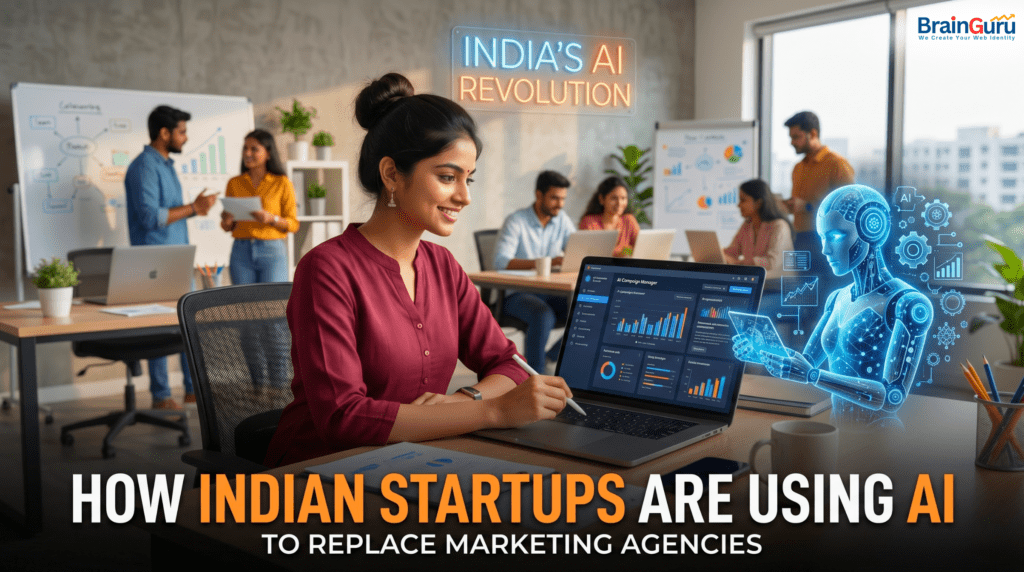
This is a conversation happening in startup offices across India right now: 'We're paying ₹80,000/month to an agency. Our website traffic hasn't moved in 6 months. Can AI do this better?'
Short answer: for many tasks - yes. But the full picture is more nuanced, and understanding it could save your startup from two expensive mistakes: staying with the wrong agency, or going fully DIY without a plan.
Here's the honest breakdown.
What Traditional Marketing Agencies Actually Deliver in India
Let's be fair first. A good marketing agency brings strategy, creative talent, industry relationships, and execution capacity that most early-stage startups can't build in-house.
The problem is that many Indian agencies (especially in the ₹30,000–₹1,00,000/month tier) are selling strategy but delivering templates. The same blog post structure, the same Google Ads playbook, the same monthly PDF report.
This isn't unique to India. But in a market where every rupee counts and startup runways are measured in months, it matters more.
What AI Can Now Do That Agencies Used to Own
Content Creation & SEO
AI tools like Claude, Jasper, and Surfer SEO can research competitors, identify keyword opportunities, draft blog posts, optimize for Google, and publish, in a fraction of the time and cost of a traditional content agency.
A dedicated founder or marketing manager using AI content tools can produce 8–12 high-quality SEO articles per month for less than ₹10,000 in tool costs.
Social Media Management
AI scheduling tools with built-in optimization (Buffer, Hootsuite, Lately) can analyze your audience's engagement patterns, recommend optimal post times, repurpose long-form content into social snippets, and A/B test captions, automatically.
Paid Advertising Optimization
Google Performance Max and Meta Advantage+ use AI to optimize campaigns in real-time: adjusting bids, audiences, and creative automatically. A founder can now oversee a sizeable ad budget in a few hours a week.
Previously, this required a dedicated PPC manager or an agency team.
Email Marketing
AI email platforms write copy, segment audiences, predict optimal send times, and A/B test, without a copywriter or marketing coordinator.
Analytics & Reporting
AI analytics tools now automatically surface insights, flag anomalies, and recommend actions. No more waiting for the agency's monthly presentation to know that your top-performing campaign from last month has stopped working.
→ Explore Digital Marketing Solutions
What AI Still Can't Replace
Brand Strategy & Positioning
AI can write content, but it can't tell you whether you should be positioned as the premium option or the scrappy challenger in your market. That requires strategic thinking, market insight, and human judgment.
Creative Campaign Ideas
The campaigns that go viral, that generate PR, that people actually remember: those come from human creativity. AI can support the execution, but the big idea still needs a human brain.
Relationship-Driven PR & Partnerships
Getting featured in YourStory, The Ken, or The Economic Times requires relationships that AI can't build. Media relations, influencer partnerships, and event marketing still run on human trust.
Complex Paid Media Strategy
For high-budget campaigns (₹50 lakh+/month), a dedicated paid media strategist who understands your business deeply outperforms automated AI optimization, because the strategic layer requires nuanced judgment.
The Smart Startup Approach: AI-Augmented, Not Agency-Replaced
The startups winning in 2026 aren't going fully DIY; they're building lean, AI-augmented marketing teams and working with specialized partners for what AI can't do.
What this looks like in practice:
- 1 in-house marketing manager (₹50,000–80,000/month)
- AI tools stack replacing content writers, schedulers, analysts (₹25,000–40,000/month)
- Strategic partner for brand positioning, creative campaigns, PR
- Performance marketing partner for large ad budgets
Total: ₹1,00,000–1,50,000/month (compare that with what the same capabilities cost you today).
→ Startup Solutions | Brainguru's AI-Augmented Marketing
How to Evaluate Whether to Fire Your Agency
Before making any decisions, ask your current agency three questions:
- What specific KPIs have improved in the last 90 days, and what did you do to move them?
- What AI tools are you currently using in our campaigns?
- Can you show me a before/after comparison of campaign performance since you took over?
If the answers are vague, defensive, or full of jargon without data, you have your answer.
Ready to Build Your AI Marketing Engine?
Brainguru Technologies has served 850+ businesses across India and helps them put AI-driven marketing to work.
Or explore our solutions:
The Most Affordable Way to Replace or Augment an Agency
The cheapest workable answer is almost never "cancel the retainer and buy tools". It is to split the work into three buckets and only pay a person for the bucket that genuinely needs one.
- Automate the repeatable. Keyword research, first drafts, scheduling, audience segmentation, anomaly alerts and monthly reporting are tool work now. This is the only bucket where AI replaces spend outright rather than merely assisting it.
- Keep exactly one owner in-house. Someone has to decide what the company says and hold the calendar. A single marketing generalist with a tool stack behind them will out-deliver a retainer that nobody internally supervises.
- Buy specialist time by the project, not by the month. Positioning, a campaign concept, a site migration or a paid-media rebuild are finite pieces of work. Paying for them as projects removes the part of a retainer that quietly funds status calls.
The ordering matters more than the tool choice. Founders who buy the stack first and hire the owner later end up with software nobody drives. Founders who hire the owner first usually discover the tool bill is smaller than expected, because that person only buys what they will actually operate.
Augmenting rather than replacing is also the cheaper first move in most cases. Keep the agency on the one workstream where it demonstrably performs, move everything else in-house behind AI tooling, and renegotiate the retainer to match the narrower scope. That is a reversible decision. Firing the agency outright is not.
If you would rather not assemble the stack yourself, our AI marketing services and tooling guide for startups cover the same ground in more detail.
What Usually Breaks When Startups Go Fully In-House
Going fully DIY looks cheaper on a spreadsheet and fails in fairly predictable ways. Knowing the failure modes in advance is most of the remedy.
- Nobody owns the strategy. AI will produce a great deal of competent output in whatever direction you point it. If nothing points it, you get volume without a position, which is expensive in a different currency.
- Tool sprawl. Trials accumulate, two products end up doing the same job, and the monthly total quietly climbs back toward the retainer you cancelled. Review the stack on a fixed schedule and cut anything nobody opened last month.
- Brand drift. Different tools, different prompts and different people produce different voices. Write the voice down once, keep the examples where the tools can reach them, and have one person approve anything customer-facing.
- Attribution gaps. Agencies usually inherit a working measurement setup. Teams that build their own often discover months later that conversions were never tracked properly, which makes every performance argument unresolvable.
- Unchecked claims. Generated copy will happily assert statistics, certifications and outcomes you cannot support. Everything published needs a human who is accountable for whether it is true.
A Realistic Transition, in Three Stages
Startups that move well tend to stage the change rather than switch it off in one month.
Stage one: instrument before you change anything. Fix analytics and conversion tracking while the agency is still running, so you have a defensible baseline to compare against. Changing the team and the measurement at the same time guarantees you will never know which one moved the numbers.
Stage two: bring one channel in-house. Pick the channel with the clearest feedback loop, usually content and organic search, and run it internally with AI tooling while the agency keeps the rest. You learn the real operating cost on a small surface instead of across the whole programme.
Stage three: renegotiate to the remaining scope. Once one channel runs internally without slipping, the conversation with the agency changes from cancellation to scope. Most will restructure rather than lose the account, and you keep the relationships and the specialist depth you would otherwise have thrown away.
Brainguru has worked with startups and established businesses for 17+ years, across 850+ clients. If you want a second opinion on which parts of your programme should move in-house, talk to our team or call +91-8010010000.
Frequently Asked Questions
Can AI completely replace a marketing agency for an early-stage startup?
For execution-heavy work, largely yes. Content drafting, SEO research, scheduling, email and routine campaign optimisation can all run in-house with AI tooling and one competent owner. What does not transfer is positioning, original campaign ideas, media and influencer relationships, and strategy for large paid budgets. Startups that replace only the execution layer usually save money; those that also replace the thinking layer tend to produce more output and fewer results.
What is the most affordable option for replacing or augmenting a performance marketing agency with AI?
Augment before you replace. Keep the agency on the single workstream where it clearly performs, move the repeatable work in-house behind AI tools, and renegotiate the retainer down to that narrower scope. Then hire or assign one internal owner before buying the stack, because tools without an operator become shelfware. This path is cheaper than a full in-house rebuild and, unlike cancelling outright, it is reversible if the numbers move the wrong way.
Which marketing work should stay with people rather than tools?
Anything where the value comes from judgement or trust. Deciding whether you are the premium option or the challenger, inventing a campaign somebody remembers, building relationships with journalists and partners, and steering high-budget paid media all sit with people. Tools make those people faster; they do not replace the decision.
How do we know whether our current agency is worth keeping?
Ask three questions and read the answers rather than the tone. Which specific metrics improved in the last ninety days, and what action moved them? Which AI tools are already in our campaigns? Can you show performance before and after you took over? Clear answers with data mean the relationship is working. Vague or defensive answers usually mean you are paying for capacity, not expertise.
Related Services
Related Articles

AI Marketing Strategy for Indian Startups
A complete AI marketing strategy guide for Indian startups in 2026. Learn how to use AI tools to generate leads, reduce costs, and scale faster.
Read More
AI Marketing Stack for Startups Under ₹50K/Month (2026)
Build a complete AI marketing stack for under ₹50,000 per month. Best AI tools for Indian startups across SEO, ads, email, and lead generation.
Read More
AI vs Human Marketing Team: What Should Indian Startups Choose? (2026)
AI or human marketing team? The decision-stage guide for Indian startup founders in 2026. Costs, capabilities, and the smart hybrid approach.
Read More
Comments
Be the first to share your thoughts on this article.