
In this article
- Key takeaways
- Why AI Marketing Cost in India Varies So Much
- The Main Cost Components
- Hidden Costs Most Pricing Posts Skip
- Freelance, Agency or In-House: How the Models Compare
- How Budgets Change With Company Stage
- How Sector Changes the Budget
- Setting Realistic ROI Expectations
- Questions to Ask Before You Sign
- Red Flags in Pricing
- The Bottom Line
- Frequently Asked Questions
AI marketing cost in India depends far more on your stage, sector and goals than on any price list. This guide breaks the budget into its parts: AI tools, data and measurement, the people who run the work, media spend and the hidden costs most quotes leave out. It then shows how to compare freelance, agency and in-house options.
Why AI Marketing Cost in India Varies So Much
Two businesses can both say they "do AI marketing" and spend completely different amounts. One founder uses a general AI assistant to draft posts and runs ads alone. Another company has a team using AI for content, ad creative, lead scoring and reporting, with its own data pipeline behind it. Both are reasonable. They are simply buying different things.
Three questions explain most of the gap. First, what is the AI doing: drafting, analysing, automating conversations or predicting which leads will buy? Second, who runs it: the founder, a freelancer, an agency or an in-house team? Third, how much media spend sits on top, because the tools and the team are usually a smaller share of the total than the ads they manage.
Prices also move quickly. AI tool makers change plans, add usage limits and launch new tiers often. Any number you read in an article, including an old version of this one, will date. The structure of the budget dates far more slowly, so that is what this guide covers.

The Main Cost Components
AI tool subscriptions: the base layer. It usually includes a general AI assistant for writing and analysis, an image or video tool for creative, an SEO tool, an email or WhatsApp platform, and a CRM. Most are priced per user per month, some by usage, such as messages sent or contacts stored. Cost grows with the number of people who need a login and the volume you push through each tool.
Usage-based AI: if you build AI into your own website or app, such as a chatbot or an automated reply system, you pay the model provider by usage, measured in tokens. The bill grows with traffic and with the length of each conversation. Our AI cost calculator lets you estimate this from your own expected volumes.
Measurement and data: Google's analytics and dashboard tools have free versions that cover most small businesses. Costs appear when you need attribution across many channels, server-side tracking, a data warehouse, or an engineer to keep data pipelines working. These matter more as spend grows, because a small error in measurement then wastes more money.
People: usually the biggest variable. Someone has to set the strategy, write the prompts, check the output, launch the campaigns and read the numbers. That can be the founder, a freelancer, an agency or staff.
Media spend: the money paid to Meta, Google, LinkedIn and other platforms for ads. It is separate from tools and fees. AI features inside ad platforms can help spend it better, but they do not replace the budget itself.
Hidden Costs Most Pricing Posts Skip
- Data clean-up: AI tools give poor answers on messy data. Merging duplicate contacts, fixing tracking and labelling past leads takes time before any AI scoring is useful.
- Privacy and consent work: collecting and using customer data for marketing needs proper notice and consent records. Our article on the DPDP Act for digital marketers explains what to check.
- Switching and retraining: tools change and teams change. Moving data, rebuilding automations and teaching people a new tool all cost time.
- Experiments that fail: some tests will not pay back. Plan for that as a normal cost of learning, rather than assuming every campaign works.
- Review time: AI drafts need a human to check facts, tone and claims before they go out. That time is real, and it rises with volume.
- Management time: the hours a founder or manager spends briefing, approving and reviewing. It rarely appears on an invoice, but it is often the largest hidden cost.
Freelance, Agency or In-House: How the Models Compare
| Model | When it fits | Main risk |
|---|---|---|
| Freelancer | Narrow scope, tight budget, a founder who can manage the work | Quality varies widely and one person can disappear |
| Agency retainer | Defined scope, several skills needed, a wish for accountability | Vague deliverables and junior staff on your account |
| In-house team | Steady workload, larger budgets, knowledge that must stay inside | Salaries are fixed even when work is slow |
| Hybrid | An internal owner with specialist help from outside | Unclear split of duties between the two |
Freelance pricing: usually per project, per piece or per hour. Rates follow experience, city and specialism. Freelancers suit simple, well-defined jobs such as setting up an email flow or writing a set of articles, where you can check the result yourself.
Agency pricing: usually a monthly retainer for an agreed scope, sometimes with a one-time setup fee. The fee depends on how many channels are covered, how much content is produced, how senior the people are and how often you get reports. Our guide to digital marketing agency pricing in India explains how retainers are built.
In-house cost: salary is only part of it. Add benefits, tool seats, hardware, training, management time and the cost of hiring and replacing people. An in-house team usually makes sense once the workload is steady and large enough to keep each person busy.
How Budgets Change With Company Stage
Before revenue: the founder usually does the marketing personally with one general AI assistant and free analytics. The best spend here is time, not money: talk to customers, test messages, and learn which channel brings real interest. Avoid long agency contracts.
Early stage: a small set of paid tools plus one specialist, often a freelancer or a small agency, for the channel that is already working. Keep scope narrow and review results every month.
Growing companies: a fuller tool stack, an agency for specialist work, and possibly a first in-house marketing hire who owns strategy and data. Measurement starts to matter a lot here.
Larger businesses: an in-house team with agencies for specialist projects, plus investment in data engineering, attribution and governance for how AI is used across teams.
How Sector Changes the Budget
Sector shapes cost in ways that have little to do with AI itself.
- Regulated sectors: fintech, insurance and healthcare need legal and compliance review of claims, data use and messaging. That review adds time and cost to every campaign.
- D2C brands: spend leans towards ad creative and performance media, where AI helps produce and test many creative versions.
- B2B SaaS: longer sales cycles mean more content, CRM work and lead scoring, and less pure media.
- Real estate: spend is often planned per project, with heavy use of lead forms, WhatsApp follow-up and site-visit tracking.
- Education: seasonal admission cycles push spend into a few busy months, which makes planning and cash flow important.
Setting Realistic ROI Expectations
It is tempting to attach a fixed return to each budget level. Real outcomes depend on your offer, margins, channel mix and execution, so treat any return figure as a planning assumption to test, not a promise.
- Small budgets leave little room to test, so results take longer to read and vary more.
- Well-managed larger budgets can fund proper testing and measurement, which makes results more stable.
- Returns usually improve with scale up to a point, after which each extra rupee brings less.
Model your own payback from your unit economics, then compare it with actual results each quarter. The AI marketing ROI calculator helps you set up those scenarios, and our guide to measuring internet marketing ROI explains which numbers to track.
Questions to Ask Before You Sign
- Proof in your sector: ask for examples of similar work and how results were measured.
- Scope, not only rate: the rate is set by the market. What you can shape is what is delivered each month.
- Regular reviews: build a review point into the contract, with a way to change scope or exit if agreed measures are missed.
- Ownership: you should own your analytics property, ad accounts, WhatsApp number, email list and any content produced.
- Reporting rhythm: agree how often you will see results. More frequent check-ins help in the first months.
- Sector fit: a provider that knows your sector usually saves you time and mistakes.
- AI use: ask which tools they use, who checks AI output, and how your data is handled inside those tools.
Red Flags in Pricing
- "Unlimited posts" for a very low fee: usually means no strategy and no measurement.
- A team you never meet: you may be paying for a name while the work goes elsewhere.
- Promises of top rankings or fixed results: no honest provider controls search engines or ad auctions.
- Long contracts with no review point: you carry all the risk.
- A premium for "AI" alone: most providers use tools you can also buy. Pay for skill and sector knowledge instead.
- Vague targets: "improve engagement" is not a measure. Ask for leads, sales or cost per lead.
Similar warning signs apply to SEO quotes; our guide to SEO cost in India covers them in detail.
The Bottom Line
AI marketing in India does not have one price. It has a range that follows your stage, sector and goals. Start small with a few tools and one specialist for the channel that already works. Measure everything, budget for the hidden costs, and add people or agencies only when the workload is steady. As you grow, bring strategy and data in-house and use outside specialists for work that needs skills you do not have. Own your accounts and data at every stage.
Frequently Asked Questions
What is the minimum budget for AI marketing in India?
There is no fixed minimum. A founder can start with one general AI assistant, free analytics and a WhatsApp or email tool, doing the work personally. Spend more only when a channel shows real enquiries. Below that point, money is often better spent on product or sales than on extra tools.
Are AI marketing agencies in India expensive?
Often less than abroad. In Ahrefs' survey of 439 SEO providers, updated in August 2024, those in India were among the lowest-charging. Within India, fees vary widely with scope, seniority, channels and sector knowledge, so compare quotes against a written list of monthly deliverables.
Should I pay more for an AI-first agency?
Usually not. Most agencies now use the same AI tools you can buy yourself, so the label alone is not worth a premium. Pay extra for proven experience in your sector, senior people on your account and honest measurement. Ask how AI output is checked before it goes out.
When is an in-house team cheaper than an agency?
In-house becomes cheaper when the workload is steady and large enough to keep each person fully busy. Count the full cost: salary, benefits, tools, training, management time and replacing people who leave. Until then, an agency or freelancer is often cheaper for the same output.
How do I know if I am overspending on AI marketing?
Watch for marketing spend taking a growing share of revenue, payback periods stretching beyond your usual range, or channels staying below break-even for several quarters. Also check for paid tools that few people use. Any of these is a prompt to cut scope, switch providers or move budget.
Read next
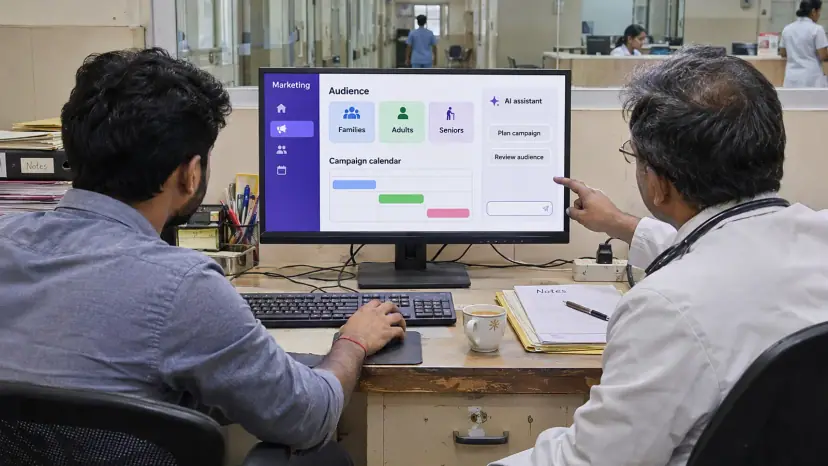
AI Marketing for Healthcare in India: A Playbook for Hospitals and Clinics
Doctors may not boast of cases or cures. See five AI plays, from doctor-reviewed patient education to WhatsApp booking, that fit the rules.
Read article
AI Marketing for Real Estate in Delhi NCR: A Developer Playbook
Lead scoring, WhatsApp site-visit booking and AI walkthrough videos for NCR projects, plus the RERA and DPDP rules every campaign has to follow.
Read article
ChatGPT for Marketing: A Practical Guide for Indian Businesses
Twelve marketing jobs ChatGPT can draft, prompts to copy, what each plan costs in India, and which data to keep out of personal accounts.
Read article
Comments
Be the first to share your thoughts on this article.