In this article
- What "ROI" Actually Means for SME Internet Marketing
- The 4 Numbers Every SME Must Track
- How to Think About AI's Effect on Payback
- Illustrative Planning Ranges (Not Benchmarks)
- How to Compare Channels (Without Fooling Yourself)
- Illustrative, Hypothetical Scenarios
- Use the ROI Calculator
- Common ROI Traps
- Frequently Asked Questions
- The Bottom Line
- Where Brainguru Can Help
"Internet marketing ROI" is one of those phrases that means whatever the person saying it wants it to mean. Some agencies measure attributed revenue, some measure pipeline, some measure traffic. Vendors will sell you on impression counts. The result for most Indian SMEs is the same: they spend money on digital marketing every month, don't really know what they're getting, and can't decide whether to scale up or pull back.
This is a practical 2026 guide to thinking about internet marketing ROI for Indian SMEs: the four numbers every founder should track, how to reason about cost-per-customer and payback, the common traps that distort ROI math, and a calculator you can run on your own numbers. The figures used below are planning illustrations to show how the maths works — they are not measured industry benchmarks, and your real numbers will depend on your segment, offer, and execution.
What "ROI" Actually Means for SME Internet Marketing
The most common ROI mistake Indian SMEs make: counting traffic or leads as ROI. They aren't. ROI is a return on investment — the financial return from money you put in.
Properly calculated, internet marketing ROI is:
ROI = (Revenue Generated − Marketing Cost) / Marketing Cost
For B2B, "Revenue Generated" should typically include lifetime value, not just first-purchase revenue. For D2C, first-purchase revenue plus a reasonable LTV estimate is the working definition.
And "Marketing Cost" includes not just ad spend, but tooling, agency fees, and properly-allocated team time. When SME ROI calculations include only ad spend, they tend to overstate the true return — sometimes substantially — because real costs are left out.
The 4 Numbers Every SME Must Track
If you can't easily produce these four numbers for your business, your ROI conversation is theoretical:
1. CAC (Customer Acquisition Cost)
Definition: total marketing spend in a period divided by new customers acquired in the same period. Spend includes ad budget, tools, and team time (at fully-loaded rates).
Why it matters: this is the floor of your unit economics.
2. LTV (Lifetime Value)
Definition: average revenue (or contribution margin) you get from a customer across their lifetime with you. For new businesses without LTV history, use a sensible projection (e.g. expected years retained × annual repeat purchase × contribution margin).
Why it matters: LTV minus CAC is your effective profit per customer acquired. As a widely-used rule of thumb, an LTV:CAC ratio of around 3:1 or higher is considered healthy for many segments.
3. Payback Period (Months)
Definition: how many months it takes to recoup CAC from a typical customer's contribution margin.
Why it matters: this determines whether you can scale spending. A short payback lets you scale more aggressively. A long payback means you need cash on hand before scaling.
4. Contribution Margin
Definition: revenue minus directly-variable costs (cost of goods, payment processing, fulfilment) — but before marketing and overhead.
Why it matters: this is the rupee available to recover CAC. A business with a thin contribution margin has far less room per rupee of revenue to fund marketing than one with a high margin — and so, all else equal, can afford to spend less on acquisition.
How to Think About AI's Effect on Payback
A common claim in 2026 is that AI tooling has shortened marketing payback periods for SMEs. There is a plausible mechanism behind this, even if the exact size of the effect varies enormously by business and is hard to measure cleanly. The levers usually cited are:
1. Cheaper creative production
AI-assisted creative can lower the cost of producing ad and content assets. The leverage often shows up not as more output for the same budget, but as similar output at lower cost — freeing budget for media spend. How much you actually save depends heavily on your quality bar and workflow.
2. Better targeting precision
AI-driven campaign types such as Meta Advantage+ and Google Performance Max can help smaller advertisers compete on targeting precision, potentially reducing wasted impressions. Results are not guaranteed and vary by account, creative, and audience.
3. Channel choice and personalisation
Reaching a lead on a channel they actually engage with (for many Indian SMEs, WhatsApp) and tailoring the message can lift conversion versus generic outreach. The size of any lift is specific to your list and offer, not a fixed multiplier.
Treat all of these as directional levers to test, not as guaranteed improvements. The honest framing is: AI can compress payback for operators who deploy it well — but the magnitude is something you measure in your own account, not a number you can assume.
Illustrative Planning Ranges (Not Benchmarks)
The table below is an illustrative planning aid, not a set of measured industry benchmarks. The intent is to show the relationships between segment economics — for example, that high-margin B2B can sustain a much higher CAC than thin-margin D2C — so you can sanity-check your own assumptions. Do not treat these as figures you should expect to hit; replace every cell with your real numbers before making decisions.
| Illustrative segment | Pattern to reason about |
|---|---|
| D2C (skincare, fashion, food) | Low CAC, low LTV, fast payback; margin and repeat-purchase rate decide whether it works. |
| B2B SaaS (SMB tier) | Higher CAC offset by high LTV and high contribution margin; longer payback, scales on recurring revenue. |
| Local services (dental, salon, gym) | Low-to-moderate CAC, strong repeat/referral value; often the fastest to clear payback. |
| Professional services (CA, lawyer, consultant) | Moderate CAC, high per-client value; few clients can justify meaningful spend. |
| Manufacturing (SME B2B) | High CAC and long cycles, but very high deal value; cash position matters for scaling. |
| EdTech / Fintech | Volume-driven; CAC discipline and retention are decisive. |
For planning guidance on what programmes cost, see Digital Marketing Agency Pricing in India and How Much Does SEO Cost in India.
How to Compare Channels (Without Fooling Yourself)
Rather than relying on quoted "ROI ranges" per channel — which vary so widely by business that any single number is misleading — compare channels on the dimensions that actually matter for your situation:
| Channel | Typical time to see signal | Generally suited to |
|---|---|---|
| Local SEO + Google Business Profile | Several months | Local service businesses |
| WhatsApp marketing | Weeks | D2C and services with an existing list |
| Email + drip campaigns | A few months | Any business with repeat purchase |
| SEO (broad) | Two to four quarters | Content-driven businesses |
| Meta Ads | Weeks to a few months | D2C, real estate, services |
| Google Search Ads | Weeks to a few months | High-intent purchase |
| Influencer (micro) | Weeks to a few months | D2C primarily |
| LinkedIn organic | Several months | B2B founders |
| LinkedIn paid | A few months | B2B mid-funnel |
The "time to signal" column above is indicative only — fast-moving channels surface results sooner, but that is not the same as higher ROI. Measure each channel against your own CAC, LTV and payback before reallocating budget.
Illustrative, Hypothetical Scenarios
The scenarios below are hypothetical illustrations created to show how the four-number framework plays out across different motions. They are not real clients, and they contain no real revenue or ROI figures — only the qualitative logic you'd apply.
Hypothetical: a B2B component manufacturer
A manufacturing SME with long sales cycles and high deal value. Because each client is worth a lot, a relatively high CAC can still be acceptable — provided the business has the cash to wait out a longer payback. The right move is to track marketing-influenced pipeline over trailing windows rather than judging any single month.
Hypothetical: a multi-location dental clinic
A local services business where repeat visits and referrals drive most of the value. Here the fastest, most defensible wins usually come from local search visibility, a well-managed Google Business Profile, review acquisition, and easy WhatsApp booking. Payback can be quick because customers are local and high-intent.
Hypothetical: an early-stage B2B SaaS startup
A founder-led motion where recurring revenue is the prize. Early on, founder-driven LinkedIn presence plus content and email nurture can build pipeline cheaply, but payback is longer because value accrues over the subscription lifetime. The decision to scale spend should follow proof that LTV:CAC and payback hold up, not a single good month.
Use the ROI Calculator
To turn this framework into numbers for your own business, plug your figures into our AI marketing ROI calculator — it lets you work from your target margin and payback period toward an allowable CAC. Pair it with the AI cost calculator for tool budgeting, and you'll have a defensible model to take into your next investor or board conversation. The output is only as good as the inputs you give it — use your real costs and margins.
Common ROI Traps
Trap 1: Last-Click Attribution
Most CRMs and analytics tools default to last-click, which over-credits the final channel. A user who saw 12 of your Instagram Reels, clicked an email, and finally converted via Google search will be credited 100% to Google. This makes Instagram look unprofitable and Google look hyper-profitable. Fix: at minimum use position-based attribution; ideally use data-driven attribution in GA4.
Trap 2: Counting Tools as ROI
"We saved ₹40K/month by switching from agency to in-house" is not ROI — it's a cost saving. ROI is incremental revenue generated. Don't conflate the two.
Trap 3: Brand vs Performance Double-Counting
If you run brand campaigns AND performance campaigns, brand often inflates performance attribution (users see brand ad, search you, click performance ad — performance gets the credit). Be honest about the assist.
Trap 4: Ignoring Time-To-First-Purchase Lag
For B2B and considered-purchase D2C, your marketing in month 3 creates revenue in month 6–9. If you cut spend in month 4 because "ROI looks low this month", you'll see real decline 3–4 months later. Look at trailing 90-day windows.
Trap 5: Excluding Team Time From Cost
Your social media manager's salary is real marketing cost. Include it. Otherwise you'll think organic is "free" and dramatically overestimate ROI.
Frequently Asked Questions
What's a good internet marketing ROI for an Indian SME in 2026?
There's no single right number — it depends heavily on your segment, margin and stage. A common rule of thumb is that an LTV:CAC ratio around 3:1 or better is healthy, and higher is stronger. Rather than chase a headline ROI figure, judge your performance against your own unit economics over a sensible time window.
How do I track marketing ROI when my sales cycle is 90+ days?
Use a "marketing-influenced revenue" metric instead of attributed first-touch revenue. CRMs (HubSpot, Salesforce, Zoho) support this with multi-touch attribution. Look at trailing 6 or 12 month windows, not monthly snapshots.
Should I include team salaries in CAC calculation?
Yes. Fully-loaded cost (salary + benefits + tools used + overhead allocation). This usually makes CAC look higher than the convenient "ad-spend only" version — which is the point. Convenient numbers don't help you make decisions.
How long should I wait before judging marketing ROI?
As a general guide: a few months for D2C, longer for B2B services, and longer still for SaaS with extended sales cycles. Below those windows, you're usually looking at noise more than signal.
Is AI marketing actually delivering better ROI than traditional?
It can, primarily through cheaper creative production and better targeting precision — but "AI marketing" isn't a homogeneous category. Smart deployment of AI tools by skilled operators can deliver strong ROI; lazy "we use AI" badging delivers none. Measure it in your own account rather than assuming a result.
What's the fastest channel to positive ROI for an Indian SME?
It depends on your motion. Local service businesses often see early signal from Local SEO, Google Business Profile and WhatsApp. D2C with an existing list often moves fastest on WhatsApp or email. B2B services typically build pipeline through founder-led LinkedIn. All are cheap to start and harder to sustain.
The Bottom Line
Internet marketing in 2026 gives Indian SMEs access to tools and channels that didn't exist a few years ago, and AI can genuinely help compress costs and improve targeting. But the gains accrue to operators who measure honestly, attribute carefully, and pick channels matched to their motion.
The four-number discipline (CAC, LTV, payback months, contribution margin) is non-negotiable. Without those, every ROI claim — yours or your agency's — is theatre.
If you'd like a structured review of your current ROI math and where to find the next improvement, our digital marketing team works with Indian SMEs across these motions. You can reach us on +91-8010010000 or via our contact page.
Where Brainguru Can Help
If you want to model this against your own numbers rather than ours, start with the AI marketing ROI calculator. For the work itself, digital marketing services and SEO services are where most SME engagements begin, and AI marketing pricing explains how we structure and measure them.
Related Articles
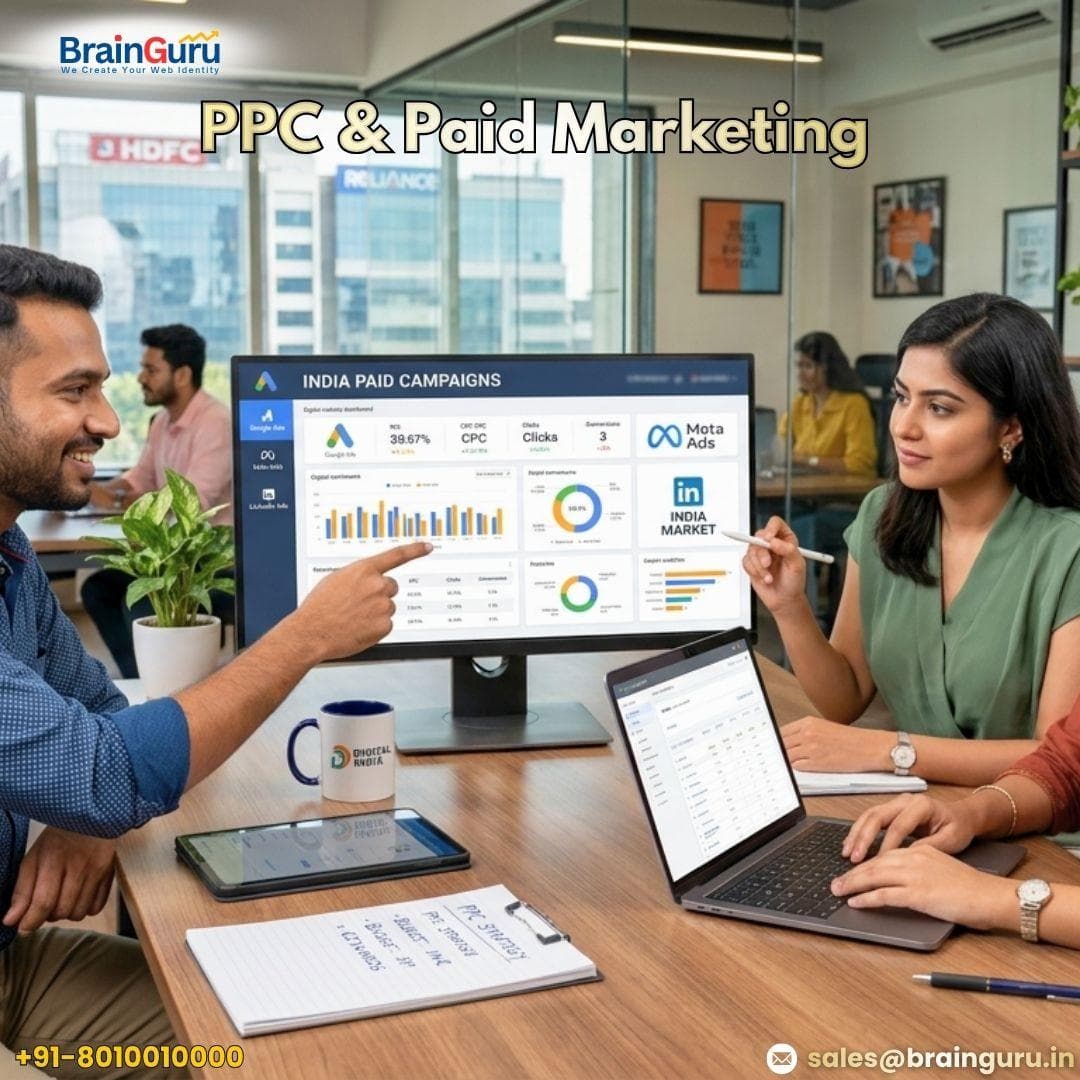
PPC & Paid Marketing: Complete Guide for Indian Businesses (2026)
Every rupee your business spends on advertising should be accountable. That is the core promise of PPC (Pay-Per-Click) marketing -- you only pay when someone…
Read More
Google Ads vs Meta Ads: Which Works Better for Indian SMEs?
Google Ads vs Meta Ads Indian Small and Medium Enterprises (SMEs) are at the heart of the country’s economic growth, contributing to employment generation,…
Read More
Digital Marketing and Search Engine Marketing Services
In today’s digital-first world, businesses need more than just an online presence-they need a robust, results-driven strategy that connects them with their…
Read More
Comments
Be the first to share your thoughts on this article.