In this article
- The Healthcare Marketing Challenge
- Three Audience Segments — Each Searches Differently
- Sub-Vertical Playbooks
- Five AI Plays for Indian Healthcare
- Compliance — The Non-Negotiables
- A Note on US HIPAA
- An Indian Healthcare AI Marketing Stack (3 Tiers)
- Illustrative Scenario: A Speciality Clinic
- Frequently Asked Questions
- The Bottom Line
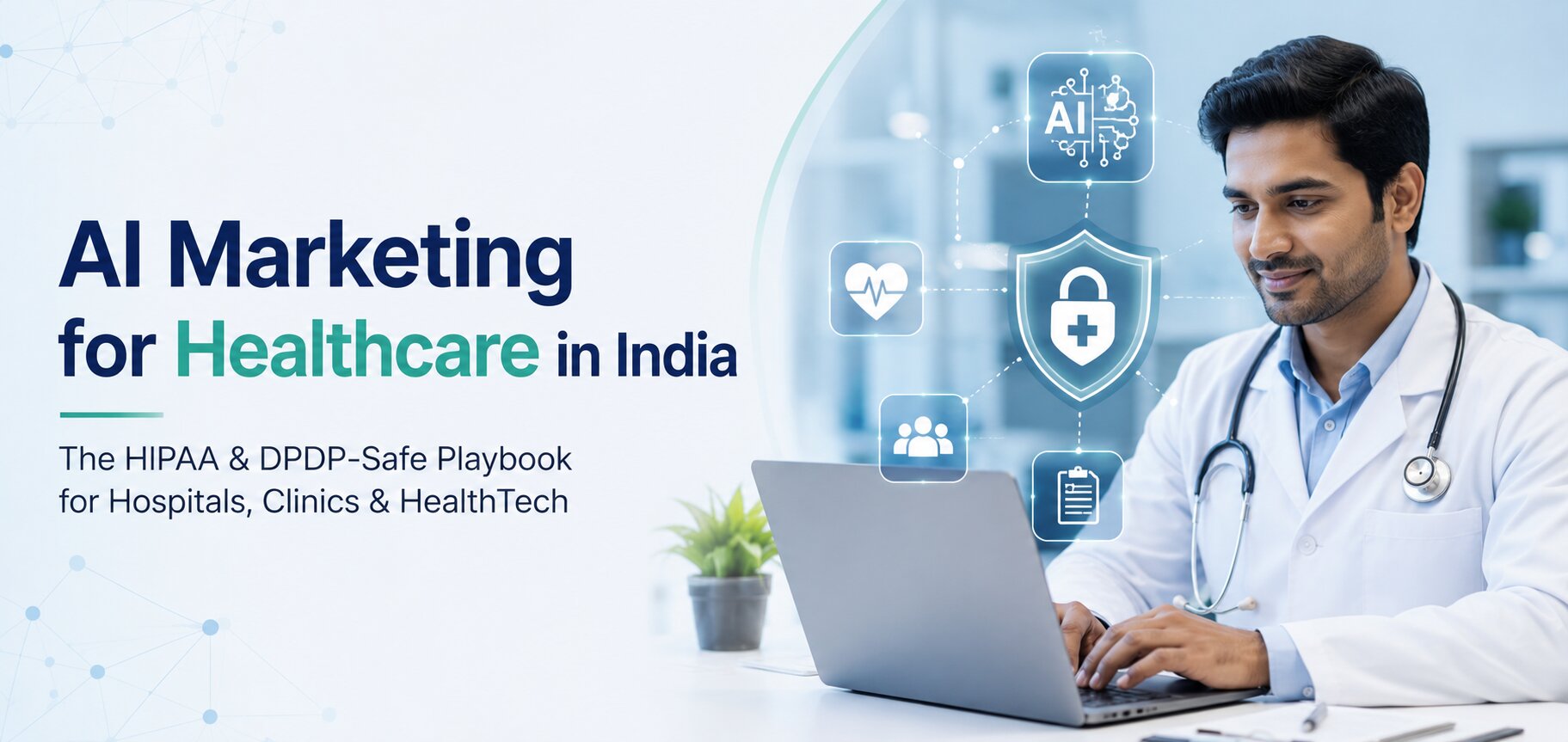
Healthcare marketing in India is one of the most heavily regulated categories. The National Medical Commission (NMC) advertising norms shape what doctors and hospitals may claim, the Telemedicine Practice Guidelines 2020 govern digital consultations, and the Digital Personal Data Protection (DPDP) Act 2023 treats personal data — including health data — as something to be handled with care. The practical result is that many healthcare marketing teams operate cautiously, unsure of exactly where the lines fall.
This is a practitioner-oriented guide to AI marketing for healthcare in India. It is written with hospitals, clinics, diagnostic labs, healthtech apps, and D2C wellness brands in mind, and focuses on AI-assisted plays that respect patient privacy and ethical-advertising norms.
This article is general marketing guidance, not legal or medical-compliance advice. Healthcare data and advertising are heavily regulated — verify your obligations against the DPDP Act 2023, its notified Rules, and applicable medical-council and advertising regulations, and consult qualified legal counsel before acting.
The Healthcare Marketing Challenge
Several forces combine to make healthcare marketing harder than most other categories:
Heightened care for health data. Personal data — including health-related data — should be handled with heightened care. Consent, clear purpose, and sound data-handling practices matter, and many hospital CRMs were not originally designed with these expectations in mind. Verify your specific obligations against the DPDP Act 2023 and its Rules rather than relying on rules of thumb.
Medical-advertising norms. Medical-council advertising norms generally discourage direct comparisons with peers and unsubstantiated claims of superior outcomes, and place conditions on patient testimonials. Marketing teams often operate with caution but can cross lines without realising it.
Telemedicine guidelines. Tele-consultation has its own requirements around practitioner registration, prescription protocols, and patient consent, which in turn affect how telemedicine offerings can be marketed.
At the same time, Indian healthcare is a large and growing market, with established players and many speciality clinic chains expanding their marketing efforts. The opportunity is real for teams that play within the rules.
Three Audience Segments — Each Searches Differently
1. Patients (Hindi/English, Vernacular, Voice Search)
The largest segment by volume. Patients often search in mixed language ("Hindi-English doctor near me"), make significant use of voice search, and respond strongly to local trust signals.
What tends to work: Google Business Profile optimisation, local SEO with specialty/area specificity, vernacular video content (Hindi and regional languages), patient testimonials handled within applicable norms, and WhatsApp appointment booking. Avoid: comparison claims, success-rate statistics without an official basis, and exaggerated outcomes.
2. Referring Physicians (LinkedIn, Journals, CMEs)
A B2B motion within healthcare. Hospitals and speciality clinics that want a referral pipeline from GPs and other specialists. The audience lives on LinkedIn, in medical journals, and at Continuing Medical Education (CME) events.
What tends to work: thought-leadership content from named clinical staff, anonymised case studies handled within applicable norms, CME-aligned content, and white papers on procedures. Avoid: direct comparison marketing and financial-incentive claims.
3. Corporate Health Buyers (B2B2C — Insurance, OPD)
Companies buying OPD packages, preventive health checks, employee assistance programmes, and insurance tie-ups. Typically a long sales cycle with formal RFP processes and multi-stakeholder decisions.
What tends to work: B2B content marketing on the cost of employee healthcare, a sales-led approach with marketing support, and account-based marketing into specific HR and finance targets. Avoid: B2C-style outcome claims.
Sub-Vertical Playbooks
Hospitals & Chains
Multi-location, multi-speciality, and brand-driven, typically with the largest marketing budgets. AI plays here focus on operational excellence at scale.
What tends to work: programmatic SEO at the procedure × location level, AI-assisted patient-journey personalisation, demand modelling for scheduling, and AI-assisted patient-education content.
Speciality Clinics (Dental, Dermatology, IVF, Eye Care)
Lower volume but higher ticket value per patient, which changes the economics. Local SEO is foundational.
What tends to work: detailed educational before/after content handled within applicable norms, patient-story videos with documented consent, AI-assisted retargeting for high-consideration procedures, and WhatsApp consultation booking.
Diagnostic Labs
High-volume B2C, often with WhatsApp and UPI integration. Speed and convenience tend to matter more than brand.
What tends to work: hyperlocal targeting, WhatsApp doorstep-collection booking, sensible timing for repeat tests, and B2B insurance-partner marketing.
HealthTech Apps
App-first acquisition, sensitive to acquisition cost. AI plays focus on activation and retention.
What tends to work: paid app-install campaigns optimised with predictive modelling, AI-personalised content for activation, helpful reminders, and AI-assisted cross-sell within appropriate consent boundaries.
D2C Wellness
Closer to general D2C marketing than to clinical healthcare. Acquisition is often through Meta, Instagram, and content. Compliance depends on the product (for example, AYUSH or food-supplement rules rather than medical-council norms).
What tends to work: influencer marketing, content-led acquisition, subscription models, and AI personalisation in product recommendations.
Five AI Plays for Indian Healthcare
1. AI-Assisted Patient Education Content (With Medical Review Workflow)
Much of a patient's pre-decision research is educational — what a procedure is, how it works, and what to expect. The hospital or clinic with the clearest, most trustworthy educational content tends to win the consideration phase.
A sound pattern: LLM-generated patient-education drafts, reviewed by qualified clinical staff for accuracy and compliance, then published with a byline. This lets a small marketing team produce a meaningful volume of patient-education content at clinical quality.
2. Predictive Lead Scoring for High-Ticket Procedures
For high-ticket procedures, the gap between enquiry and decision can stretch over months, and many enquiries never convert. Predictive scoring can help prioritise the enquiries most likely to book, so clinical staff invest their time where it matters most.
The operational impact: a better experience for high-intent patients and less staff time spent on low-intent enquiries.
3. WhatsApp Chatbot for OPD Appointments (With Consent)
A common pattern: a lead clicks, WhatsApp opens, a bot asks about specialisation, location preference, available time, and urgency, then offers a calendar slot picker and a confirmation with directions and pre-visit instructions.
This tends to convert better than a traditional tele-caller flow while improving patient experience. See our broader piece on AI Chatbot Development Services in India.
Handle data responsibly: obtain clear consent for data processing, document your retention approach, provide an opt-out mechanism, and have a breach-response process ready. Verify the specifics against the DPDP Act 2023 and its Rules.
4. Voice Search Optimisation for "Near Me" and Symptom Queries
Voice search is meaningful in healthcare because patients with symptoms often use it ("ENT specialist near me", "best hospital for diabetes in Delhi"). Voice queries tend to be conversational and long-form.
What to do: use FAQPage schema with natural-language questions, structure content so it can be quoted in voice answers, and optimise your Google Business Profile for voice-friendly answers.
5. Programmatic SEO for Procedure × City
Indian healthcare search is highly fragmented by procedure, city, and sometimes sub-area ("IVF treatment in Noida", "knee replacement cost in Pune", "skin specialist in Bandra"). Building content for each combination manually is impractical. Programmatic SEO done well — with genuinely unique, useful content per page — can capture this long tail.
Compliance — The Non-Negotiables
The following are general orientation points, not a substitute for legal advice. Verify each against current regulations and qualified counsel.
Medical-Advertising Norms (for Doctors & Hospitals)
- Avoid direct comparisons with named competitors
- Avoid "best", "leading", or "top" claims without substantiation
- Be careful with testimonials that praise specific outcomes
- Treat before/after imagery for cosmetic procedures with caution — consent and appropriate disclaimers matter
- Avoid financial inducements that could be seen as improper
Telemedicine Practice Guidelines 2020
- Practitioners offering tele-consultation must be appropriately registered
- Prescriptions must follow the prescribed consent and identity-verification requirements
- Tele-consultation should not be marketed as equivalent to in-person care
- Appropriate disclaimers may be required in marketing material
DPDP Act 2023 — Health Data Considerations
- Health data is sensitive and should be handled with heightened care
- Be clear about purpose — treatment, marketing, and research are distinct, and consent should reflect that
- Have a documented, defensible approach to retention and to breach response
- Take care with cross-border hosting and transfers, including data hosted outside India
Confirm the precise obligations, timelines, and thresholds against the DPDP Act 2023 and its notified Rules — do not rely on generic figures.
What You Generally Should Not Claim
- Specific success-rate percentages without an official, substantiated basis
- Comparative superiority claims ("most experienced in [city]", "faster recovery than competitors")
- Cosmetic before/after content without consent and appropriate disclaimers
- Specific medical outcomes attributed to a procedure alone
A Note on US HIPAA
HIPAA is a United States law. It does not govern healthcare marketing for patients and hospitals in India. HIPAA becomes relevant only in the narrow case where an Indian entity serves US patients or handles US patient data — for example, US-outsourced medical billing or telehealth work performed from India. If that describes your business, treat HIPAA as a separate, US-specific requirement and seek qualified advice on it. For purely India-facing healthcare marketing, the relevant frameworks are the DPDP Act 2023, medical-council and telemedicine norms, and general medical-confidentiality expectations.
An Indian Healthcare AI Marketing Stack (3 Tiers)
The ranges below are indicative planning guidance only; actual costs vary widely by scope, location, and vendor.
| Tier | Stage | Illustrative Stack | Indicative Cost (₹/mo) |
|---|---|---|---|
| 1 | Single clinic / small chain | Google Business Profile + WhatsApp tooling + SEO plugin + an LLM assistant + a design tool | 40,000–60,000 |
| 2 | 5–20 location chain | Add: a healthcare-capable CRM, programmatic SEO infrastructure, video production tooling, and a clinical-content review workflow | 1,80,000–3,00,000 |
| 3 | National hospital chain | Add: enterprise EMR integration, an analytics team for patient-journey work, dedicated data-protection oversight, and agency partnerships | 6,00,000+ |
Illustrative Scenario: A Speciality Clinic
The following is a hypothetical, illustrative scenario, not a real client engagement. It contains no actual figures or outcomes.
Consider a speciality clinic that finds its acquisition cost high, its enquiry volume steady but its conversion to first consultation low, and its advertising creative inconsistent against medical-advertising norms. A privacy-respecting, AI-assisted programme for such a clinic might combine several of the plays above:
- Programmatic SEO for procedure-and-area pages, each with genuinely unique content, treating-doctor profiles, and FAQ schema
- An AI-assisted patient-education library, drafted with AI and reviewed by clinical staff for accuracy and compliance
- A WhatsApp chatbot for consultation booking with a clear, consent-based data flow
- Predictive lead scoring on historical CRM data to help prioritise high-intent enquiries
- Voice-search optimisation for symptom and procedure queries
- A compliance check built into the creative workflow
The plausible direction of travel for such a programme is lower wasted spend, better prioritisation of clinical time, and a more consistent compliance posture. Any specific results would depend entirely on the clinic, its market, and disciplined execution.
Frequently Asked Questions
How should I think about patient-acquisition cost in healthcare?
Acquisition cost varies widely by procedure value, city competition, and channel mix — high-ticket procedures naturally carry higher acquisition costs than routine OPD appointments. Rather than anchoring on a single benchmark, measure your own cost per qualified enquiry and per booked consultation, and improve from there.
Is patient-testimonial marketing allowed?
Testimonials can be used, but with care. Avoid claiming specific outcomes attributable to a procedure, avoid framing that amounts to comparative "best" claims about named doctors, and keep documented consent from the patient. Confirm the current position under applicable medical-council norms.
Can I use an AI assistant to write patient-education content?
Yes, for drafts. But all clinical content must be reviewed by qualified medical staff for accuracy before publication. Treat AI as a drafting aid, not the publisher.
How does the DPDP Act affect health data in marketing?
Health data is sensitive and should be handled with heightened care: clear consent, distinct purposes for treatment versus marketing, a defensible retention approach, and a breach-response plan. Many CRMs were not designed with this in mind and may need changes. Verify the specifics against the DPDP Act 2023 and its Rules — see our piece on DPDP Act 2023 Compliance for operational context.
Should hospitals do influencer marketing?
Carefully. Healthcare influencer marketing draws heavy scrutiny. Prefer verified medical-professional voices, document agreements clearly, ensure content is compliant, and avoid making clinical claims about your services through influencers.
What CRM should an Indian healthcare provider use?
It depends on scale. Smaller clinics often start with a general-purpose CRM or one with healthcare-specific workflows; multi-location chains may need a more capable platform; large hospital networks often move to enterprise health-cloud systems. Choose based on your data-handling needs, integrations, and compliance posture rather than brand alone.
The Bottom Line
Healthcare marketing in India is tightly regulated, but teams that navigate it well can grow responsibly while less careful competitors accumulate compliance problems and brand risk. The five AI plays — patient-education automation, predictive lead scoring, WhatsApp booking, voice-search optimisation, and programmatic SEO — can be genuinely powerful when paired with disciplined privacy and advertising practices.
The non-negotiables are medical-advertising norms, telemedicine guidelines, and the DPDP Act 2023. Get those right, with qualified advice, and AI becomes a real advantage; skip them, and the cost of a single notice or PR incident can dwarf any short-term marketing gain.
If you would like a focused review of your healthcare marketing setup, our healthcare AI marketing team works with multi-speciality hospitals, speciality clinics, diagnostic chains, and healthtech apps. You can also call us on +91-8010010000 or reach out via our contact page.
Related Articles
How Much Does AI Marketing Cost in India? Complete 2026 Pricing Guide (Freelance vs Agency vs In-House)
What AI marketing actually costs in India in 2026 agency fees, tool subscriptions, in-house hiring. Real ₹ tables for SaaS, D2C, B2B & SMEs. Calculators included.
Read More
AI Marketing for Real Estate in Delhi NCR (2026): The Actual Lead-Cost Breakdown
What real estate developers in Delhi NCR actually pay per qualified lead in 2026 - AI marketing playbook with Noida/Gurugram/Greater Noida cost benchmarks, RERA-compliant creative pipeline, WhatsApp chatbot for site-visit booking.
Read More
AI Tools for Performance Marketing in India: Google & Meta (2026)
The best AI tools for Google and Meta performance marketing in India. How to use AI to reduce CPA, improve ROAS, and scale paid campaigns.
Read More
Comments
Be the first to share your thoughts on this article.