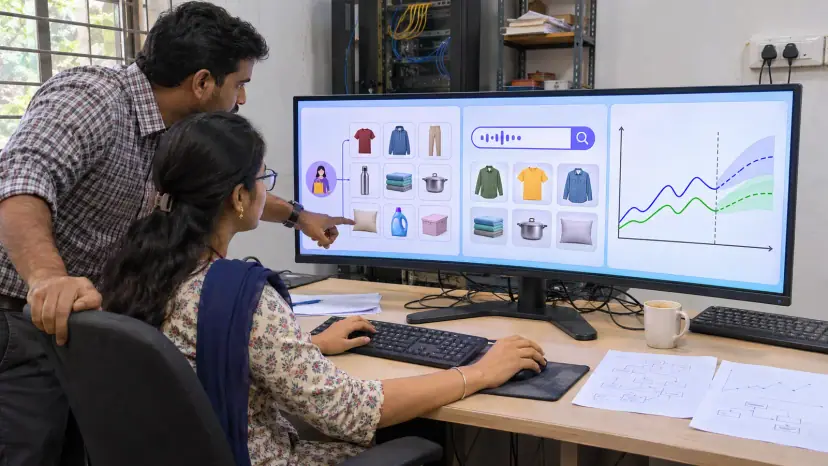
AI solutions for ecommerce use machine learning on your catalogue, orders and browsing data to recommend products, forecast demand, answer shoppers, spot fraud and set prices. Brainguru designs and builds them in Noida for D2C brands, multi-vendor marketplaces and B2B stores, and connects them to platforms such as Shopify, Magento and WooCommerce.
Why ecommerce businesses are turning to AI
Online retail in India is large and still growing fast. IBEF reports that India's online retail market reached about US$ 80 billion in FY26, with 21% year-on-year growth, and that India had nearly 290 to 300 million online shoppers in 2025, with Tier-2 and smaller cities contributing around 65% of new shoppers. More shoppers from more places means more variety in what people search for, how they pay and what they expect.
Most stores also lose a large share of buyers before payment. Baymard Institute's cart abandonment research calculates an average documented abandonment rate of 70.22%, based on 50 different studies. Some of that is unavoidable browsing, but some comes from irrelevant products, slow answers to questions and surprises at checkout, which AI can help with.
Shoppers and businesses both expect personalisation. In Twilio Segment's State of Personalization 2024, 89% of decision-makers said AI-driven personalisation will be critical to their success over the next three years.
Our team of data scientists, machine learning engineers and ecommerce specialists works with your staff to choose the use cases that matter, build models on your data and keep them working after launch.
Six AI solutions for ecommerce
Recommendation engines
Collaborative filtering, content-based methods and deep learning suggest products on the home page, product pages, cart and emails, using browsing history, purchases and the current session. The aim is higher order values and more cross-sell and repeat purchases, measured with controlled tests rather than assumed. Our page on AI for personalization covers this in more depth.
Demand forecasting with machine learning
Models use sales history, seasons, promotions, prices and outside signals to forecast demand by SKU and location. Better forecasts mean fewer stockouts, less dead stock and better use of warehouse space and cash. Forecasts come with ranges, so buyers can see how confident the model is.
Chatbots and shopping assistants
Assistants answer questions about availability, order status, returns and delivery, including outside office hours, using your catalogue and order system as the source of truth. They hand complex issues to an agent with the full conversation attached. See AI chatbot development for how we build them.
Visual search and image recognition
Shoppers upload a photo and computer vision finds similar products by colour, pattern, shape and style. It is most useful in fashion, home decor and lifestyle, where people often know what they want when they see it but cannot describe it in words. The same models can tag catalogue images automatically.
Fraud detection
Models score each order on transaction patterns, device signals, location and behaviour. High-risk orders are held for review and low-risk ones go straight through, so honest customers are not blocked. Regular retraining keeps up with new fraud patterns. Payments matter here: IBEF reports that UPI processed 22.35 billion transactions worth Rs. 29.03 lakh crore in April 2026, and fast payment rails move fraud quickly too.
Dynamic pricing
Pricing models consider competitor prices, demand, stock levels and promotion results to recommend prices within rules you set, such as minimum margins and price limits. A person approves the rules; the model works within them across thousands of SKUs. See AI for pricing optimization.
Industries and use cases
- Fashion and apparel: Visual search and recommendations for personalised shopping journeys.
- Consumer electronics: Demand forecasting and pricing for short product lifecycles and price-sensitive buyers.
- Grocery and food delivery: Inventory forecasting for perishable goods and chatbots for high volumes of order questions.
- B2B ecommerce: Fraud checks and pricing models for large orders and negotiated price lists.
- Multi-vendor marketplaces: Consistent search, recommendations and seller quality checks across many sellers.
What data each use case needs
| Use case | Main data needed |
|---|---|
| Recommendations | Product catalogue with attributes, orders, browsing or click events |
| Demand forecasting | Sales history by SKU and location, promotions, prices, stock levels |
| Chatbots | Policies, product information, order and delivery status from your systems |
| Visual search | Good product images with consistent tags |
| Fraud detection | Orders with outcomes (chargebacks, returns, confirmed fraud), device and payment data |
| Dynamic pricing | Your price history, competitor prices, demand and margin rules |
Smaller stores can start with less. Pre-trained models and simple rules give a working first version, and accuracy improves as your own data builds up.
How to choose where to start
- Follow the money: Start where a small improvement moves revenue or cost the most, such as cart recovery for a high-traffic store or forecasting for a business with expensive stock.
- Check the data first: A recommendation engine needs reliable click and order events. Fix tracking before building models.
- Plan a fair test: Compare the AI version with the current one on a split of traffic, not before and after a sale season.
- Keep people in the loop: Pricing rules, fraud holds and chatbot answers need an owner who reviews them.
- Protect customer data: Personal data needs a lawful purpose and consent records. In India, the Digital Personal Data Protection Act, 2023 applies, with its main duties starting on 13 May 2027.
Retention often pays back faster than acquisition. If repeat purchase is your main goal, see AI for customer retention. For the storefront itself, our ecommerce web design team builds fast, conversion-focused sites.
Why choose Brainguru for ecommerce AI
We combine AI engineering with an understanding of how online stores run: seasonal peaks, inventory across channels, pricing pressure and the cost of a poor customer experience. We work with businesses from early-stage startups to established retailers.
Delivery is from our Noida office, with agile development, quick prototypes and regular releases. After launch we provide monitoring, performance tuning and retraining, so models keep working as your catalogue, customers and market change.