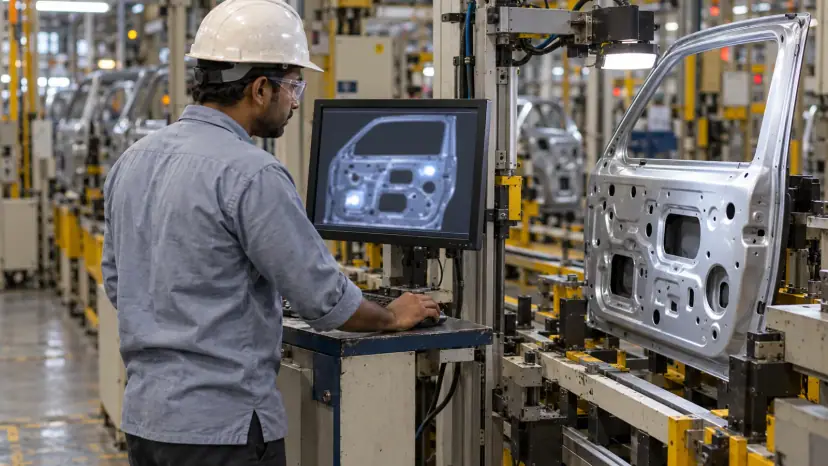
Brainguru builds AI solutions for the automotive industry: custom software for vehicle manufacturers, component suppliers and dealer networks. A focused project can inspect one defect type, rank maintenance alerts for a machine group or answer dealer questions from an approved parts catalogue. Scope depends on your data, equipment and the review process your engineers already use.
Where AI solutions for the automotive industry fit
These are software development and integration options to evaluate. Production vehicle control, autonomous driving and safety certification are outside the standard workflows described here and would require separate specialist engineering and assurance.
The Indian automotive industry in numbers
Scale is what makes small improvements worth the effort. According to IBEF, citing the Society of Indian Automobile Manufacturers (SIAM), automobile sales in India reached 28.03 million units in FY26, up 7.1% year on year, with passenger vehicle sales at a record 4.49 million units. IBEF also reports production of 34.71 million units in FY26 and exports of more than 6.7 million units, up 24%.
Electric vehicles add new data and new problems: battery packs, charging behaviour and software updates. The Ministry of Heavy Industries reported in March 2025 that 19.50 lakh electric vehicles were sold in India in calendar year 2024, a 7.44% share of all vehicles sold. For a plant producing at that volume, a defect caught one station earlier or one avoided breakdown on a critical press can matter more than a large new system.
Practical Automotive AI Use Cases
Computer vision for component quality inspection
A vision system can flag visible defects when image capture, lighting and labelled examples are suitable. Start with a defined component, defect taxonomy and inspection station. Occlusion, reflections, camera movement and rare defects can affect performance. Quality engineers review the results and decide how an alert fits the existing inspection and release process.
Condition monitoring and maintenance assistance
Sensor readings, machine alarms and maintenance logs can support anomaly detection or failure-risk modelling. The model should distinguish a useful maintenance signal from ordinary operating changes. Engineers verify alerts and approve work orders; predictive maintenance cannot promise to detect every failure or eliminate downtime.
Dealer, spare-parts and after-sales assistance
An assistant can retrieve approved part information, report confirmed order status and route warranty or service enquiries. Fitment answers require reliable catalogue identifiers and compatibility rules. Prices, stock and delivery dates should come from the authorised system rather than a model’s guess. Warranty decisions and safety-related advice need staff escalation.
Illustrative Pilot: Inspection at One Production Station
Define a visible surface defect and gather images of both acceptable and defective components from the actual station. Split the data so nearly identical images from the same batch do not inflate test results. Compare alerts with quality-engineer labels, then trial the system in shadow mode while the existing inspection remains in use.
Report missed defects, false rejects and performance under different lighting and production conditions. A release decision must consider downstream quality risk and the engineer’s review workload. This is an illustrative project design, not a reported plant deployment or an accuracy guarantee.
Automotive Data and System Integration
- Visual inspection: representative images, defect labels, component identifiers and the camera, lighting and line-speed constraints.
- Maintenance: timestamped sensor readings, operating states, service history and failure records where available. Rare failures can limit supervised modelling.
- Dealer support: an approved parts catalogue, compatibility data, warranty policies and permitted access to order and inventory records.
- Integration: MES, ERP, maintenance or dealer-management APIs; network constraints; identity controls; and a defined path for approving write actions.
Data availability determines whether to use rules, an existing model, a custom model or a combination. A document assistant does not replace a validated fitment database, and a dashboard does not become predictive maintenance simply by displaying sensor values.
How We Evaluate Automotive AI
- Inspection: review missed defects and false rejects by component and defect class, using data from production conditions rather than only curated sample images.
- Maintenance: compare alerts with existing maintenance practice, including the cost of unnecessary intervention and the consequences of missed failures.
- Dealer assistance: check source accuracy, part compatibility, stale inventory handling and escalation for unsupported or safety-sensitive questions.
- Operations: measure review effort, response time, reliability and business impact. Test outages, manual override and rollback before live integration.
NIST’s industrial AI evaluation guide, published in December 2021, examines system-level impact and investment analysis for condition monitoring. It supports evaluating operational consequences alongside model performance; it does not establish results for a particular plant or certify a Brainguru solution.
Common mistakes in automotive AI projects
- Testing on curated images only: A model that sees clean sample photos in the lab can fail under real line lighting, dust and vibration.
- Starting with too many defect types: One clear, frequent defect makes a better first pilot than a catalogue of rare ones.
- No owner for labels: Someone in quality must decide what counts as a defect, or the training data drifts.
- Skipping shadow mode: Running the system alongside the current process first shows real error rates before anyone relies on it.
- Letting an assistant guess: Prices, stock and fitment must come from the authorised system, never from a language model's memory.
Questions to ask an automotive AI provider
- Data: Which data do you need, in what format, and who keeps ownership of images, labels and models?
- Evaluation: How will missed defects and false rejects be measured, and on which production data?
- Integration: Which MES, ERP or dealer system APIs will the solution read from or write to, and who approves write actions?
- Change: What happens when a camera, component or supplier changes?
- Exit: Can another team run and retrain the system if you change provider?
If your challenge is selling vehicles or services rather than making them, AI marketing for the automotive industry covers dealer and customer marketing. For parts movement and inbound logistics, see AI solutions for logistics and supply chain.
Delivery, Budget and Ongoing Engineering Review
Discovery selects the station, equipment group or dealer workflow and confirms data access. A historical evaluation comes before a limited pilot, followed by a monitored rollout if the agreed criteria are met. Assign owners for image capture, labels, catalogues and maintenance feedback. Recheck performance after changes to components, cameras, machines or operating conditions.
Budget depends on data collection, labelling, hardware interfaces, models, integrations and support. Hardware procurement and specialised assurance must be explicitly scoped. Read our manufacturing chatbot guide for dealer and order-status workflows, and enterprise AI consulting guide for deciding whether a custom build is justified.