In this article
- Indian Manufacturing in 2026 - Why Digital Lags
- The 6 Chatbot Use Cases That Work for Indian Manufacturers
- WhatsApp Business API as the Platform of Choice
- Multi-Language Support — Hindi, Marathi, Tamil, Telugu, Gujarati, Bengali, Punjabi, Kannada
- Integration With ERP — Tally, SAP, Oracle, Microsoft Dynamics
- The "Supervised AI" Model — Human-in-the-Loop Escalation
- Cost & ROI — What a Manufacturing Chatbot Typically Costs
- An Illustrative Scenario (Hypothetical)
- Common Pitfalls
- RFP Template for Choosing a Chatbot Vendor
- Frequently Asked Questions
- The Bottom Line
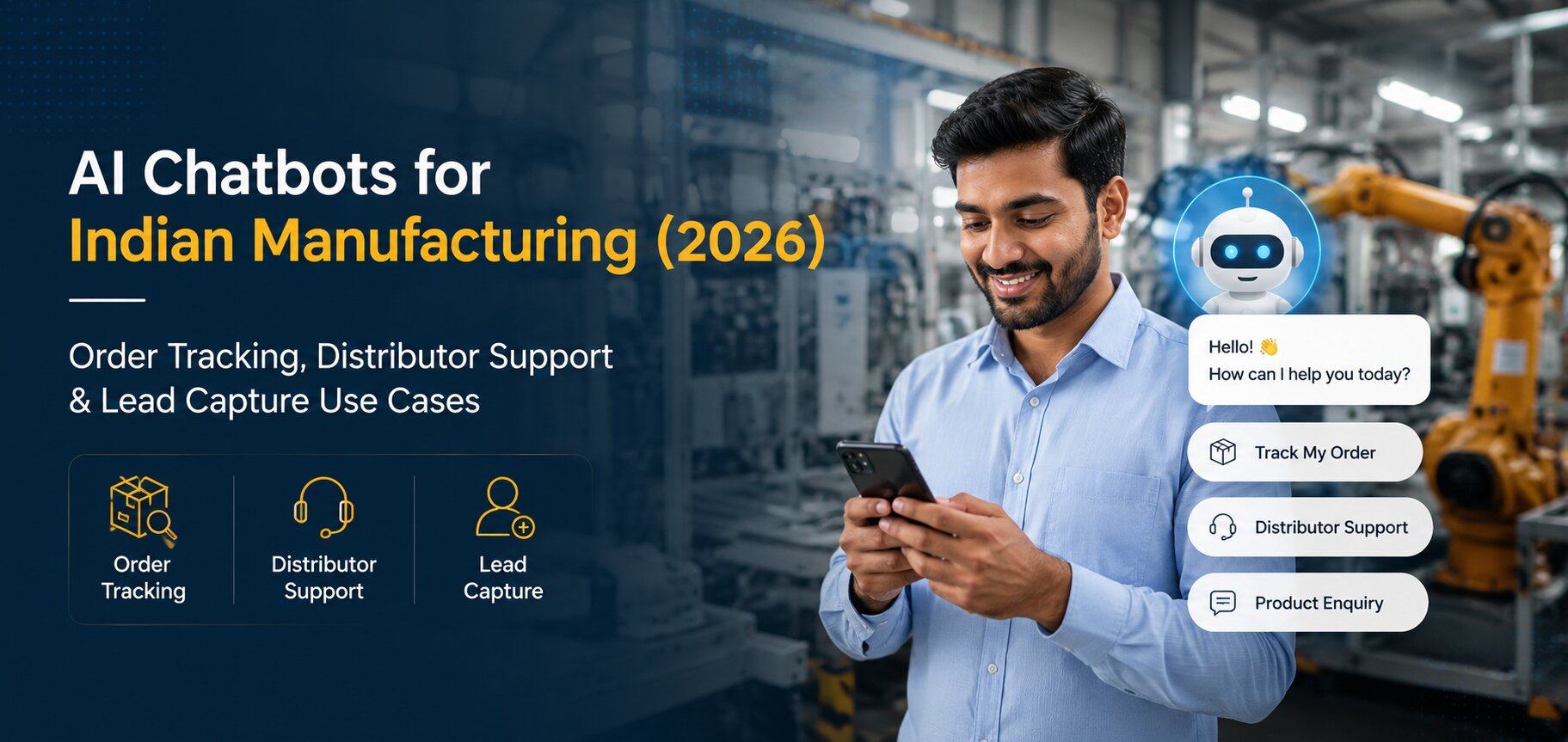
Indian manufacturing has historically digitised more slowly than many other sectors - and that gap is part of the opportunity. A typical Indian manufacturer in 2026 may run SAP or Tally for finance, an aging CRM (or even an Excel sheet) for customers, and very little automation in dealer support, distributor onboarding, or after-sales communication. The encouraging news is that AI chatbots aren't only a B2C novelty - they can address real operational problems in B2B manufacturing, often with a reasonable payback period when scoped sensibly.
This is a practical 2026 guide to AI chatbots for manufacturing in India. It covers the chatbot use cases that tend to work for Indian manufacturers, why WhatsApp Business API is the dominant platform for reaching distributors, multi-language support for Bharat-tier audiences, ERP integration patterns with Tally and SAP, indicative costs, and an RFP template for choosing a vendor.
Indian Manufacturing in 2026 - Why Digital Lags
There are a few structural reasons Indian manufacturers have digitised more slowly than other sectors:
Distributor relationships predate digital. Many relationships were built before WhatsApp existed. A large share of distributors still prefer phone calls and face-to-face interaction. The original sales motion is often older than the digital tools layered on top of it.
Multi-language across regions. Indian manufacturing distributors work in Hindi, Marathi, Tamil, Telugu, Gujarati, Bengali, Punjabi, Kannada and more. Building digital tools for this fragmentation has traditionally been expensive.
Risk aversion in B2B. Manufacturers have been cautious about experiments that could disrupt dealer relationships, often preferring to wait for mature solutions.
By 2026, AI chatbots — particularly WhatsApp-based, multi-language ones — have matured considerably. For manufacturers willing to start now, there is a meaningful first-mover advantage over slower-moving competitors.
The 6 Chatbot Use Cases That Work for Indian Manufacturers
1. Dealer / Distributor Onboarding & Support
New distributors need product catalogues, pricing sheets, terms documents, dealer login credentials and training materials. Handled manually, this can take several hours per new distributor. A chatbot can handle much of it in minutes.
A common pattern: a distributor scans a QR code or messages your WhatsApp Business number, the chatbot collects details, verifies eligibility, delivers documents, and schedules a first call with a manager. This can free up significant onboarding capacity.
2. Order Tracking + ETA Queries on WhatsApp
"When will my order arrive?" is one of the most frequently asked questions by Indian distributors. Handled manually, each query can take several minutes — looking it up in the ERP, calling the distributor, and communicating back. A chatbot connected to the ERP can respond in seconds.
For a manufacturer with a large distributor base, repetitive order-status queries can consume a substantial amount of customer-service time each month. A chatbot can absorb a large portion of this repetitive load.
3. Lead Capture From Product Enquiries
Inbound enquiries from product brochures, your website, or trade shows need qualification — volume, industry, urgency. A chatbot can ask a handful of qualifying questions, gauge intent, route high-intent leads to the sales team, and send others into a nurture flow.
The intended impact is that your sales team spends more of its time on qualified leads, and faster response improves the odds of converting enquiries into orders. Actual results vary by industry, product, and how leads are followed up.
4. After-Sales Support & Complaint Routing
Complaints, warranty queries and return requests can flood manufacturing customer service. A chatbot can triage these: collect details, classify severity, route to the right team (production, logistics, quality, returns), and provide status updates.
The goal is faster acknowledgement and shorter resolution times, which tends to improve customer satisfaction. The degree of improvement depends on how well the routing and human follow-up are set up.
5. Spare Parts Identification (With Image Input)
A particularly useful feature for Indian manufacturing chatbots: a distributor sends a WhatsApp photo of a broken or needed spare part, a vision-enabled AI suggests the likely part SKU, confirms with the distributor, and then places an order or generates a quote.
This kind of image-based identification has become far more practical in recent years. Treated carefully — with confirmation steps so the distributor verifies the match — it can be a strong differentiator. It works best as a suggestion-plus-confirmation flow rather than a fully automatic one.
6. Internal Queries (HR, IT, Ops) for Plant Staff
Larger Indian manufacturers may have hundreds of plant employees with routine questions (leave balance, salary slip requests, IT access). An internal chatbot - for example in Hindi — can handle many of these without adding to the HR backlog, freeing up coordinator time for higher-value work.
WhatsApp Business API as the Platform of Choice
For Indian manufacturing, WhatsApp Business API is hard to ignore. Reasons commonly cited:
A large majority of Indian distributors are comfortable with WhatsApp, often more so than email or web portals
Engagement (open and response rates) tends to be considerably higher than email or SMS
It works cross-region and cross-language on a single platform
Replies are inexpensive; Meta bills per delivered template message (in India about ₹0.86 for marketing and ₹0.115 for utility templates at the time of writing)
Voice notes are supported (valuable for vernacular communication)
Image and document attachments are native
Where it fits, build the chatbot on WhatsApp Business API rather than only on web chat or an app. You can use providers such as AISensy, WATI, or Gupshup, or build custom if your scale warrants it.
For broader chatbot context, see our AI Chatbot Development Services in India and WhatsApp Chatbot Development Cost in India.
Multi-Language Support — Hindi, Marathi, Tamil, Telugu, Gujarati, Bengali, Punjabi, Kannada
By 2026, leading foundation models handle the major Indian languages well. As a rough guide:
Hindi, Marathi, Bengali, Tamil, Telugu, Gujarati, Kannada and Punjabi: generally strong, production-suitable
Malayalam, Odia, Assamese: workable but more error-prone
Bhojpuri, Maithili and similar: still emerging
The usual pattern: the chatbot identifies the user's language from the first message, switches mode, and conducts subsequent interactions in that language. A distributor in Tamil Nadu sees Tamil; a distributor in Maharashtra sees Marathi — the same backend, with a different language wrapper.
One important detail: when integrating with an ERP for data lookups, the system often returns English text or codes. The chatbot needs to translate ERP responses back into the user's language. This is where many otherwise-simple chatbot deployments run into trouble, so plan for it.
Integration With ERP — Tally, SAP, Oracle, Microsoft Dynamics
A chatbot's usefulness depends heavily on real-time data access. Common ERP integration patterns and indicative effort:
ERP | Integration Approach | Typical Effort |
|---|---|---|
Tally | Tally Connector / TDL customization | 4–12 weeks |
SAP | OData APIs + middleware (Mulesoft / custom) | 8–20 weeks |
Oracle E-Business Suite | REST APIs + custom adapters | 10–20 weeks |
Microsoft Dynamics | Power Automate + Dynamics Connector | 4–10 weeks |
Custom / legacy | Database-level connectors + custom middleware | 12–24 weeks |
The most common ERP in Indian manufacturing is Tally — and Tally integration is often the trickiest because its API is dated. It is reasonable to plan for several weeks of integration work, with the exact timeline depending on your Tally version and customisations.
The "Supervised AI" Model — Human-in-the-Loop Escalation
For manufacturing chatbots, full autonomy is rarely advisable. A pattern that tends to work well uses tiers:
Tier 1: the chatbot handles routine queries autonomously (order status, basic information, document delivery)
Tier 2: the chatbot drafts a response but escalates to a human reviewer for confirmation (pricing exceptions, custom quotes)
Tier 3: full human handling (complaints involving quality issues, contract disputes, and similar sensitive matters)
The reviewer is typically a distributor manager or sales coordinator. They see the chatbot's draft, edit if needed, and send. Even with a review step, this is usually much faster than handling each query fully manually.
Cost & ROI — What a Manufacturing Chatbot Typically Costs
The figures below are indicative ranges to help with budgeting, not quotes. Actual costs depend on language count, ERP complexity, message volume and scope.
Component | Indicative Cost (₹) | Note |
|---|---|---|
Chatbot build (custom) | 4–18L | Depending on language count and ERP integration complexity |
WhatsApp Business API setup | 0–50K | Via provider, often free |
Provider monthly fee (AISensy/WATI) | 3–25K | Based on volume |
WhatsApp message costs | Varies with volume | About ₹0.86 per marketing and ₹0.115 per utility template (Meta India rates at the time of writing) |
ERP integration build | 3–15L one-time | Most variable cost |
Ongoing maintenance | 30K–1L/month | Bug fixes, content updates, scaling |
For a mid-size Indian manufacturer, first-year cost typically lands in a low-to-mid double-digit-lakh range. Whether that pays back — and how quickly — depends on your query volumes, the customer-service time you currently spend, and how much faster response actually improves conversion. We would always recommend modelling this against your own numbers rather than relying on a generic figure.
An Illustrative Scenario (Hypothetical)
The following is a hypothetical, illustrative example — not a real client project — to show how the pieces fit together. The numbers are placeholders for your own planning, not measured outcomes.
Imagine a mid-size auto-parts manufacturer with a few hundred distributors across India and several manufacturing facilities, whose customer-service team is stretched thin across WhatsApp messages, phone calls and emails. A staged rollout might look like:
Language detection + multi-language responses in the distributors' most common languages
Tally integration for order status, invoices and payment status
Image-based spare-part identification (distributor sends a photo, the bot suggests an SKU for confirmation)
Dealer login + brochure delivery automation
Tiered escalation with a regional manager handling Tier 2
Analytics dashboard for response time, query types and escalation patterns
In a scenario like this, the plausible benefits are faster query responses, reduced repetitive load on the customer-service team, and improved distributor experience. The actual magnitude would depend entirely on the manufacturer's starting point and execution — which is exactly why a short discovery and a pilot are worth doing before committing to a full build.
For automotive suppliers and dealer networks, our automotive AI development guide separates catalogue and order-status assistance from visual inspection and maintenance projects. Each requires its own data, integration plan and engineering-reviewed acceptance criteria. For a detailed implementation checklist, read visual inspection.
Common Pitfalls
1. Multi-language
An LLM can produce a wrong-language response in error scenarios. Fix: language guardrails plus sanity checks before any message is sent.
2. ERP timeouts
Tally and other ERP queries can be slow during peak hours, and users abandon. Fix: an async response pattern plus expectation setting (for example, "Checking your order status, will reply shortly").
3. Escalation friction
If a Tier 2 reviewer doesn't get prompt notifications, human response slows down. Fix: notification urgency and SLA tracking.
4. Over-personalisation backfires
A bot that says "Hi Rajesh, how's your daughter's school?" can feel intrusive when it appears to remember everything. Restraint matters in B2B.
5. Distributors learn the bot's limits and exploit them
Distributors may figure out which words trigger human escalation and use them. Monitor for this pattern and adjust.
RFP Template for Choosing a Chatbot Vendor
Useful questions for vendor selection:
WhatsApp Business API platform integration depth and pricing
Languages supported with production quality (test in your top 3 languages)
ERP integration experience (specifically Tally/SAP/your platform)
Image recognition capabilities (for the spare-parts use case)
Escalation workflow flexibility
Analytics and reporting capabilities
Pricing model (fixed vs per-message, ongoing maintenance)
Past clients in manufacturing (request references)
Implementation timeline (often in the range of a couple of months to several months)
Support response time SLA
Data security and DPDP compliance posture
Customisation flexibility for your specific workflows
Frequently Asked Questions
Is WhatsApp Business API expensive for Indian manufacturers?
Setup is typically free via a provider. Meta charges per delivered template message (in India about ₹0.86 for marketing and ₹0.115 for utility templates at the time of writing). For most manufacturers this remains modest relative to the customer-service time it can save, but you should estimate it against your own message volumes.
Can chatbots handle Hindi well in 2026?
Yes. Leading foundation models handle Hindi at production quality, and Tamil, Telugu, Marathi, Bengali, Gujarati, Kannada and Punjabi are also generally well supported. It is still worth testing in your specific top languages before committing.
How long does Tally integration take?
Often several weeks for a full custom integration. Newer Tally versions tend to be easier. Pre-built Tally connectors exist (via Tally Definition Language) but usually require customisation.
What about SAP integration?
SAP integration commonly takes a couple of months or more for a custom build. SAP's OData APIs handle most use cases; middleware such as Mulesoft or a custom layer handles more complex workflows.
Can the chatbot handle voice notes from distributors?
Yes - via transcription plus an LLM response. This is particularly useful for distributors who prefer voice over typed messages.
What's the right starting use case for a manufacturing chatbot?
Order tracking is a strong starting point. It is among the most-asked queries, has a clear rationale, doesn't require complex AI, and validates the approach quickly. Other use cases such as lead qualification and spare-parts identification can be added in a later phase.
The Bottom Line
AI chatbots for Indian manufacturing in 2026 are no longer experimental. The technology is production-grade, the potential return is real when scoped sensibly, and there is a meaningful advantage to moving ahead of slower competitors.
For a typical mid-size Indian manufacturer, a sensible starting point is: WhatsApp Business API + an order-tracking chatbot + multi-language support. Spare-parts identification, lead qualification and after-sales support can follow in subsequent phases.
For a discovery call on what a manufacturing chatbot would look like for your specific operation, talk to our manufacturing AI team. You can also reach us at +91-8010010000.
Related on this blog: AI Chatbot Development Services in India (services overview), WhatsApp Chatbot Development Cost in India (budget breakdown), Best Use Cases of WhatsApp Chatbots in India.
Related Articles

Why Telemedicine Needs AI-Powered Call Center Support in India
Why Telemedicine Needs AI-Powered Call Center Support in India In India, telemedicine has shifted from being a convenience to a necessity . With the rise of…
Read More
AI Claims Document Processing: Workflow, Data Requirements and Human Review
Plan an insurance claims document AI pilot: extraction fields, source evidence, exception handling, data controls and human-reviewed acceptance tests.
Read More
AI Contract Review for Indian Legal Teams: Playbooks, Citations and Confidentiality
Evaluate AI contract review using an approved playbook, clause evidence, matter permissions and lawyer-reviewed tests. Includes a practical NDA pilot checklist.
Read More
Comments
Be the first to share your thoughts on this article.