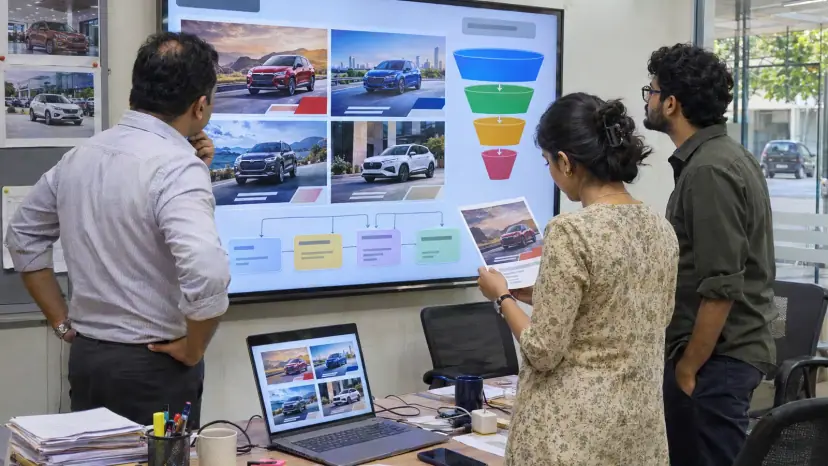
AI marketing for automotive industry businesses helps dealerships, vehicle makers, EV brands, used car businesses and service centres turn online interest into test drives, sales and service visits. Brainguru plans and runs this work from Noida: lead scoring, inventory-led campaigns, EV education, follow-up and owner marketing, with every price and offer confirmed by the dealer.
How car buyers shop now
Most buyers research online long before they visit a showroom. They compare models and variants, read reviews, watch walkaround videos and check prices and finance options. By the time they enquire, many have a shortlist. Marketing has to be present and accurate during that research, then respond quickly when someone is ready.
The market is large and still growing. According to IBEF, citing the Society of Indian Automobile Manufacturers, passenger vehicle sales in India rose 5.1% to a record 4.49 million units in FY26, and two-wheeler sales rose 7.2% to 20.50 million. More choice for buyers means more competition for each enquiry.
Electric vehicles add a new kind of buyer. The Ministry of Heavy Industries reported in March 2025 that 19.50 lakh electric vehicles were sold in India in calendar year 2024, 7.44% of all vehicles sold. IBEF reports that EV sales grew 30% to 2.66 million units in FY26, with two- and three-wheelers making up nearly 87% of EV volumes. EV buyers ask different questions, about range, charging and running costs, and marketing has to answer them honestly.
What AI marketing for automotive industry teams covers
Lead scoring for dealerships: Not every enquiry is a buyer. A scoring model looks at what each prospect did, such as models viewed, configurator use, trade-in or finance questions, and replies to WhatsApp or email, and ranks enquiries by likely intent. Sales staff call the warmest leads first, and the rest go into a follow-up sequence. The model learns from your own sales outcomes, so it improves with use.
Inventory-led marketing: Stock changes every week. When your inventory system is connected, new arrivals can create website listings, social posts and search ads automatically, and sold vehicles can be removed from ads. Ageing stock can get more promotion, within limits the dealer sets. This keeps ad spend on cars you can actually deliver.
EV marketing: EV buyers research more and worry about range, charging access, battery life and total cost of ownership. We plan content that explains these clearly, nurture sequences that answer each concern in turn, and campaigns aimed at people already showing interest in EVs. Subsidy and incentive messages always point to the current official source.
Test drive booking and follow-up: Prospects can book a test drive through the website or a chatbot, choosing the model, time and showroom. Reminders go by SMS, email or WhatsApp. After the drive, follow-up covers the questions the prospect raised, such as finance, trade-in value or a comparison with a rival model, at a sensible pace.
Owner lifecycle marketing: After the sale, service reminders, warranty renewals, accessory offers, recall notices and, years later, replacement offers keep the relationship going. Messages are timed from the ownership record and only go to customers who have agreed to receive them.
Social media and local search: Walkaround videos, delivery moments and service content perform well on Instagram, YouTube and Facebook. AI helps plan, draft and schedule this content and test ads. For showrooms and workshops, accurate Google Business Profiles and local SEO bring nearby buyers who search by area.
Connecting marketing to the dealer's systems
Automotive marketing works only when it connects to the systems that hold stock, leads and sales. That usually means the dealer management system, the CRM and the website. We connect these through APIs where the systems allow it, so enquiries flow straight to the right sales person and outcomes flow back to marketing.
Where a dealer group still tracks leads in spreadsheets, a simple CRM sales automation set-up is often the first step. It gives every enquiry an owner, a status and a history, which the AI tools need in order to learn.
Chat is increasingly the first contact. An AI chatbot on the website or WhatsApp can answer questions on variants, colours, availability and booking, then pass the conversation to a person with the full history.
AI marketing workflow for automotive
Vehicle promotion must match what the dealer can actually supply. Showroom enquiries, fleet purchases, servicing and charging products follow different paths, so a single campaign cannot treat them as the same conversion.
The stages below are a suggested way to plan vehicle marketing. They are not a case study and do not promise any result. They give dealer managers, sales staff and marketers one agreed description of the work before any tool is chosen.
Vehicle discovery: Keep model, variant and stock information consistent with the dealer's approved details. Check AI-written comparisons for accuracy before publishing.
Appointment qualification: Capture the vehicle or service requested, the location and a preferred time. Record whether a test drive or showroom visit actually happened, rather than counting a form as a sale.
Dealer follow-up: Send each enquiry to the dealer that can fulfil it. Link appointment, booking and sale stages, and remove duplicates across dealers and campaigns.
What to measure: Count attended appointments, qualified fleet enquiries and completed sales by vehicle or service type. Leave finance eligibility and technical advice to qualified staff, and never advertise stock, prices or offers the dealer has not confirmed.
For a first conversation, bring the approved offer, how showroom, fleet and service enquiries are handled now, a summary of your customer and stock data, and the name of the person who signs off vehicle content. Agree who can access which systems and which event counts as the result before anything is connected.
Rules to keep in mind
- Prices and offers: Advertised prices, discounts and finance rates must match what the dealer will honour on the day.
- EV claims: Range and running-cost figures should come from the maker's approved material and state the test conditions.
- Charging information: The Ministry of Power issued charging infrastructure guidelines on 17 September 2024, as noted in the same ministry release. Check current rules before making claims about home or public charging.
- Customer data: India's Digital Personal Data Protection Act, 2023 applies to enquiry and owner data. Its main duties start on 13 May 2027, so plan notices and consent now.
What affects the cost?
We quote after scoping. Cost depends on the number of showrooms and brands, how many systems must be connected, the size of ad budgets, the volume of content and whether owner marketing is included. A single showroom can start with lead scoring and local search, while a dealer group may need a shared CRM and reporting first.
Local Automotive Planning Guides
Choose a city for official local references, enquiry information and a reviewed workflow. We serve the dealers and buyers these guides describe from Noida and have no branch network in these cities.